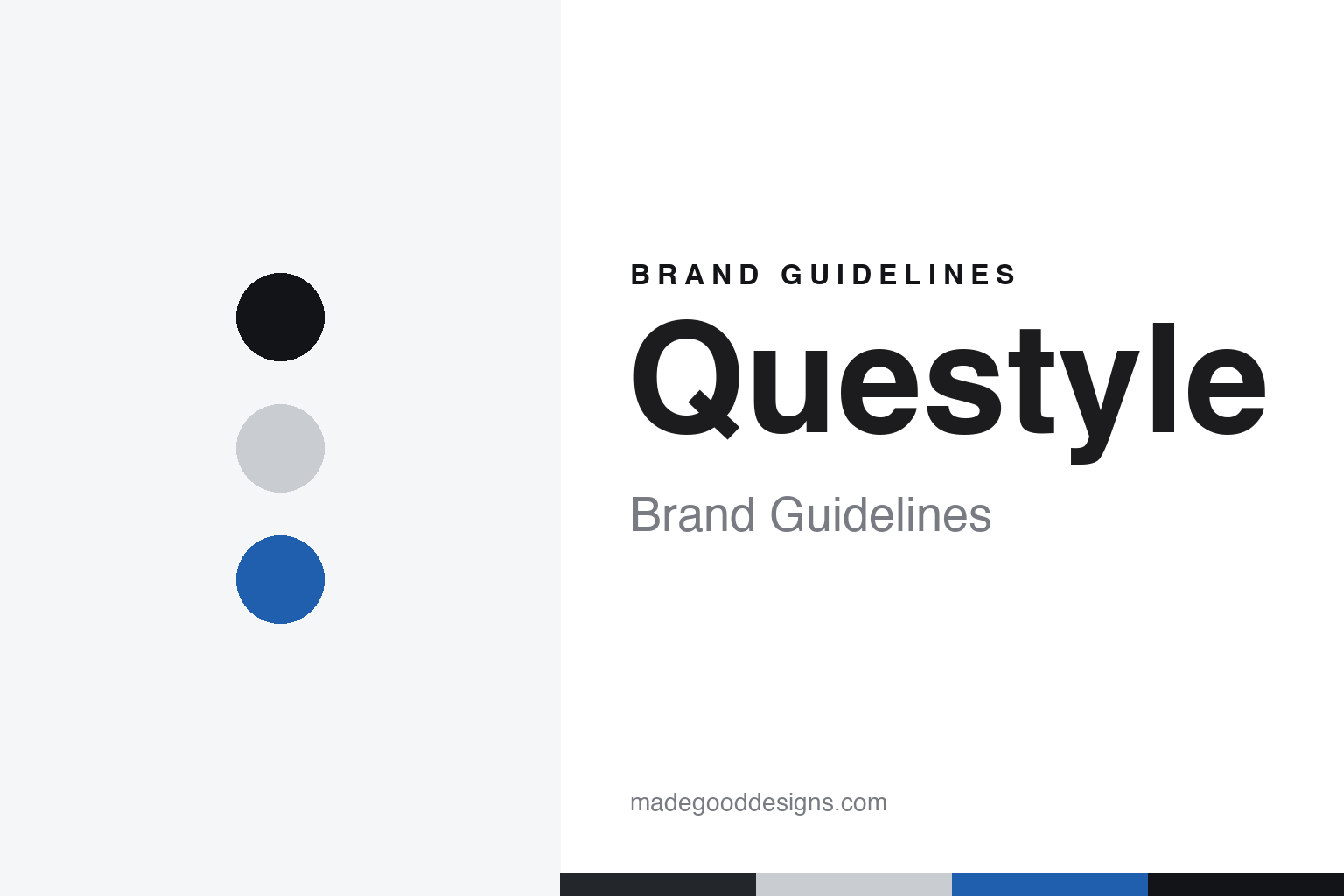
Questyle Brand Guidelines
The Shenzhen maker built on current-mode amplification.
Aa
Two constants: a Questyle graphite, silver and blue palette and a technical sans register. Abstract homage — not a Questyle product or mark; no device, logo or nameplate is reproduced.
Jason’s CMA
An engineer, a circuit and a company in Shenzhen.
Questyle is a Shenzhen audio company founded in 2012, according to its own websites; Chinese press coverage of a 2026 product launch gives the date as December 2012. Its Chinese name is 旷世 (Kuangshi), and its English company name, as recorded on a United States patent assigned to it, is Questyle Audio Technology Co., Ltd. Its contact page today gives an office on the 13th floor of the Yunsong Building on Tairan 8th Road, in Shenzhen’s Futian district.
The founder’s name is worth getting right, because it is often garbled. The founder and chief executive is Wang Fengshuo, who uses the English name Jason Wang. That is how Questyle’s own press material for CES 2016, published by Enjoy the Music, introduced him, and it is the name on the patent for the company’s amplifier circuit.
The company’s account of him, from a 2023 version of its website, says he became interested in audio at the age of seven, won first prize in a national electronic design competition for college students in 2005, published three papers in Chinese journals and then spent six years at an audio chip company listed in Silicon Valley, working on core design, technical support and business development. Those are Questyle’s statements; we have not checked them independently.
Questyle’s early story is told through one product. Its 2023 history says its patented current-mode amplification was “first commercially applied” in 2012, with the launch of the CMA800 headphone amplifier, and that “Jason’s CMA” quickly became known among hi-fi enthusiasts. Older Questyle and retailer material dates the CMA800 to 2007 and Wang’s first current-mode circuit to a 2004 university project, which would put the design several years ahead of the company; we note both versions.
Colour
An amplifier that works on current.
The idea behind the products is technical. Most audio amplifiers are described as working in voltage mode; Questyle says its designs amplify the signal by modulating current instead, and it presents this current-mode amplification as the basis of its sound and its low distortion figures. The circuit is documented: United States patent 9,614,483, “Current analog audio amplifier,” names Fengshuo Wang as inventor, claims a priority date of 18 March 2014 and was granted on 4 April 2017; Google Patents records its assignment from Wang to Questyle Audio Technology in August 2022.
The products built on it moved from the desk to the pocket. The CMA800R desktop headphone amplifier, the CAS192D converter and the CMA800P preamplifier were sold together as a gold-finished “Golden Reference” system, which Enjoy the Music reviewed in 2016. Questyle showed its first portable players at CES in January 2015, and its own history calls the QP1R of that year the world’s first current-mode lossless portable player; a flagship player, the QPM, followed in 2019.
The CMA Twelve, a DAC and headphone amplifier, was reviewed by Sound+Image on the What Hi-Fi? website in March 2021, at $1,500, with the verdict that it “proves a fine headphone amplifier able to drive even the most esoteric of headphone designs”; the reviewer’s complaints were the lack of MQA support and of an analogue input. Smaller products followed the move to phones: the company says it introduced the M12 and M15 USB DAC-amplifiers for smartphones in 2021, and its current range includes the M15i and M18i Max, the CMA15 and CMA18 units, Bluetooth amplifiers under the Sigma name and the QCC Dongle wireless adapters.
The company also lists recognition. In 2019 it said it had won more than 20 international awards since 2015, naming a CES Innovation Award, an iF industrial design award and a VGP Lifestyle award in Japan; its Japanese site now says more than 100. We have not matched those claims against the award organisers’ own records.
Typography
Shenzhen and the headphone trade.
The seven brands in this guide come from one corner of southern China: the Pearl River Delta in Guangdong, around Guangzhou, Shenzhen, Zhuhai and Dongguan. English Wikipedia notes that the delta’s industrial cities have been called the “Factory of the World” and describes the region as a major manufacturing base for electronics. Shenzhen became one of China’s first special economic zones in 1980; Zhuhai is another.
Much of that output carried other companies’ names. Darko.Audio reported in 2020 that the Dutch brand PrimaLuna’s products were built at Cayin’s factory, and the German magazine stereoplay wrote in 2021 that Cayin’s German distributor had created the Cayin brand in the late 1990s. The makers here now sell under their own names.
Valve amplifiers remain a speciality. Cayin and Line Magnetic, both Zhuhai companies, list them prominently in their ranges, and Shanling’s company history records a valve power amplifier in 2002.
Shanling, which began in Jieyang in eastern Guangdong, moved to Shenzhen in 1996; the city is also home to iBasso, which says it was founded there in 2006, and Questyle, founded in 2012. Cayin, founded in 1993, and Line Magnetic are in Zhuhai; Denafrips and Musician Audio are in Guangzhou, according to their own websites.
Much of the debate about them happens online — in reviews on Headfonics, Soundnews and Darko.Audio, and on the Audio Science Review forum, where a member posted measurements of Musician Audio’s first converter in 2020.
This guide sets out what can be checked about each brand — who founded it, who owns it, and what it says about where its products are made — and marks clearly what rests only on the company’s own word.
Aa
A technical sans — the register of a measurement-led brand. (Specimen set in Barlow, a sans STAND-IN that Questyle’s web store also loads; NOT the Questyle logo.)
Questyle
Foxconn, Focal and investors.
On where its products are made, Questyle has been specific. Its English “About” page in 2019 said that Foxconn Technology Group, “the strategic partner of Questyle Audio, is where all the Questyle products are manufactured,” and the Chinese page said the same; its 2023 history dates the supply-chain and manufacturing partnership with Foxconn to 2015. The current English and Japanese pages we checked do not repeat the statement, so we give it as the company’s claim at that time. The same 2019 page described final ageing tests by engineers in its own laboratory, more than 30 tests on each unit before shipping, and a test report in two copies, one in the box and one filed by serial number.
The rest of its recent history also comes from its own timeline. It says it formed a dual-brand cooperation with the French loudspeaker and headphone maker Focal in 2018; that its equipment was designated for monitoring at Guangzhou’s Xinghai Concert Hall and by the Guangzhou Symphony Orchestra in 2019; that it agreed a framework with USI, Universal Scientific Industrial, to develop audio chips in 2020; and that it entered car audio in 2022, the year it says it received investment from China Merchants Capital, Huanxu and Eastern Rich Sea. In 2026 Chinese technology press reported its “easyHiFi” wireless speaker system, including a model co-branded with the driver maker SEAS.
Questyle presents itself in a plain sans-serif — its web store loads Barlow alongside Nimbus Sans — and its stated design concept, in the 2019 version of its site, was “being professional and concise.” No official colour values are published.
For a design guide, Questyle shows how a single circuit idea, patented and repeated in product names from the CMA800 to the CMA Twelve, can carry a brand. Compare Topping, another Chinese maker of DACs and headphone amplifiers, and iBasso, also from Shenzhen. For this guide we use graphite, brushed silver and a signal blue with a sans, an unofficial interpretation; no product or logo is reproduced.
Explore & save
Keep Questyle’s identity on hand — save it to a board in the Made Good inspiration library.
Questyle identity set
Pin the Questyle graphite, silver and blue palette and the technical sans register to your own board.