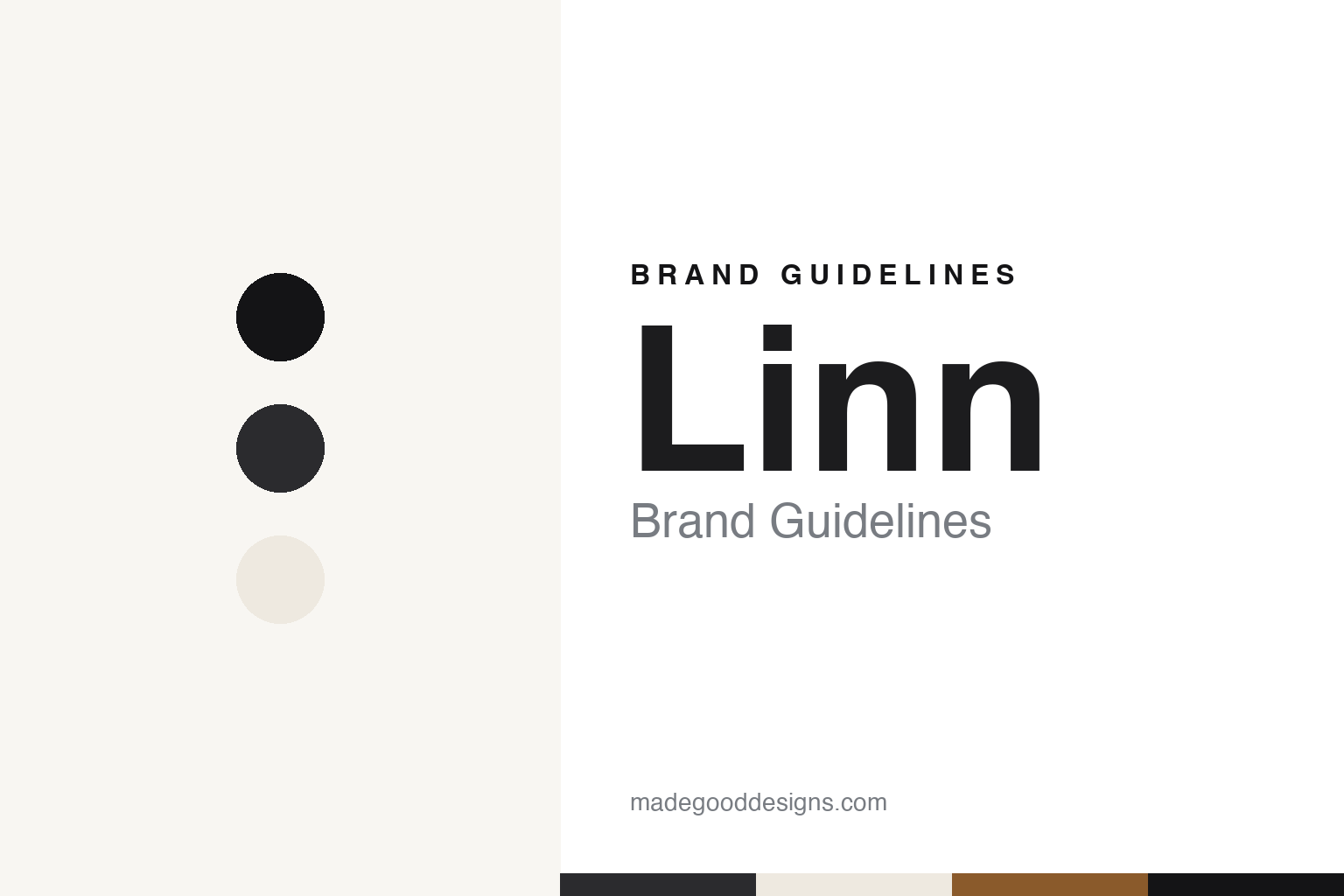
Linn Brand Guidelines
The Glasgow turntable maker that put the source first.
Aa
Two constants: a Linn graphite, oak and bone palette and a geometric sans register. Abstract homage — not a Linn product or mark; no turntable, logo or nameplate is reproduced.
Sondek
A turntable, a machine shop and a new name.
Linn Products was incorporated on 19 February 1973, Companies House records show, and its founder was the Glasgow engineer Ivor Tiefenbrun. The opening line of English Wikipedia’s article gives 1972, but its own history section and the public register both point to February 1973, so we use that. The company started in Castlemilk, on the south side of Glasgow, opposite Linn Park, next door to Castle Precision Engineering, the machining business run by Tiefenbrun’s brother, English Wikipedia says.
Its first product came with a history. English Wikipedia says the engineer Hamish Robertson designed the Ariston RD11 turntable in 1971, with Castle Precision machining many of its parts, and that Linn was formed “to sell turntables made by Castle Precision Engineering.” An advertisement in Hi-Fi News & Record Review in February 1973 announced: “The turntable previously available under the name Ariston RD11 is now available under the name Linn LP12.” There were claims at the time, and patent litigation, that the LP12 was a copy of the RD11; the patent, published in 1975, went to Linn, according to English Wikipedia.
Linn tells the story with a different emphasis. The company says Tiefenbrun founded it to make the Sondek LP12 after finding that the turntable he had bought was “adversely influenced by the changes in sound pressure of the loudspeakers.” The LP12 is a suspended sub-chassis turntable with a single-point platter bearing, and it is still made.
The name “Sondek,” Tiefenbrun told Positive Feedback in 2002, was a contraction of “sound deck.” The hard “k” stuck, and became a naming habit that runs from Isobarik and Klout to Klimax, Akurate and Majik.
Colour
The source first, then the whole system.
The LP12 gave Linn an argument as well as a product: that the source matters most. With Naim Audio, whose amplifiers it paired with through much of the 1970s and 1980s, Linn promoted this “source first” idea and single-speaker demonstrations in shops, English Wikipedia says, citing Hi-Fi News. The turntable has never been radically redesigned. Instead it is improved through retrofittable upgrades — more than fifty over five decades, the company says, including the Karousel bearing of 2020.
From there Linn widened its range. Its own timeline lists the Isobarik loudspeaker (1974 by the company’s account, 1975 by English Wikipedia’s), the Valhalla power supply of 1982 — its first electronics — and the founding of the Linn Records label the same year, followed by the LK1 preamplifier and LK2 power amplifier in 1985.
In 1987, the company says, it moved its headquarters to a purpose-built factory at Waterfoot, between Glasgow and Eaglesham, designed by Richard Rogers. English Wikipedia, citing the Royal Institute of British Architects’ picture library, describes it as the only building in Scotland designed by the architect. The plant was organised around what Linn calls “Single Stage Build”: one operator builds a whole product from start to finish and signs it. Today the company says each system “is built by hand in our Glasgow factory, and bears the name of the engineer who made it.”
Recognition followed. Tiefenbrun was appointed MBE, in 1992 according to the company. Linn says it received a Royal Warrant in 2002 as supplier of entertainment systems to the then Prince of Wales, and that a £7 million expansion in 2004 almost doubled its manufacturing space at Waterfoot. Gramophone named Linn Records its Label of the Year in 2010, and in 2012 the company won the Queen’s Award for Enterprise in the Innovation category.
Typography
British hi-fi in context.
Much of Britain’s hi-fi electronics trade clusters in Cambridgeshire. Quad, founded in London by Peter Walker in 1936, moved to Huntingdon in 1941 after being bombed out during the war, English Wikipedia says. Meridian, founded in 1977 by Bob Stuart and Allen Boothroyd, is based in the town, and Cyrus says its research team has worked from its Huntingdon head office since 1984.
Several old British names now belong to one group. International Audio Group (IAG), a Chinese company based in Shenzhen, says it set up its UK arm in Huntingdon in September 1997 after acquiring Wharfedale, Quad, Leak, Ekco and Castle, then added Audiolab in 2004 and Mission in June 2005. It says its manufacturing is centralised at its own factory in Ji’an, in Jiangxi province.
Scotland’s Linn, founded in Glasgow by Ivor Tiefenbrun — in 1973, by the company’s timeline and the company register, though the opening line of English Wikipedia gives 1972 — says each system is built by hand at its factory at Waterfoot, outside the city.
Today, by their own accounts and the records we checked, Audiolab, Leak and Mission give IAG’s address on Glebe Road in Huntingdon; Cyrus, still based in Huntingdon, says it moved its manufacturing to SMS Electronics in Nottingham in 2019; Meridian, on Latham Road in Huntingdon, says its research, design and engineering have been led from Britain since 1977; and Roksan, founded in 1985, has belonged since November 2016 to Monitor Audio, of Rayleigh in Essex.
This guide sets out what can be checked about each brand — who founded it, who owns it, and what it says about where its products are made — and marks clearly what rests only on the company’s own word.
Aa
A geometric sans — English Wikipedia says, without a citation, that the Linn logo is a geometric representation of the LP12’s single-point bearing. (Specimen set in Jost, a sans STAND-IN; NOT the Linn logo.)
Linn
From the turntable to the network.
The company nearly failed in the mid-2000s. In 2006 Linn went into loss, carrying up to £6.8 million of short-term debt, and its bank placed it on a “special measures” list, the Sunday Herald reported in 2010. In 2007 it shed about two-thirds of its staff, English Wikipedia says, and later closed its original Glasgow factory. The way out was the home network. In 2007 Linn launched the Klimax DS, a player that streamed music over a home network, and Linn Records began selling studio-master downloads — the first label in the world to do so, the company says. In November 2009 the BBC reported that Linn would stop making CD players altogether.
Ivor Tiefenbrun’s son Gilad Tiefenbrun was named managing director in 2009, with his father as executive chairman. Since then Linn has added Exakt, which keeps the signal digital until it reaches the loudspeaker (2013); a redesigned Klimax DSM with an in-house DAC called Organik (2021); the 360 loudspeaker, shown at its 50th-anniversary conference in 2023; and, in 2026, the first drive units it designed entirely itself, according to the company. Linn remains private and family-controlled: since April 2021 Companies House has listed NGS Family Investments Limited, a Scottish company, as holding more than 75 per cent of its voting rights.
For a design guide, Linn shows how a single product and a single idea — the source first — can organise a whole brand, down to the “k” in its product names. Compare Naim Audio, its partner in that argument, and Rega, another British turntable maker. For this guide we use graphite, an oak brown and a bone white with a geometric sans, an unofficial interpretation; no product or logo is reproduced.
Explore & save
Keep Linn’s identity on hand — save it to a board in the Made Good inspiration library.
Linn identity set
Pin the Linn graphite, oak and bone palette and the geometric sans register to your own board.