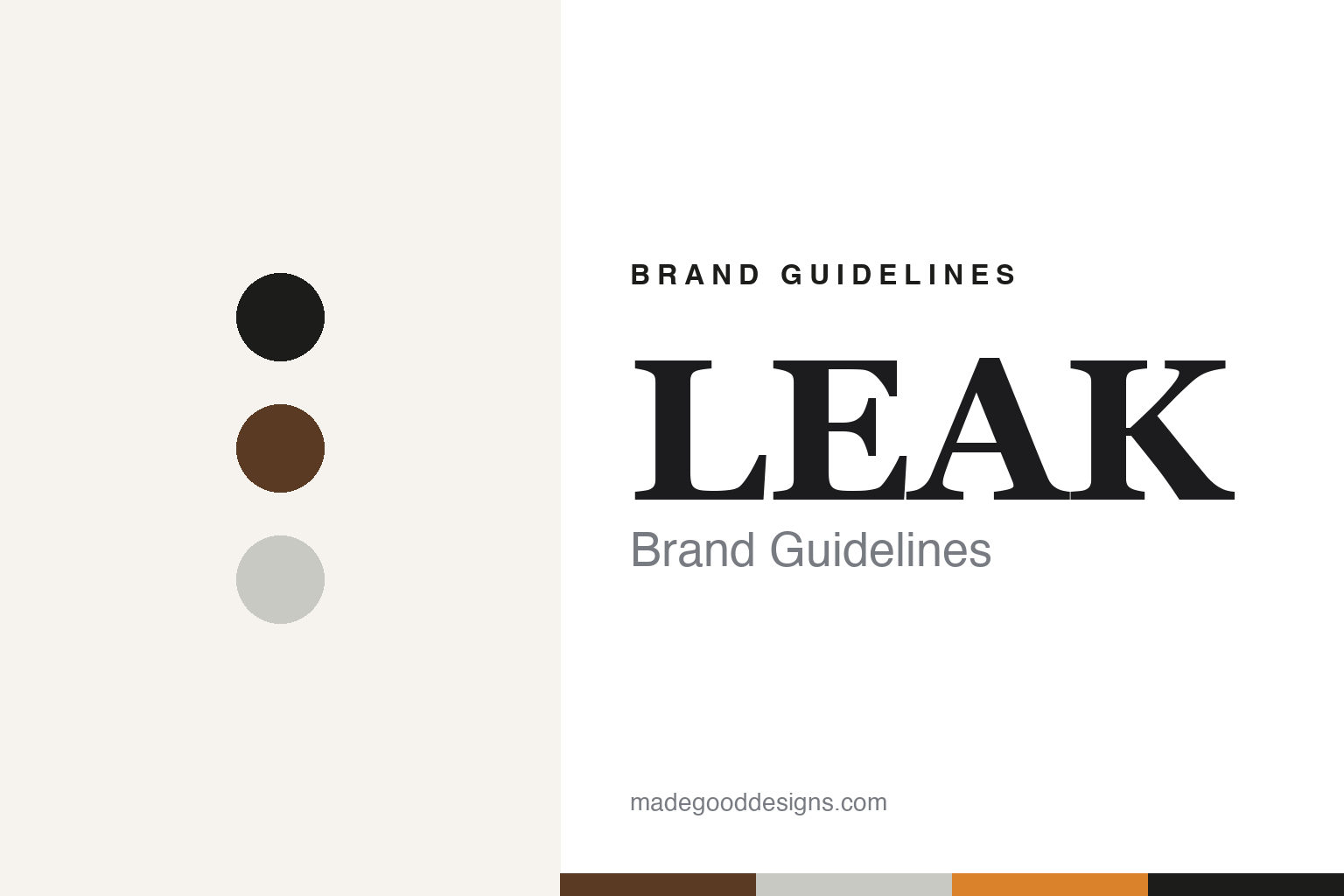
LEAK Brand Guidelines
The 1934 London amplifier maker revived by IAG in 2020.
Aa
Two constants: a LEAK walnut, silver and amber palette and a Classic serif register. Abstract homage — not a LEAK product or mark; no amplifier, logo or nameplate is reproduced.
H. J. Leak & Co.
A London amplifier maker and its 0.1 per cent.
LEAK is the brand of H. J. Leak & Co. Ltd, the London company founded in 1934 by Harold Joseph Leak, according to English Wikipedia and the brand’s current owner. The unofficial history site 44bx.com, which draws on a 1996 history in Hi-Fi World and a 1989 obituary in the Journal of the Audio Engineering Society, gives Leak’s birth as January 1907 and the company’s founding as 14 September 1934; we give those exact dates as that site’s.
The firm began by making amplifiers for public-address systems and theatres, with only a few staff, Wikipedia says. According to 44bx.com, its premises in Hammersmith, west London, were destroyed by bombing around 1940; it moved to Uxbridge Road in Shepherd’s Bush and, in the late 1940s, to the Westway factory estate in Acton, where its letterhead gave the address Brunel Road, London W3.
Wartime work on negative feedback produced the company’s breakthrough. In September 1945, Wikipedia says, it released the first of its “Point One” amplifiers, named for 0.1% total harmonic distortion at rated output, at a time when 2% was generally considered acceptable. The first, the Type 15, gave 15 watts from a pair of KT66 valves, with 26 dB of feedback applied over four stages, a layout Wikipedia compares with the Williamson amplifier published in Wireless World in 1947. In 1948 a simpler three-stage circuit arrived as the TL/12, which Wikipedia credits with “establishing and securing the future of the company” in the hi-fi boom of the 1950s and 1960s. The brand’s owner says the TL/12 became a BBC standard in 1951.
Colour
Trough-Line, Sandwich and Stereo 30.
The TL/12 also opened up export markets. According to 44bx.com, Harold Leak demonstrated it at the Audio Engineering Society’s exhibition in New York in 1949, which led to American distribution through British Industries, and by that year the company had a staff of about twenty. The range grew through the 1950s, with the TL/10, the TL/25 and the “Plus” series of mono power amplifiers, and, in 1958, according to 44bx.com, the Stereo 20 and Stereo 50. The Trough-Line FM tuner followed in 1955; in 2020 StereoNET’s David Price called it “arguably the world’s best-sounding analogue radio tuner.”
In 1961 came the LEAK Sandwich loudspeaker. Harold Leak engaged Don Barlow, who had devised a cone made of expanded polystyrene foam sandwiched between two sheets of aluminium foil, very light and very stiff. A publicity photograph showed Leak standing on one of the cones, and the speaker was made, little changed, for about ten years, English Wikipedia says. Transistors followed: the Stereo 30 of 1963, which the brand now calls the first commercially available all-transistor amplifier, a claim we give as its own, and the Stereo 70 of 1968, according to 44bx.com.
In January 1969 the business was sold to the Rank Organisation, and Harold Leak retired. Rank already owned the loudspeaker maker Wharfedale, which it had bought in 1958, Wikipedia says. Under Rank the range expanded, with receivers and amplifiers such as the Leak 2000 and the Delta series listed by the German reference site hi-fi-wiki, but the brand could not hold off competition from Japanese manufacturers, and “by the late 1970s, electronics and speaker production ceased under the LEAK name,” in Wikipedia’s words; Stereophile puts the end of production in 1979. Harold Leak died in August 1989, according to 44bx.com.
Typography
British hi-fi electronics.
Much of Britain’s hi-fi electronics trade clusters in Cambridgeshire. Quad, founded in London by Peter Walker in 1936, moved to Huntingdon in 1941 after being bombed out during the war, English Wikipedia says. Meridian, founded in 1977 by Bob Stuart and Allen Boothroyd, is based in the town, and Cyrus says its research team has worked from its Huntingdon head office since 1984.
Several old British names now belong to one group. International Audio Group (IAG), a Chinese company based in Shenzhen, says it set up its UK arm in Huntingdon in September 1997 after acquiring Wharfedale, Quad, Leak, Ekco and Castle, then added Audiolab in 2004 and Mission in June 2005. It says its manufacturing is centralised at its own factory in Ji’an, in Jiangxi province.
Scotland’s Linn, founded in Glasgow by Ivor Tiefenbrun — in 1973, by the company’s timeline and the company register, though the opening line of English Wikipedia gives 1972 — says each system is built by hand at its factory at Waterfoot, outside the city.
Today, by their own accounts and the records we checked, Audiolab, Leak and Mission give IAG’s address on Glebe Road in Huntingdon; Cyrus, still based in Huntingdon, says it moved its manufacturing to SMS Electronics in Nottingham in 2019; Meridian, on Latham Road in Huntingdon, says its research, design and engineering have been led from Britain since 1977; and Roksan, founded in 1985, has belonged since November 2016 to Monitor Audio, of Rayleigh in Essex.
This guide sets out what can be checked about each brand — who founded it, who owns it, and what it says about where its products are made — and marks clearly what rests only on the company’s own word.
Aa
A classic serif for a 1930s London name. (Specimen set in Libre Caslon Text, a serif STAND-IN; NOT the LEAK logo or lettering.)
LEAK
A name brought back in walnut.
The name returned in 2020. International Audio Group (IAG), the Chinese company that also owns Wharfedale, Quad, Audiolab and Mission, relaunched LEAK with the Stereo 130 integrated amplifier and the CDT CD transport, its first new products in about 40 years. StereoNET reported in May 2020 that the Stereo 130 took its styling from the 1963 Stereo 30, with an optional walnut case, at £799, or £699 without the case. IAG says the relaunch fell in the year of Harold Leak’s 113th birthday.
Not every critic saw continuity. Reviewing the pair in December 2020, StereoNET’s David Price wrote that they had “absolutely nothing to do with the company that Harold Leak founded in 1934,” calling them “exercises in badge engineering, made in IAG’s Shenzhen factory in China with some platform sharing from Audiolab.” Stereophile, reviewing the later Stereo 230, wrote that IAG had revived the company “by reinstating its design facilities in the UK.” The Stereo 230, a more powerful step-up model rated at 75 watts per channel into eight ohms, went on sale in January 2023 at £1,249 with its walnut case, and in February 2024 the brand added the Sandwich 150 and Sandwich 250 loudspeakers, whose cones bond aluminium skins to a polymethacrylimide foam core, according to company announcements published by hi-fi+; they were priced at £999 and £1,999 a pair. LEAK’s UK website gives its address as 13/14 Glebe Road, Huntingdon, Cambridgeshire, IAG’s British base; in 2022 IAG named Leak among the brands whose products were set to follow Mission in being made there.
For a design guide, LEAK shows how a dormant name can be revived through the look of its own past products. Compare Quad, another historic British amplifier name now owned by IAG, and Mission. For this guide we use walnut, brushed silver and a valve amber with a serif, an unofficial interpretation; no product or logo is reproduced.
Explore & save
Keep LEAK’s identity on hand — save it to a board in the Made Good inspiration library.
LEAK identity set
Pin the LEAK walnut, silver and amber palette and the Classic serif register to your own board.