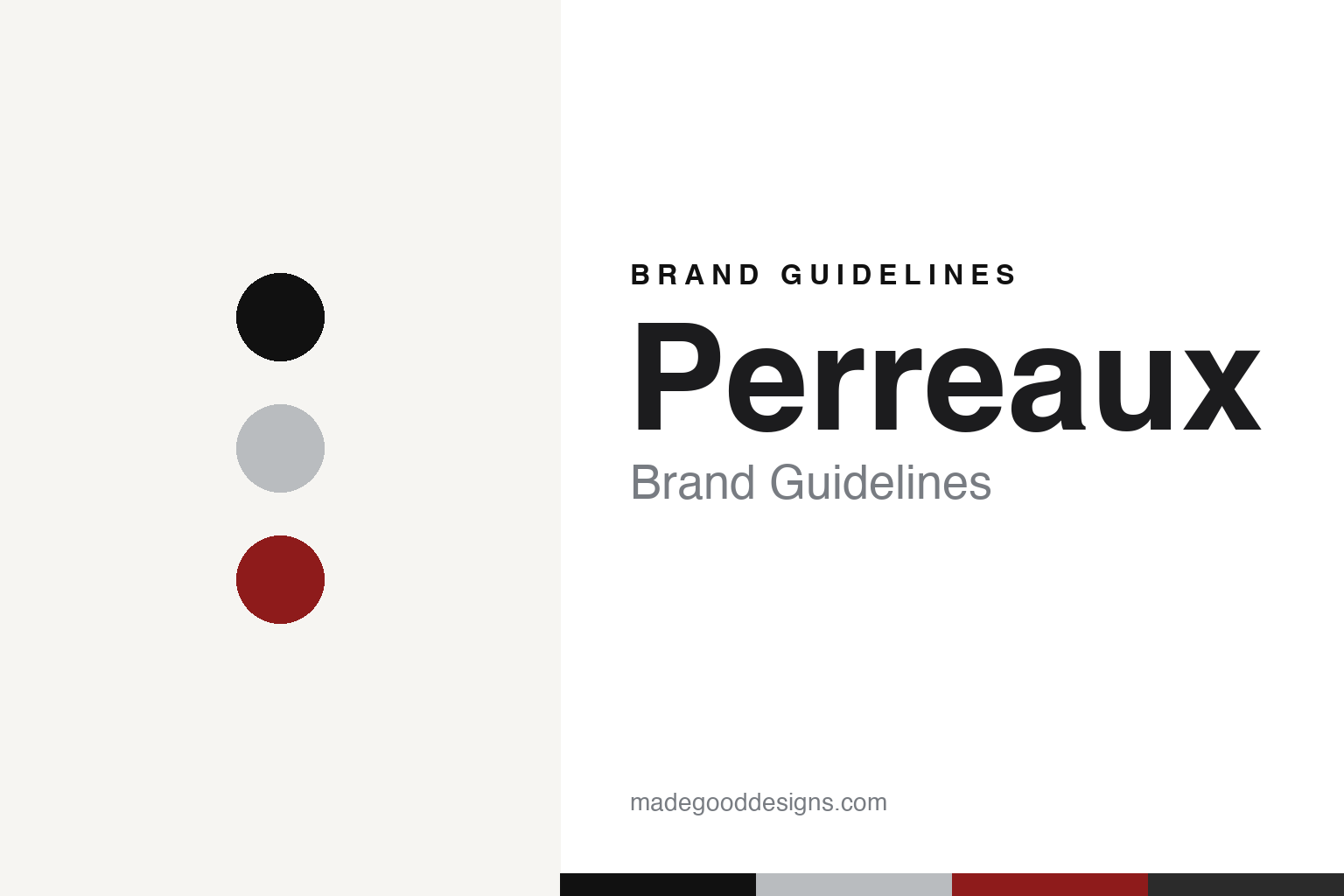
Perreaux Brand Guidelines
The New Zealand amplifier maker that began in Napier in 1974.
Aa
Two constants: a Perreaux black, alloy and red palette and an engineered sans register. Abstract homage — not a Perreaux product or mark; no amplifier, logo or nameplate is reproduced.
Napier, 1974
A one-man business in Hawke’s Bay.
Perreaux is usually filed as a Dunedin company, but it did not start there. The firm was founded in 1974 by Peter Perreaux in Napier, on the Hawke’s Bay coast of the North Island, What Hi-Fi? reported in 2020, drawing on Australian Hi-Fi; the New Zealand site Witchdoctor likewise placed the start “in the Hawkes Bay in 1974.” The Australian music magazine Mixdown, in a 2023 feature on the company, says it began with an investment of $1,000.
According to Witchdoctor, Perreaux first made its name with concert sound systems before becoming known for hard-wearing amplifiers sold abroad; SoundStage! Australia describes a reputation built across home, studio and live-sound amplification. The first product, by the company’s own telling as relayed by Mixdown, was the GS 2002, a Class A transistor integrated amplifier of about 22 watts a channel. The same feature lists the 4004A integrated and the 2100 EXR, 2200 EXR and SP 100 power amplifiers in the mid-1970s, export grants for Australia and the Americas, and a first MOSFET power amplifier, the SA80B, in 1979.
The business grew quickly. By 1987, What Hi-Fi? wrote, it had gone from a one-man operation to a multi-million-dollar company exporting Class A preamplifiers and MOSFET amplifiers to 17 countries.
Colour
From Techport to the Mosgiel workshop.
America was the market that made the name. In the early 1980s Perreaux reached the United States with the SM2 stereo preamplifier and the PMF2150B power amplifier, the company said in a 2009 press release. Stereophile reported in December 2001 that its 2150B and 5150B power amplifiers had been distributed there in the 1980s and early 1990s by Techport and then Audiophile Systems, and that a new arrangement with Audio Advisor would begin in 2002. Mixdown’s history adds the 8000B power amplifier of 1982, the Silhouette SX1 of 1985 and the SM6 “dog bone” preamplifier of the 1990s, and says the company milled, bevelled and etched its own metalwork in the 1980s — a claim we give as the company’s.
The company also moved twice. Its 2009 press release gives the sequence as Napier from 1974, Auckland from 1991 and Dunedin from 2005; the works are at Mosgiel, about 15 kilometres west of the city, hi-fi+ reported in 2023. The same release called the éloquence 250i “the most powerful Class-AB integrated amplifier in the world” — the company’s claim, not a measured ranking — and said Perreaux products were designed and made in New Zealand and sold in more than 30 countries. It named van Rooyen as managing director and Clinton Jensen as engineering manager, and gave the smaller éloquence 150i as 150 watts into 8 ohms.
In 2015 the company’s website described Perreaux as a “New Zealand based designer and manufacturer,” gave its mission as “the perfect re-creation of a musical event,” and signed off with components “made in New Zealand with pride since 1974.” The same page promised “rock-solid construction that is built to last a lifetime” and “hand selected components.”
The look has been part of the story too. Recalling the brand in 2018, StereoNET described early Perreaux models as having chrome, wishbone-shaped fascias on deep black chassis — a pairing of bright metal and black that our palette borrows from.
Typography
Asia-Pacific hi-fi.
Hi-fi making in Australia and New Zealand has largely been the work of small firms a long way from their biggest markets. Plinius says it was founded in 1980 to serve “local customers in New Zealand,” and that its amplifiers are assembled at a Christchurch facility shared with other manufacturing work. Krix says it was established in Australia in 1974.
Ownership has often followed the fortunes of a parent. Halcro, its website says, was created by the physicist Bruce Candy inside his metal-detector company, Minelab; when Codan bought Minelab in 2008, Halcro was shelved, until Longwood Audio, set up by the owners of an Australian hi-fi importer, bought its assets — in 2014 or 2023, as different pages of the same site say.
South Korea’s best-known hi-fi names are digital specialists. Astell&Kern began as the premium player brand of iriver, which SK Telecom bought in 2014 and which renamed itself Dreamus in 2019; English Wikipedia says bemyfriends became Dreamus’s largest shareholder in 2025. Aurender makes music servers, and HiFi Rose belongs to Citech, a listed company that made its name with kiosks; Citech says 87% of HiFi Rose’s 2024 sales were exports.
The makers in this guide are Krix and Halcro in Australia, along with Redgum, which stopped manufacturing at the start of 2025; Plinius, in Christchurch, and Perreaux in New Zealand; Aurender, whose head office is at Anyang, just south of Seoul; and HiFi Rose, run from Citech’s offices in Seoul, according to their websites and filings.
This guide sets out what can be checked about each brand — who founded it, who owns it, and what it says about where its products are made — and marks clearly what rests only on the company’s own word.
Aa
An engineered sans for a maker of hand-built amplifiers. (Specimen set in Archivo, a sans STAND-IN; NOT the Perreaux logo.)
Perreaux
Two sales and a paint shop.
Perreaux has changed hands twice, as hi-fi+ put it. Peter Perreaux sold the business to Martin van Rooyen, but sources differ on when: What Hi-Fi? gave 1995, while StereoNET and Witchdoctor, reporting his exit in 2018, said he had run it since 1998, so we give both. In June 2018 van Rooyen sold to Edwin Nieman, a Dunedin electronics engineer and owner of Kamahi Electronics, a design and manufacturing firm; van Rooyen said Nieman’s “team of 20 electronic engineers will bring an incredible depth of expertise to Perreaux.” In a 2018 interview with the New Zealand retailer Rapallo AV, Nieman said awareness of the brand had “declined over the past 10-15 years” and set out plans for three new products a year and a push into Asia. Witchdoctor noted that he was born in the Netherlands; he told Rapallo AV that his first job had been with D&R, a Dutch maker of mixing desks. He described the range then in three tiers: Audiant, the cost-effective line; Eloquence; and Prisma, the hand-built top tier.
The current range is built around integrated amplifiers. In 2020 What Hi-Fi? reported the 155iX and 255iX, with built-in DACs and the headphone circuit from the SXH2 Class A headphone amplifier, offered hand-painted to “luxury automotive paint standard” and, in the words of sales and marketing manager Paul Sammes, “in any colour of the customer’s choice,” alongside an “All Black” version. The 200iX followed; SoundStage! Australia reviewed it in 2022 and hi-fi+ in 2023, the latter at £5,840.
For a design guide, Perreaux shows how a small export maker can keep one name through three owners and three cities — and how colour itself can become a product option. Compare Plinius, another New Zealand amplifier maker, and Krell, an American maker of high-power amplifiers. For this guide we use black, brushed alloy and a deep red with a sans, an unofficial interpretation; no product or logo is reproduced.
Explore & save
Keep Perreaux’s identity on hand — save it to a board in the Made Good inspiration library.
Perreaux identity set
Pin the Perreaux black, alloy and red palette and the engineered sans register to your own board.