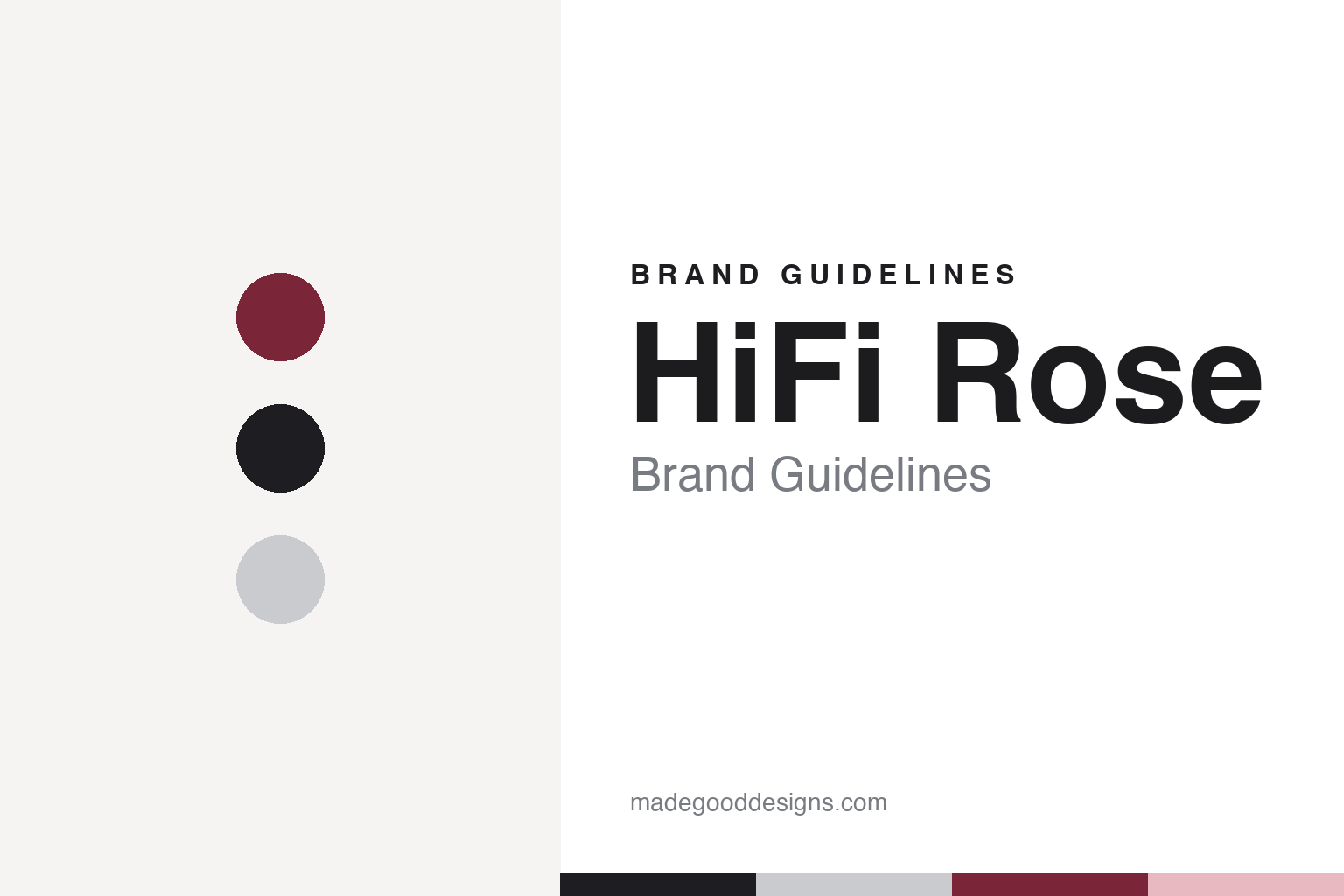
HiFi Rose Brand Guidelines
The Seoul kiosk maker that put a touchscreen on the streamer.
Aa
Two constants: a charcoal, aluminium and deep-rose palette and a geometric sans register. Abstract homage — not a HiFi Rose product or mark; no device, logo or nameplate is reproduced.
Kiosks to streamers
The audio division of a listed Seoul company.
HiFi Rose is not a stand-alone company. It is the audio brand of Citech Co., Ltd., a Seoul company listed on the Korea Exchange whose businesses before audio were kiosks and cable set-top boxes. CE Pro, reporting the brand’s arrival in the United States in October 2020, described Citech as “a global IT company that also manufactures interactive KIOSK brands and set-top box (STB) products.” Citech’s quarterly report, filed in May 2025, places HiFi ROSE in its media division, alongside set-top boxes it supplies to the Korean cable operator D’LIVE.
Trade press usually says Citech was founded in 1967, and its filings do give 17 January 1967 as the date of establishment. But that date belongs to the listed company, not to an electronics business. According to the same filing, the company was a textile maker, Samyoung Mobang, which renamed itself Samyoung Holdings in 2006. In January 2015 it bought a maker of kiosks and certificate-issuing machines called Citech, merged it on 31 March 2015 and took its name on 2 April 2015. Its shares have been listed on the exchange’s main board since 30 November 1989. The registered head office is in the Garak Mall office building in Songpa-gu, Seoul, and the chief executive named in the filing is Kim Dae-young.
The audio brand came in 2017. In a June 2025 profile, StereoNET said HiFi Rose began as the project of Citech’s chairman, Youngmin Kim, an audiophile since his university days, and that a team of five had grown to about 40 people; Korean Wikipedia says the first products were developed in 2017 and went on sale in Korea in 2018.
Colour
A screen on the front of the box.
HiFi Rose made its name with network streamers that carry large touchscreens, applying to hi-fi the touchscreen know-how of a kiosk maker. Its American launch, as CE Pro reported in October 2020, paired the RS150, a $4,000 streamer built around an Asahi Kasei AK4499EQ converter chip, with the RS201E, an all-in-one player with a 100-watt amplifier and an 8.8-inch touchscreen. Sean Kim, described by CE Pro as the brand’s general director, said the RS201E showed that “exceptional performance and design aesthetics are not mutually exclusive.”
The range has widened since then. Citech’s 2025 filing lists streamers and players including the RS150B, RS250A, RS520, RS201E and RS301, the RS130 digital transport, the RA180 integrated amplifier, the RD160 converter, a CD drive and a USB fibre-optic hub; Korean Wikipedia says the line had grown to 12 products by 2024. StereoNET reported that the RA180 was launched at the High End show in Munich in 2023 and that streamers account for about three-quarters of sales. Jun Gu, its technical lead, told the magazine: “We even design our own op-amps.”
Most of what HiFi Rose makes is sold abroad. Citech’s filing says 87% of HiFi ROSE sales in 2024 were exports, with the United States the largest market at 21% of exports, followed by European countries including Germany, Switzerland, the Netherlands and France. Korean Wikipedia credits the brand with a PINUP Design Award in 2017, iF and Red Dot design awards in 2018 and an iF award in 2023; we have not confirmed these with the award bodies.
Typography
Making hi-fi far from the big markets.
Hi-fi making in Australia and New Zealand has largely been the work of small firms a long way from their biggest markets. Plinius says it was founded in 1980 to serve “local customers in New Zealand,” and that its amplifiers are assembled at a Christchurch facility shared with other manufacturing work. Krix says it was established in Australia in 1974.
Ownership has often followed the fortunes of a parent. Halcro, its website says, was created by the physicist Bruce Candy inside his metal-detector company, Minelab; when Codan bought Minelab in 2008, Halcro was shelved, until Longwood Audio, set up by the owners of an Australian hi-fi importer, bought its assets — in 2014 or 2023, as different pages of the same site say.
South Korea’s best-known hi-fi names are digital specialists. Astell&Kern began as the premium player brand of iriver, which SK Telecom bought in 2014 and which renamed itself Dreamus in 2019; English Wikipedia says bemyfriends became Dreamus’s largest shareholder in 2025. Aurender makes music servers, and HiFi Rose belongs to Citech, a listed company that made its name with kiosks; Citech says 87% of HiFi Rose’s 2024 sales were exports.
The makers in this guide are Krix and Halcro in Australia, along with Redgum, which stopped manufacturing at the start of 2025; Plinius, in Christchurch, and Perreaux in New Zealand; Aurender, whose head office is at Anyang, just south of Seoul; and HiFi Rose, run from Citech’s offices in Seoul, according to their websites and filings.
This guide sets out what can be checked about each brand — who founded it, who owns it, and what it says about where its products are made — and marks clearly what rests only on the company’s own word.
Aa
A clean geometric sans for a screen-led brand. (Specimen set in Jost, a sans STAND-IN; NOT the HiFi Rose logo.)
HiFi Rose
A Korean brand with a Swiss partner.
In Europe the brand works through a partner. In April 2024 HiFi Rose and the Swiss loudspeaker maker PIEGA, of Horgen on Lake Zurich, announced rose x PIEGA, a joint company that took over HiFi Rose distribution in Germany and other leading European markets from 1 May 2024, the German magazines hifi-journal and i-fidelity reported. Its managing directors were named as Alexander and Manuel Greiner, the second generation of PIEGA’s founding Greiner family, and Sean Kim of HiFi Rose. Citech’s 2025 filing lists ROSE x PIEGA SA as a joint venture in which it holds 50%; Korean Wikipedia dates the venture to 2023.
The parent company is changing shape too. Korean Wikipedia says Citech moved into AI health-care software in 2025, reported consolidated revenue of 41.5 billion won for that year, and set up a US subsidiary, HIFI ROSE AMERICA, INC., in June 2026.
Where the products are made is less clear than where they are designed. Trade press describes HiFi Rose as based in Seoul, and at least one retailer sells its products as made in Korea. Citech’s 2025 filing lists a company-owned factory at Yeoncheon, in Gyeonggi province, as well as leased offices, but in the sections we checked it does not say where HiFi ROSE units are assembled; Korean Wikipedia says production was brought together at a factory in Seongnam in 2026. We therefore give Korean manufacture as the description used by the company’s sellers rather than as a documented fact.
For a design guide, HiFi Rose shows how a screen can become the face of a hi-fi brand. Compare Astell&Kern, another Korean digital-audio brand inside a larger group, and Aurender, a Korean maker of music servers. For this guide we use charcoal, aluminium grey and a deep rose with a sans, an unofficial interpretation; no product or logo is reproduced.
Explore & save
Keep HiFi Rose’s identity on hand — save it to a board in the Made Good inspiration library.
HiFi Rose identity set
Pin the HiFi Rose charcoal, aluminium and deep-rose palette and the geometric sans register to your own board.