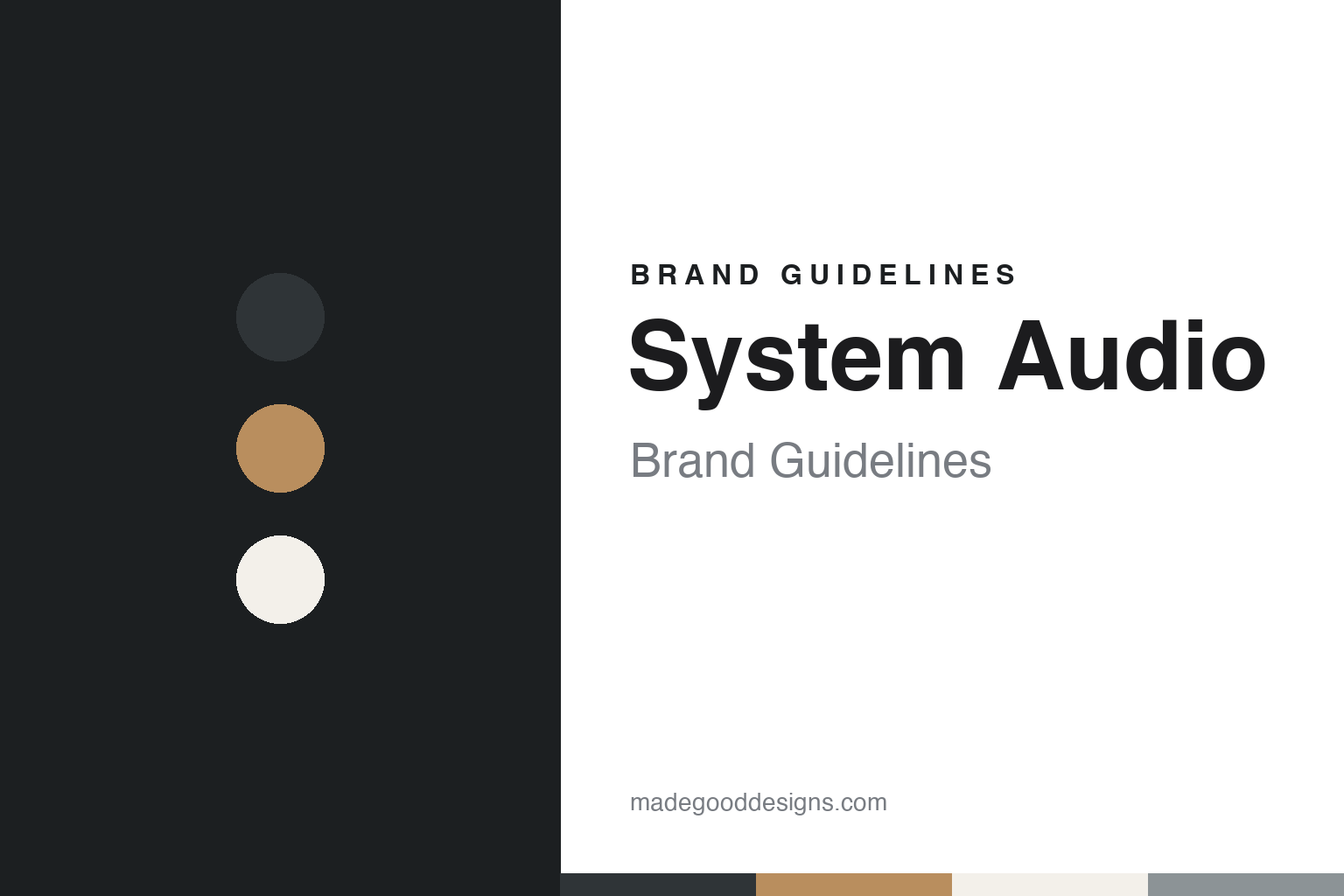
System Audio Brand Guidelines
The Danish speaker maker that began in a basement.
Aa
Two constants: a System Audio graphite, oak and warm-white palette and a Quiet sans register. Abstract homage — not a System Audio product or mark; no loudspeaker, logo or nameplate is reproduced.
The basement
A drummer, a disappointing recording and 14 pairs for KT Radio.
System Audio was founded in 1984 by Ole Witthøft, a teenage drummer from Brønshøj, in north-west Copenhagen. The story is told consistently in the Danish press. Politiken profiled him in May 2009: born in 1965, he left upper-secondary school in 1982, after his rock band played its studio recording on the good hi-fi at his parents’ house and found that the details they had worked on could not be heard. He spent the next two years building speakers in his parents’ basement. In 1984 he drove a pair in his father’s car to KT Radio on Vesterbrogade in Copenhagen, which the paper called a “mecca for hi-fi nerds”; a week later the shop ordered 14 pairs, to be delivered in three weeks. His parents guaranteed a credit line of DKK 10,000 so he could buy materials, and the basement became the workshop of the new company.
Accounts differ in the details. Børsen, in January 2019, said the band recorded in 1984, that Witthøft was 19 when he left the band and school, and that he borrowed DKK 11,000 from a local bank; Politiken called him 18. Both describe friends helping to build speakers in the basement in the evenings, and Dagbladet, Roskilde’s local paper, quoted him in 2019: “We must have built 1,000 speakers before we moved.” According to Politiken, praise from the Danish magazine High Fidelity, which put him on its cover, brought in the orders.
The company outgrew the house. It moved to its own premises in Valby, in Copenhagen, in the early 1990s according to Børsen and Dagbladet, or the mid-1990s according to Politiken. Exports began after a hi-fi show in London, where, Witthøft told Politiken, he personally signed contracts with 20 countries; the paper’s timeline dates the start of exports to 1994. Since 2002 the company has been based in Roskilde, west of Copenhagen. Its website gives its legal name as System Audio A/S, at Langebjerg 35A.
Colour
From the SA7K to Silverback.
System Audio’s speakers have usually been compact, plainly finished boxes. A 2004 reader-service page in B.T. said the company designed and developed its own models, had specialist suppliers make the components, and did all assembly itself; its flagship then, the SA7K, involved 23 factories and suppliers and took 16 weeks to build a set, Witthøft said. A 2008 feature in the magazine Quality, which reads like promotional copy, showed the SA505 and the SA1530 floorstander in white lacquer or real-wood finishes, sold through Fona stores.
The company has made a habit of involving its customers. In 2012, Dagbladet reported, the engineering magazine Ingeniøren invited Witthøft to share a project with its readers. The result was a blog, “Højttaler Q113,” on which he posted drawings and ideas for two and a half years while readers suggested improvements. The speaker that came out of it, the compact SA Pandion 2, went on to win many awards, the paper said, and involving users became a hobby horse for the firm.
Its main product today is Silverback. Witthøft told Børsen he had the idea in 2014, out of irritation at explaining to customers why one product could do one thing and another product something else. The result, the SA Legend Silverback, was a speaker with what he called “three lives”: passive, with an amplifier; active, wired directly to a source; or fully wireless. Hi-Fi Choice dated the launch of the active Silverback range to 2018. The speakers take their signal over WiSA wireless from a Stereo Hub or Surround Hub and are set up through an app called SA Cockpit. Børsen reported in 2019 that the Legend 40 Silverback had been named speaker of the year by the German magazine HiFi Test, and the company presents the Silverback 1 as an EISA award winner for 2023–24. The range now includes Legend Silverback DS models, the Silverback 1, a soundbar called Silverbar and the passive Signature series, with a seven-year factory warranty for registered owners.
Typography
Nordic hi-fi.
Beyond its best-known names, Nordic hi-fi is a business of small companies. Several of Denmark’s larger loudspeaker brands have passed to foreign owners — Jamo to Klipsch in 2005 and Dynaudio to China’s Goertek in 2014, according to English Wikipedia — while many smaller makers remain private or sit in small groups.
The clearest such group is Dantax, an audio company in Pandrup, North Jutland, listed in Copenhagen since 1984. It took over Raidho in 2009 and announced in January 2018 that it was taking over GamuT, and it has long owned the Scansonic name. In its 2024/25 annual report Dantax says it sells loudspeakers under the Raidho, GamuT and Scansonic HD names, that they are produced in Pandrup, and that it employed an average of 12 people.
In Finland, Genelec was founded in Iisalmi in 1978 by Ilpo Martikainen and Topi Partanen, and Amphion by Anssi Hyvönen in 1998, moving to Kuopio in 2000, English Wikipedia says; both say they make their speakers in Finland.
The makers in this guide are spread across three countries: Penaudio, founded in Jyväskylä in 1999 and now at Luumäki in south-eastern Finland; System Audio in Roskilde; Copland in Copenhagen; GamuT and Scansonic at Dantax in Pandrup; Holfi, whose factory was at Hillerød in 2000 and which we found no sign of trading after the late 2000s; and Dynavoice, which designs its speakers in Örebro, Sweden — according to their own websites, company registers and archived pages.
This guide sets out what can be checked about each brand — who founded it, who owns it, and what it says about where its products are made — and marks clearly what rests only on the company’s own word.
Aa
A quiet sans — for compact speakers made to blend into a room. (Specimen set in Manrope, a sans STAND-IN; NOT the System Audio logo.)
System Audio
Still the founder’s company, still in Roskilde.
Model names carry the initials SA — SA Legend, SA Saxo, SA Air, SA Signature — and British reviewers often call the company SA. On the evidence of its website, though, the initials are used for products and the app rather than as a new company name: the site, its legal notice and its press pages all say System Audio.
The company appears to have stayed in its founder’s hands. Dagbladet described Witthøft in 2019 as the owner and founder, Børsen the same year called him managing director, and Hi-Fi Choice in 2021 called him “founder and boss.” In 2019 Børsen also reported that the state-backed fund Vækstfonden had lent the company DKK 2 million to support exports and new technology. We could not check the Danish company register for its current owners, and we found no report of a sale.
On manufacturing the record shifts over time. B.T. said in 2004 that all assembly took place at System Audio. Politiken reported in 2009 that “part of the production” had moved to places including China and Eastern Europe. In 2019 Dagbladet said the company had about ten employees who assemble some 20,000 speakers a year, and captioned a photograph saying the speakers “are still made at the factory in Roskilde”; Hi-Fi Choice referred in 2021 to its “HQ and factory in Roskilde.” The company’s own website now says its speakers are “designed and perfected in Roskilde,” which describes design rather than manufacture. The company exported to 41 countries in 2019, Børsen and Dagbladet reported, and Børsen counted about 150 awards over the years.
For a design guide, System Audio shows how a brand can keep a quiet, furniture-like look while the technology inside its boxes changes completely. Compare Dali and Dynaudio, two other Danish loudspeaker makers. For this guide we use graphite, oak and warm white with a sans, an unofficial interpretation; no product or logo is reproduced.
Explore & save
Keep System Audio’s identity on hand — save it to a board in the Made Good inspiration library.
System Audio identity set
Pin the System Audio graphite, oak and warm-white palette and the Quiet sans register to your own board.