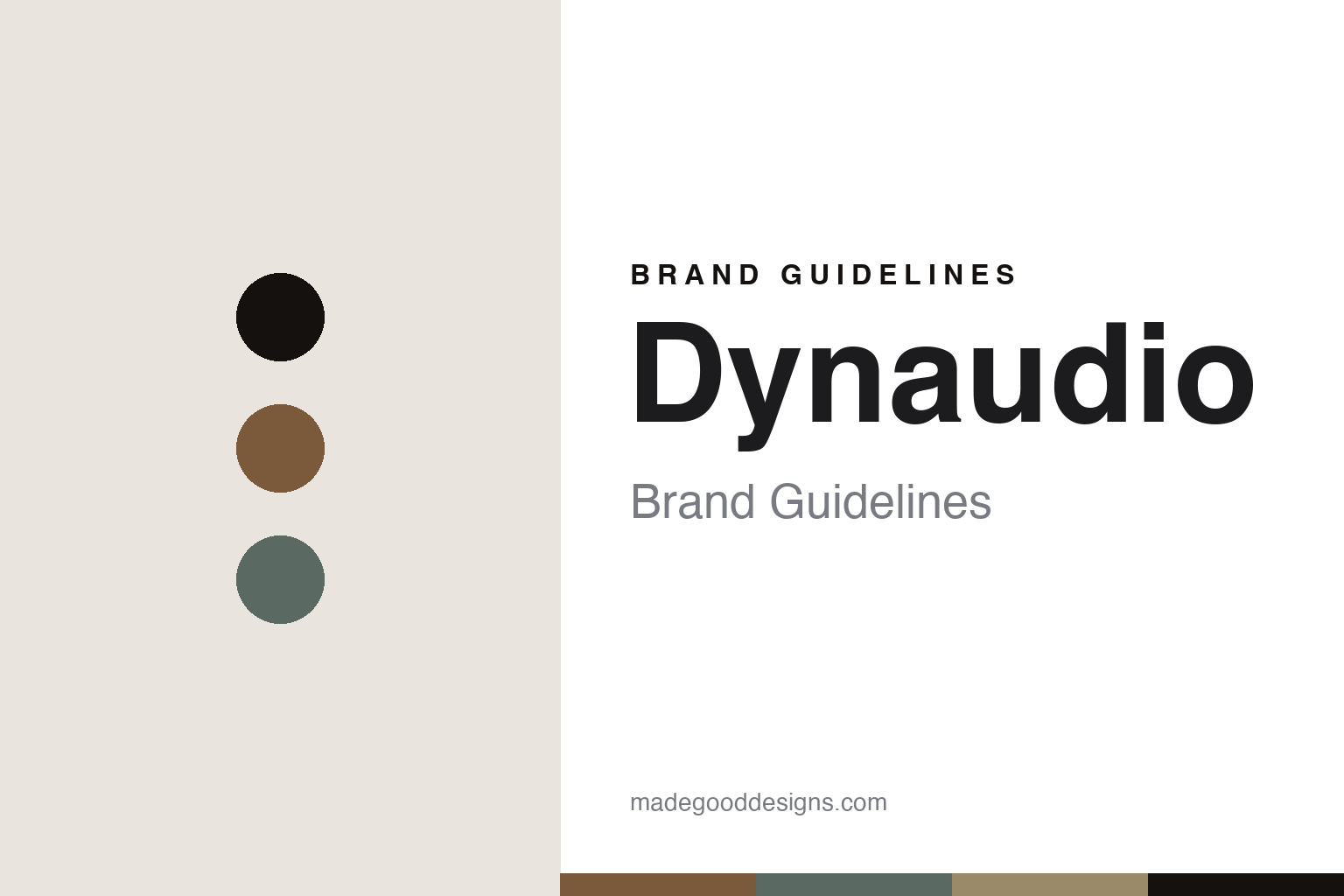
Dynaudio Brand Guidelines
The own driver.
Aa
Two constants: a walnut-and-grey palette and a nordic sans register. Abstract homage — not a Dynaudio speaker or wordmark.
The own driver
Dynaudio designs and makes its own drivers in Skanderborg, Denmark.
Dynaudio is a lesson in making the driver the identity. A Danish loudspeaker maker in Skanderborg, it is one of the few brands that designs and builds its own drive units — the tweeters and woofers most speaker makers buy in — for an understated, Scandinavian range. Sound, made from the inside out.
Its identity is the own driver. Dynaudio’s in-house soft-dome tweeters and its own cone woofers, wrapped in restrained cabinets, are the work it is known for. A component, made a signature. A maker that starts with the part everyone else outsources.
(Honest notes, so the story stays precise. Dynaudio was founded in 1977 in Denmark. On ownership: in 2014 it was acquired by the Chinese group GoerTek, which holds the majority; but it is still headquartered, designed and run from Skanderborg, so we say “owned by GoerTek, designed in Denmark.” On making: it genuinely designs and manufactures its own drivers — its Esotar soft-dome tweeter and MSP-cone woofers — which is a real differentiator; but production is not entirely Danish, since drivers are made both in Skanderborg and in a Chinese factory, and its flagship lines are assembled in Denmark while entry lines draw on Chinese manufacturing. So we say flagships are Danish-assembled, not that every model is fully made in Denmark. Its designs and name are its IP, described but never reproduced, and there is no official brand hex — these tones are an unofficial interpretation. This is design commentary and does not promote any product.)
Colour
Dynaudio lives in a walnut-and-grey palette. Click a swatch to copy the hex.
Dynaudio’s identity is understated, warm and Scandinavian — a walnut, an ink, a nordic grey, an oak, and a chalk. The palette leans walnut and grey: the register of warm wood against quiet grey. It signals restraint and warmth over flash. The honest caveat: with no published brand hex, these values are an original, unofficial interpretation, not first-party colours.
The lesson is a walnut-and-grey palette signals an understated Scandinavian identity. Dynaudio’s world is a restrained, warm, considered object. For designers, it is a reminder that a quiet, natural palette can carry a brand built on engineering rather than looks — warm walnut against calm grey. Because these tones can fail as small text, keep type dark and let the colour live in the accents, palette and band. The takeaways: make your own core parts; keep it restrained; be honest about origin; and treat any single hex as unofficial.
Typography
The register is a nordic sans — clean, warm, understated.
Dynaudio’s identity carries a clean, warm, understated spirit — a restrained object, not a showy one. A nordic sans captures the mood: even, humane and quiet, the register of a Scandinavian speaker. Set in a walnut-and-grey palette, the nordic sans feels clean and warm — exactly the personality Dynaudio carries. It is understated rather than loud, mirroring a restrained cabinet. (Dynaudio’s real speakers and wordmark are things we describe but do not reproduce, and the exact typeface is not ours to use.) Because it is not ours to use, the honest description is “a nordic-sans spirit,” shown here in a stand-in. The type behaves like the maker: clean, warm and understated.
Aa
A nordic-sans spirit — clean and warm. (Specimen set in Hanken Grotesk, a nordic-sans STAND-IN; NOT the Dynaudio wordmark or any speaker design.)
Making the driver the identity
Dynaudio stands for the own driver.
Dynaudio is a lesson in making the driver the identity. A walnut-and-grey palette, a nordic sans and understated cabinets make in-house engineering the whole maker — restrained, warm and Scandinavian. The driver is the differentiator. The differentiator is a genuine, unusual choice — designing and building its own drive units, the part most speaker brands buy off the shelf, and letting that engineering define it.
Put to work, the identity is a core part as design. A maker building in this spirit would own the component others outsource, keep the design and flagship making at home, and be candid about where the rest is made, so the customer buys into engineering rather than a veneer. It would let restraint stand for confidence, so that a plain cabinet is understood as the shell over serious internals. The lesson Dynaudio teaches is that owning the core part can build a brand: the driver gives it substance, and the restraint gives it credibility. The engineering is the personality, and the driver is the proof.
For designers and brand-builders, Dynaudio offers a clear takeaway: own the part others buy, and be honest about the rest. The lessons: make your own core parts; keep it restrained; be honest about origin; and be candid about the story. It is also a reminder to stay accurate: Dynaudio is a Danish maker founded in 1977, owned since 2014 by the Chinese group GoerTek but designed and run from Skanderborg, making its own drivers and assembling its flagships in Denmark while drawing on Chinese production for parts and entry lines — with the palette here an unofficial interpretation. Dynaudio made the own driver the maker — proof that a core part can be the difference.
Explore & save
Keep Dynaudio’s identity on hand — save it to a board in the Made Good inspiration library.
Dynaudio identity set
Pin the walnut-and-grey palette and the nordic-sans register to your own board.