Avantgarde Acoustic Brand Guidelines
The Odenwald maker of spherical horn loudspeakers.
Aa
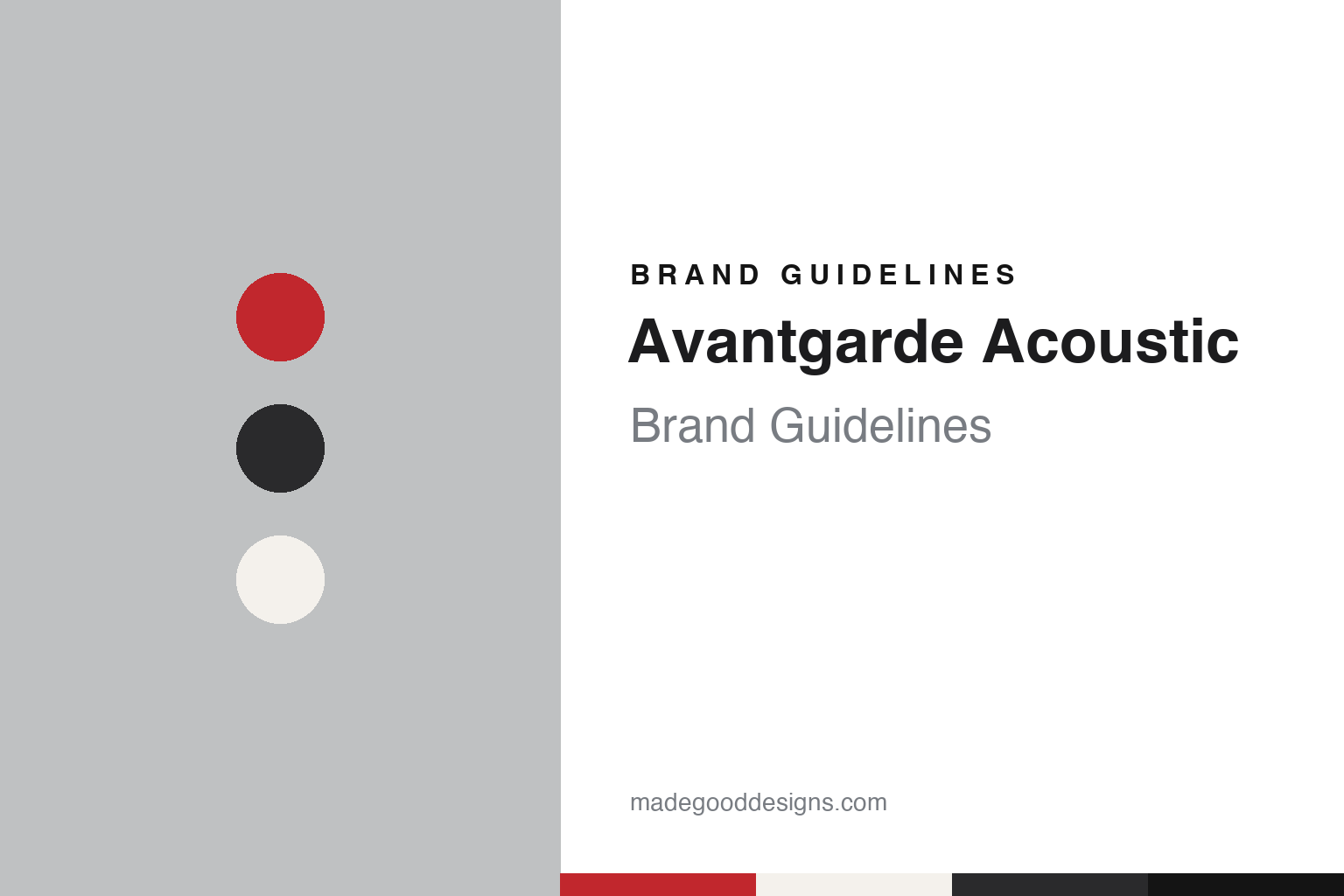
Two constants: an Avantgarde horn red, graphite and white palette and a Geometric sans register. Abstract homage — not an Avantgarde Acoustic product or mark; no loudspeaker, logo or nameplate is reproduced.
Lautertal
A horn its founder could not afford.
Avantgarde Acoustic dates its beginning to 1991. The company’s history page says that in the mid-1980s Holger Fromme and Matthias Ruff “joined forces to fulfil their dream — to build the best loudspeakers in the world.” A 2024 interview in the business magazine Wirtschaftsforum tells the story in more detail: Fromme had heard a high-quality horn loudspeaker, could not afford one, and decided to build his own, bringing in Ruff for the engineering. Their first speaker was shown at trade fairs in 1991, which the company treats as its founding moment.
The firm has stayed in the same corner of Hesse. Its legal name is Avantgarde Acoustic Lautsprecher Systeme GmbH, at Nibelungenstraße in Lautertal-Reichenbach, in the Odenwald hills near Darmstadt, according to its imprint. The company says it handcrafts its horn loudspeakers and amplifiers at the Reichenbach factory and ships them to more than 60 countries. In the same Wirtschaftsforum interview, the then managing director Ralf Steinhilber said the speakers were made only at the Lautertal headquarters, by 30 permanent staff plus freelancers. STEREO magazine, which took about 45 of its subscribers on a factory tour there in April 2022, described the production and the large listening room it saw.
Colour
The spherical horn.
Everything Avantgarde makes is built around the horn. Instead of a cone radiating freely, its drivers sit at the throat of round spherical-wave horns that guide the sound into the room. The company says its horns are circular to avoid colouration, that they are cast in steel tools, and that the horn principle raises the efficiency of sound radiation more than tenfold; those are its claims, as are the measurements it says it commissioned from the hearing-technology institute at Aachen’s university. Steinhilber put the case more plainly to Wirtschaftsforum: the shape of a horn loudspeaker “is not meant to make the products look especially avant-garde — here form follows function” (our translation), because a horn lets a small, light driver produce a high sound pressure.
The products are easier to document. The Duo has been in the range since 1993, the company says, and is now in its third generation as the Duo GT, with a 670 mm midrange horn. The flagship Trio is a three-way horn system — in its G3 version with a 950 mm bass horn — usually paired with SpaceHorn bass modules, which the company calls the successor to its BassHorn. The company gives the Trio G3 a sensitivity of 109 dB per watt at one metre, offers it passive or with built-in amplifiers, and houses the electronics in replaceable modules so that owners can upgrade later. STEREO first heard the Trio G3 in Lautertal in autumn 2021. The range also includes the Uno SD, Duo SD and Mezzo, the boxy active Zero iTRON, the Twin Sub, the smaller Colibri line, and the active Opus 1, which STEREO tested in its April 2026 issue.
The recent technical theme is electronics. iTRON, a current-drive amplifier that can be built into the speakers, won a German Innovation Award in 2023, and the company has filed patents on a horn loudspeaker in 2005 and on amplifier circuits from 2007 onwards, according to register summaries compiled by North Data.
Typography
German hi-fi and its makers.
Germany’s high-end loudspeaker makers do not share a single school. Some build on horns, some rethink the driver itself, and some put the amplifiers inside the cabinet and let electronics correct for the box and the room. The seven brands in this guide cover all three approaches, and the electronics that drive them.
Avantgarde Acoustic, at Lautertal in the Odenwald hills of Hesse, builds its range around horn loudspeakers, according to its website. Manger took a different route: its company timeline says Josef W. Manger filed his first patent in 1968 for what became a bending-wave transducer, the Manger Schallwandler, and that small-series production began in Mellrichstadt, in northern Bavaria, in 1990.
Active designs are the third strand. Backes & Müller, in Saarbrücken, marks fifty years of active, sensor-controlled loudspeakers on its website. Kii Audio, registered in Bergisch Gladbach near Cologne and building its speakers at Hamminkeln, near Wesel, sells active speakers with what it calls cardioid technology, meant to cut reflections from the room. Lyravox, in Hamburg, gives each driver its own amplifier and uses a digital signal processor in place of a passive crossover.
The electronics makers have roots in the Ruhr. Einstein Audio Components is registered in Bochum, and Audionet’s legal notice gave a Bochum address in 2015 and a Berlin one by 2018, according to archived versions of its website; the brand now belongs to audionet GmbH, registered in Berlin.
This guide sets out what can be checked about each brand — who founded it, who owns it, and what it says about where its products are made — and marks clearly what rests only on the company’s own word.
Aa
A geometric sans — clean, circular forms for a maker of round horns. (Specimen set in Jost, a sans STAND-IN; NOT the Avantgarde Acoustic logo.)
Avantgarde Acoustic
The horn as the identity.
For a brand guide, Avantgarde’s identity is unusually literal: it is the horns themselves. STEREO wrote in 2026 that the company’s speakers had “always been a sight,” with large and often brightly coloured horns, and the Trio configurator offers twelve horn colours, among them one called “Genuine Red.” In 2016 the German Design Council (Rat für Formgebung) gave Avantgarde a German Brand Award 2016 Gold in the category “Industry Excellence in Branding,” STEREO reported, praising its uncompromising technology and honest quality and “the purist, clear design of products and communications” (our translation). Fromme accepted it as managing director. Two years earlier the Zero 1 had won an EISA award as a high-end product of the year.
Ownership is less visible than the products. Annual accounts of Deutsche Steinindustrie AG, a holding company then based in Lautertal, listed Avantgarde as one of its two holdings in the years 2007 to 2012, register summaries show, without giving the size of the stake. Register filings also show that Holger Fromme stepped down as managing director in December 2024, when new lists of shareholders were filed; the imprint now names Philipp Herrmann and Wolfgang Rixen as managing directors. We could not establish who owns the company today.
The awards have continued. The Absolute Sound named the Trio G3 its 2025 Cost-No-Object Loudspeaker of the Year, the company says, and in October 2025 Avantgarde exhibited at HiEnd Asia in Singapore for the first time, where it also teased the name of the Opus 1. When STEREO tested that speaker in 2026, it described a 35 cm spherical horn above an eight-millimetre aluminium front panel — the same signature, in a flatter, more domestic cabinet.
For a design guide, Avantgarde Acoustic shows how a single technical form can become the whole brand. Compare Acapella, another German horn-loudspeaker maker, and Audionet, which won a German Brand Award the same year. For this guide we use horn red, graphite and warm white with a geometric sans, an unofficial interpretation; no product or logo is reproduced.
Explore & save
Keep Avantgarde Acoustic’s identity on hand — save it to a board in the Made Good inspiration library.
Avantgarde Acoustic identity set
Pin the Avantgarde horn red, graphite and white palette and the Geometric sans register to your own board.