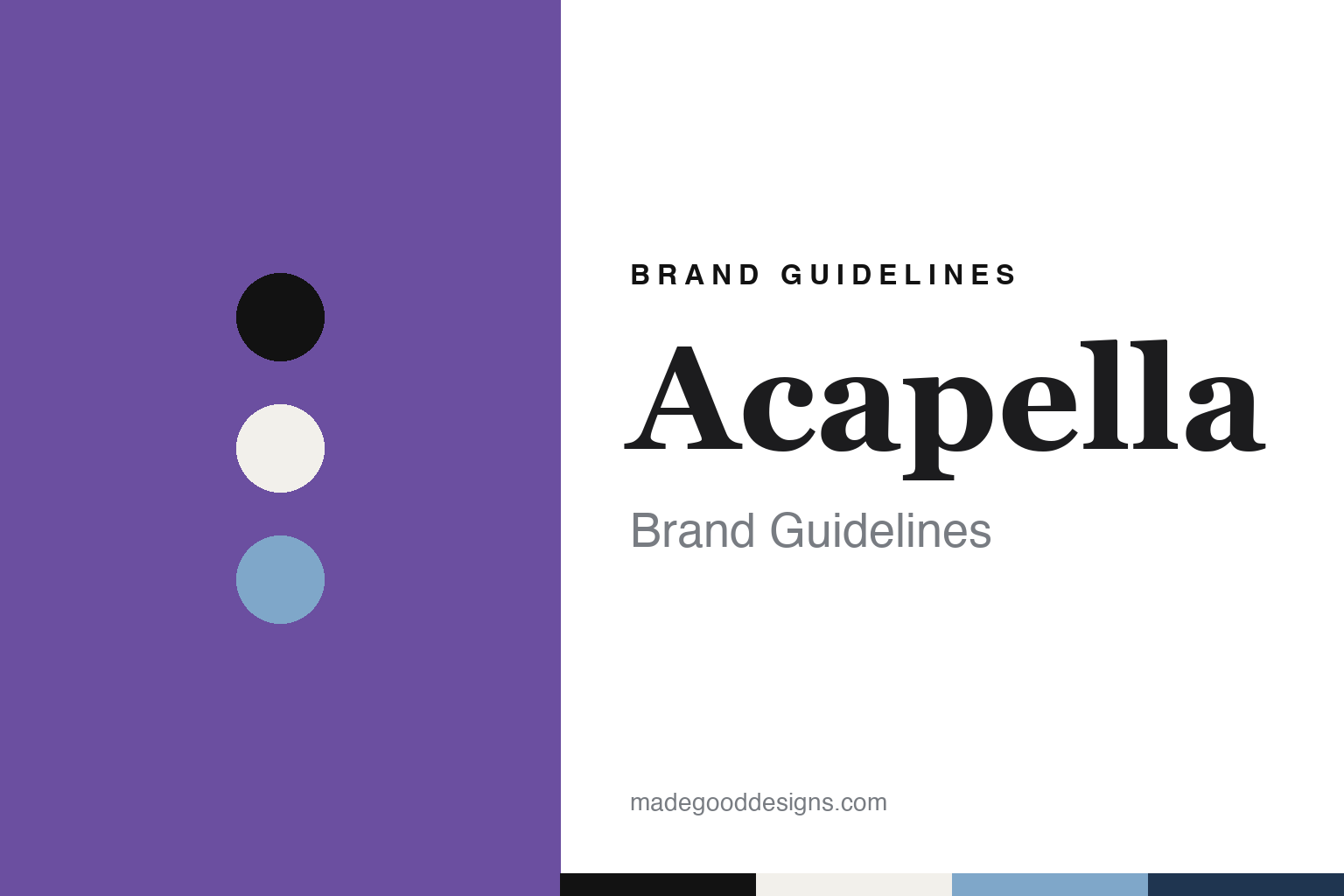
Acapella Brand Guidelines
The Duisburg horn maker behind the plasma tweeter.
Aa
Two constants: an Acapella black, white and horn-blue palette and a concert serif register. Abstract homage — not an Acapella product or mark; no loudspeaker, logo or nameplate is reproduced.
Audio Forum
A hi-fi studio on Koloniestraße.
Acapella’s story starts with a shop. Hermann Winters and Alfred Rudolph met in 1972 through hi-fi and music, the editor Dirk Sommer wrote in a 2016 portrait of the company for Positive Feedback; Winters had run a business called Hifi-Elektroakustik since his school days, and Rudolph one called ARAkustik. On 4 September 1976 the two opened a shared hi-fi studio, the Audio Forum, at Koloniestraße 203 in Duisburg. Sommer wrote that both founders treat that opening as the company’s foundation date, although their trading licence is older. English Wikipedia gives 1978 as the founding year, and says the two met in 1976, so we note both.
The company’s own history page, as archived in 2025, says it got started “as ‘Acapella Audio Arts’” in the 1980s and that its products were first shown to the public at the IFA consumer-electronics fair in Berlin, without giving a year. Its early range, it says, included the ION TW 1S plasma tweeter — the “S” standing for spherical — and models called Fidelio, Triolon, Celestron, Celesta and 5th Avenue, followed by the Violon and the Campanile, which it says were made “in the newly occupied production premises in Duisburg.” The company says the Violon has sold more than 1,000 units and that the Campanile is in its fifth generation.
The shop shaped the brand. Sommer, who first went there as a student in Bochum in 1978 or 1979, described how customers climbed towards their ideal system in steps, trading components in along the way, and recalled Winters checking a reissue of Esther Ofarim’s album Esther, sold as an “ATR Mastercut” recording, at EMI’s studio in Cologne. Fifty years on, in September 2026, the company announced that Alfred Rudolph — now described as its “senior developer” — was reopening the Audio Forum for a three-day anniversary.
Colour
Horns and a flame.
Acapella is known for two things: horns, and a tweeter without a diaphragm. The ION TW 1S uses high voltage to keep an electric arc burning in the air and modulates it with the music signal, so that the flame itself moves the air — “without membrane and without mass,” in the company’s words. Its older website lists a range from 5 kHz to above 50 kHz and a maximum of 110 dB. A bachelor’s thesis from Graz University of Technology, citing sources consulted in 2021 and 2022, named Acapella and Lansche Audio as the two German makers still building plasma tweeters, and noted that the Acapella unit, once sold on its own, is now built into speakers such as the Campanile 2 and the Triolon Excalibur. The idea is older: Magnat licensed a plasma design from the French physicist Siegfried Klein in 1978, the thesis says.
The horns are round and wide-mouthed. The company later developed what it calls a hyperspherical horn, which it says extends a horn’s usable range from the usual three octaves to more than five; those are its claims. Outside reviewers have mostly described the sound. In 2010 Stereophile’s John Atkinson reviewed the High Violoncello II, then $80,000 a pair, writing that two German companies, Avantgarde and Acapella, had “worked hard in the past 20 years” to use what horns can offer.
The range now runs from the Harlekin II and La Campanella II — €20,000 and €30,000, fairaudio reported in February 2026 — through the Cellini, Campanile and Triolon Excalibur to the Hyperion, about 2.5 metres tall, 300 kilograms and €280,000. At the top is the Hypersphere, whose horn alone is 1.7 metres across. It was first shown at the HIGH END show in Munich in 2025, priced at €5 million, fairaudio reported, and only five are planned, according to a 2026 Hifistatement interview. Acapella also makes amplifiers: the Energéia line of valve-and-transistor hybrids, which Richard Rudolph says he began four or five years earlier, first with Lorenz Martensen and then with a small team of his own.
Typography
German hi-fi, second round.
Several of Germany’s best-known loudspeaker names have spent decades under American owners. German Wikipedia says the US group Recoton bought the Heco brand rights in 1996, and that Audiovox — renamed Voxx International in 2012 — bought the insolvent Recoton in 2003. Today Magnat and Heco are brands of Premium Audio Company Germany GmbH in Pulheim, near Cologne, according to their legal notices, and Voxx itself was bought by the US company Gentex in April 2025, English Wikipedia says.
At the other end of the trade are small specialist workshops, and several are in Baden-Württemberg. Two are in the district of Karlsruhe: Octave, in Karlsbad, whose owner, Andreas Hofmann, says he turned from transistors to valve amplifiers in 1977, and AVM, at Malsch, whose legal name, Audio Video Manufaktur GmbH, uses the German word for a craft workshop. Accustic Arts is based at Lauffen am Neckar, in the same state.
The trade’s main meeting place has moved. The HIGH END show, held in Munich until 2025, took place in Vienna from 4 to 7 June 2026, and Acapella was among the exhibitors there, according to its website.
The makers in this guide are spread out: AVM in Malsch, Octave in Karlsbad and Accustic Arts in Lauffen am Neckar; Lindemann at Wörthsee, west of Munich; Magnat and Heco in Pulheim; and Acapella in Duisburg, with a showroom at Isen near Munich, according to the legal notices on their websites.
This guide sets out what can be checked about each brand — who founded it, who owns it, and what it says about where its products are made — and marks clearly what rests only on the company’s own word.
Aa
A concert serif — for a brand that calls its speakers instruments. (Specimen set in Cormorant Garamond, a serif STAND-IN; NOT the Acapella logo.)
Acapella
A second generation in Duisburg.
In February 2026 the founders handed over. fairaudio reported on 25 February that after almost fifty years under Winters and Rudolph, Alfred Rudolph’s son Richard Rudolph was now running the company; in a Hifistatement interview published on 13 February, the distributor Marc Lindike said Richard had become sole owner and managing director. Richard told the magazine he had trained as a machinist, returned to the firm at 19, later studied mechanical engineering, became a partner about seven years earlier and had built every Acapella model. He said he led the design of the Hyperion and reworked the Sphäron and the Cellini, while Lindike credited the basic construction and the horn shape to Alfred. The company’s legal notice names Acapella Audio GmbH & Co. KG, Koloniestraße 203, Duisburg, represented by Richard Rudolph.
Sales changed too. Lindike’s company, Unbelievable Audio, took over worldwide distribution, direct sales ended in favour of dealers, and a showroom of about 400 square metres, the “Sonic Sanctuary,” opened in a penthouse above the HEC store in Isen, near Munich, fairaudio reported. Production stays in Duisburg, the company side says: Lindike told Hifistatement that it takes place “not in China, but in Duisburg.” We give that as the company’s word. In June 2026 Acapella showed the La Campanella Alto 2 MK II at HIGH END in Vienna, beside a Clearaudio Statement turntable, its website says. Lindike also said the Hypersphere would be the last speaker to carry the old Acapella logo; we found no published detail of a new mark.
For a design guide, Acapella shows how one shop’s sound ideal can become a product line, and how a horn can become a visual signature. Compare Magnat, another German name tied to the plasma tweeter, and Clearaudio, whose turntable stood beside Acapella’s speakers in Vienna. For this guide we use lacquer black, horn white and a pale horn blue with a serif, an unofficial interpretation; no product or logo is reproduced.
Explore & save
Keep Acapella’s identity on hand — save it to a board in the Made Good inspiration library.
Acapella identity set
Pin the Acapella black, white and horn-blue palette and the concert serif register to your own board.


