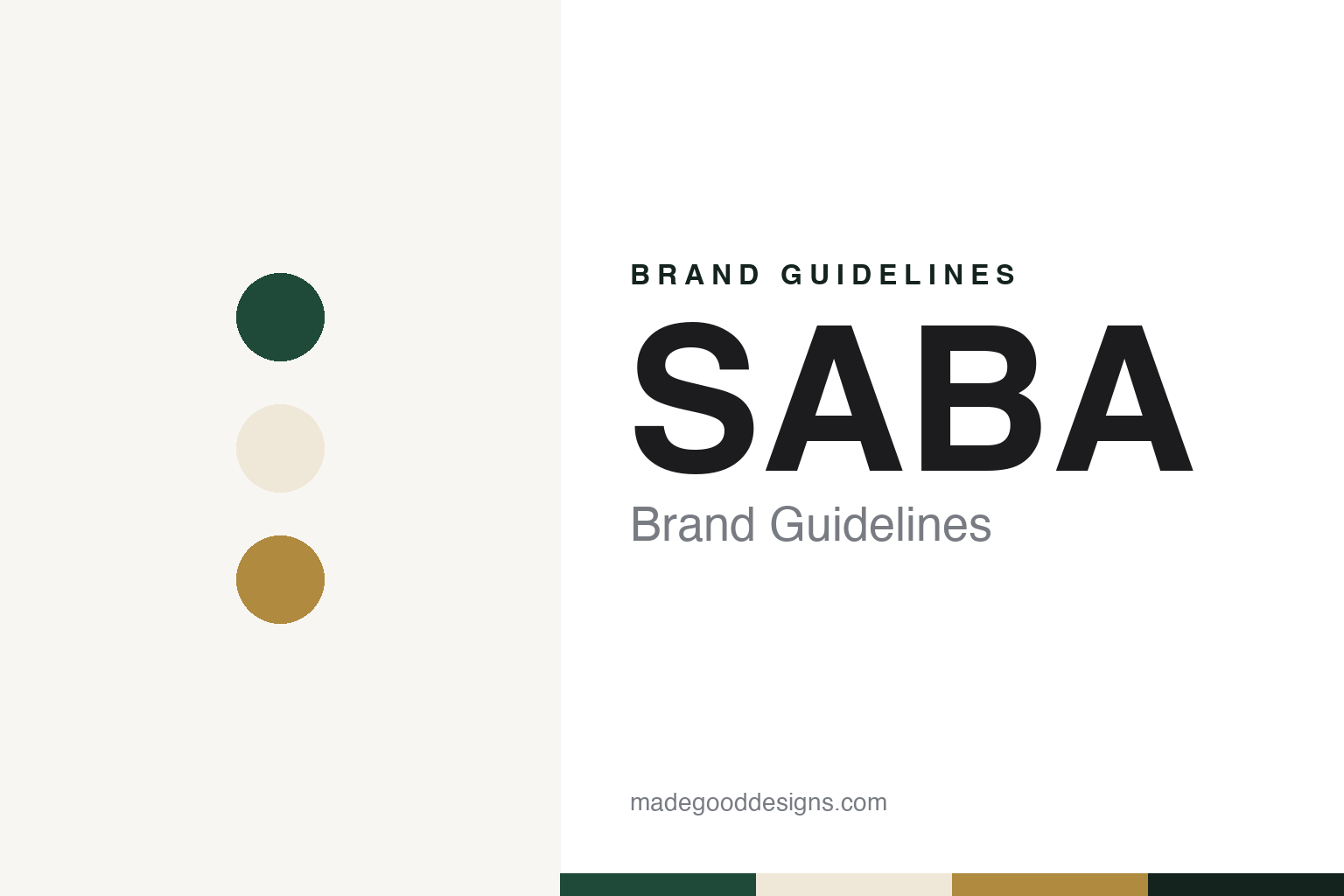
SABA Brand Guidelines
The Black Forest radio maker now licensed from abroad.
Aa
Two constants: a fir green, ivory and brass palette and a broadcast sans register. Abstract homage — not a SABA product or mark; no radio, logo or nameplate is reproduced.
From clocks to radios
A Triberg clock factory that became a radio maker.
SABA’s name is an acronym for Schwarzwälder Apparate-Bau-Anstalt — roughly “Black Forest apparatus works” — and the full company name added August Schwer Söhne. Sources date it differently. German Wikipedia traces it to a clock factory founded in 1835 in Triberg by Joseph Benedikt Schwer, which from 1865 traded as August Schwer Söhne; English Wikipedia gives 1923, the year the firm began making radio parts and took the SABA name. Both describe the same business, and a 2023 exhibition at the Franziskanermuseum in Villingen-Schwenningen marked a hundred years of the SABA mark.
The company moved to Villingen after the First World War, when Triberg left no room to expand, according to a 2016 history on Sozialgeschichte Uhrenindustrie, a site on the region’s clock industry; English Wikipedia gives 1918. Under Hermann Schwer (1877–1936), the founder’s grandson, it made coils and variable capacitors from 1923, radio kits from 1926 and complete sets from 1927. Its S35 receiver of around 1930 sold strongly, and by 1935 SABA held about ten percent of the German radio market, second only to Telefunken, German Wikipedia says. It also made versions of the Nazi-era Volksempfänger and, during the war, military radios; bombs destroyed new factory buildings in April 1945. By the end of that year, German Wikipedia says, the works were making whatever they could, from a toy crane to pill tubes for the pharmaceutical industry, while the administration building, which had lost only its roof, carried on.
Colour
Radios, televisions and a cassette of its own.
After the war SABA made telephones for the Bundespost, including the W 46 and, with other makers, the standard W 48, before radio production resumed in 1947. Its first series-built television, the Schauinsland W II, followed in 1953. Hermann Schwer was also a local patron: he set up a holiday home for workers in Meersburg on Lake Constance and endowed the Schwarzwaldmuseum in his home town of Triberg, German Wikipedia says.
In the 1960s the brothers Hans Georg and Hermann Brunner-Schwer, heirs of Hermann Schwer, led an expansion that included a tape-recorder plant in Friedrichshafen, the Sabamobil portable cassette format of 1964 and, from 1967, PAL colour televisions; its top music cabinets were sold for a time as the “Königin von Saba,” the Queen of Sheba. German Wikipedia also credits SABA with ultrasonic wireless remote controls and picture-in-picture. Hans Georg Brunner-Schwer ran a SABA jazz label, recording artists including Oscar Peterson, and later founded MPS Records, according to The New Grove Dictionary of Jazz as cited by English Wikipedia.
The workforce was large — around 4,000 at the end of 1960, by the Sozialgeschichte Uhrenindustrie account. Costly projects left the firm strained by the late 1960s, and on 26 January 1968 the family sold 85 percent to GTE International, the American telephone group, the same source says, with Hermann Brunner-Schwer keeping 15 percent and staying on as managing director. By 1972 SABA employed 4,582 people; a 6.7 million mark profit in 1973 turned into a 25 million mark loss in 1974, according to a second 2016 article on the same site. After a 100 million mark capital increase in 1975 his stake fell to 2.5 percent, and in September 1975 he left and sold his remaining shares to GTE. Hermann Mössner took over as chief executive. German Wikipedia skips the GTE years and presents the 1980 sale as the end of the family business; we follow the dated account.
Typography
Design and documentation.
In the decades after the Second World War, Europe’s radio, television and hi-fi makers were household names. By the 1970s several were losing money. Norwegian Wikipedia says Tandberg faced strong competition from Japanese and other Asian producers and made losses from 1976; German Wikipedia ties Dual’s decline to Japanese competition, and English Wikipedia describes Far East competition in Lenco’s.
Some names were absorbed by larger groups. The French Thomson group took over SABA in 1980, after GTE left consumer electronics, then Dual in 1982 and Telefunken’s television and radio business in 1983–84. Philips took a 31.6 per cent stake in Grundig, with management control, in 1984.
Others failed. Lenco went bankrupt at the end of the 1970s, Tandberg in December 1978 and Dual in 1981; Grundig filed for insolvency in April 2003. Studer, a maker of studio equipment, took another path: Willi Studer sold it in 1990, and it passed to Harman in 1994.
Many of the names lived on as brands rather than factories. Grundig belongs to Turkey’s Arçelik; the Telefunken brand, licensed through Telefunken Licenses GmbH in Frankfurt, was bought by Gordon Brothers in 2023; SABA is a licensing brand of Talisman Brands; the Dual name in Europe belongs to Dual GmbH of Fuchstal, in Bavaria; Lenco to the Dutch Commaxx group; Studer to Canada’s Evertz; and the Tandberg video-conferencing company to Cisco.
This guide sets out what can be checked about each brand — who founded it, who owns it, and what it says about where its products are made — and marks clearly what rests only on the company’s own word.
Aa
A clear broadcast-era sans for a radio maker. (Specimen set in Work Sans, a sans STAND-IN; NOT the SABA logo.)
SABA
A licensed name with a museum piece.
In 1980 GTE left consumer electronics and the French Thomson group took over SABA-Werke, English Wikipedia says; German Wikipedia gives 1980 for the sale and 1981 for the takeover. By then SABA had bought in Sanyo’s 2000 series in 1978 and, in 1979, stopped making hi-fi equipment altogether, German Wikipedia says. Under Thomson, SABA-Werke was dissolved in 1986 and the Villingen business passed through a string of names until TTE Germany, a joint venture of TCL and Thomson, became insolvent, German Wikipedia says, citing Der Spiegel; the last Villingen buildings were demolished in August 2021.
The name kept one design moment. In 1994 Philippe Starck’s Jim Nature portable television, cased in high-density chipboard, was made by Saba in France for Thomson Consumer Electronics; it is held by MoMA in New York, which credits the manufacturer as Saba, France, and by SFMOMA and Britain’s Science Museum Group.
Today SABA is a licensed brand. Technicolor, as Thomson had become, sold its trademark-licensing business to Talisman Brands, trading as Established, in May 2022. Established’s SABA website says products are distributed under licence in France, Spain, Portugal, Italy, Luxembourg and Switzerland, across television, audio and household appliances, and that licensees are solely responsible for them; it does not name them, and we found no licensee named in the sources we checked. The German national SABA trademark held by a Thomson company was deleted in 2016, German Wikipedia says, citing the DPMA register.
For a design guide, SABA shows how a Black Forest maker’s name became a licensed label sold far from home. Compare Telefunken, its 1930s market leader, and Dual, its Black Forest neighbour. For this guide we use fir green, dial ivory and brass with a sans, an unofficial interpretation; no product or logo is reproduced.
Explore & save
Keep SABA’s identity on hand — save it to a board in the Made Good inspiration library.
SABA identity set
Pin the SABA fir green, ivory and brass palette and the broadcast sans register to your own board.