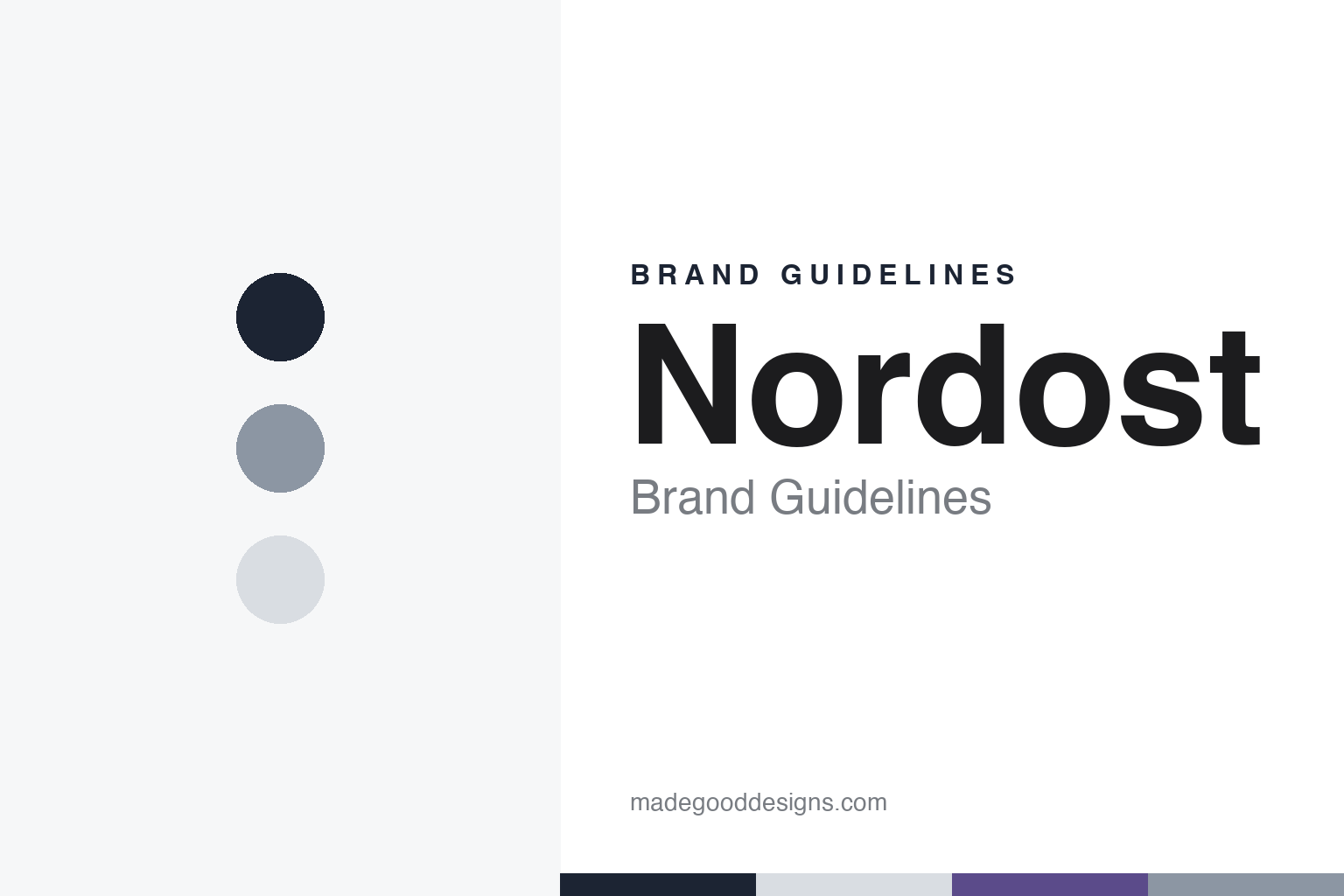
Nordost Brand Guidelines
The Holliston cable maker that started with a flat speaker wire.
Aa
Two constants: a Nordost slate, silver and violet palette and a technical sans register. Abstract homage — not a Nordost product or mark; no cable, logo or packaging is reproduced.
Flatline
A flat speaker cable from Massachusetts.
Nordost was founded in Massachusetts in 1991. English Wikipedia names its founders as Joe Reynolds, Vincent Garino and Jeffrey Garino, although that line carries no citation of its own; Stereophile called Reynolds “Nordost’s founder” in 2018, and Enjoy the Music described him as the company’s president in a 2011 interview. Its address, given by both publications, is 93 Bartzak Drive in Holliston, a town west of Boston.
One name is often attached to Nordost’s story and should be handled carefully. Lars Kristensen was, in the words of SoundStage! in 2013, “for many years … the international face of the US cable company Nordost,” and is one of the two men behind the Danish loudspeaker maker Raidho. We found no source that names him as a founder of Nordost, so we do not describe him as one.
The company’s first well-known product was Flatline, a speaker cable as flat as a ribbon. Writing in Stereophile in December 2018, Art Dudley recalled reviewing Flatline and SuperFlatline in the Spring 1996 issue of Listener, when Nordost was “then-newish.” Flatline, he wrote, used four flat copper conductors per run, separated by clear Teflon pressed flat; SuperFlatline doubled that to sixteen conductors per channel. The shape had a practical side that dealers still mention: a cable that thin could be run under a carpet.
Nordost discontinued both Flatline models in 2009, Dudley reported. In the summer of 2018 Reynolds brought him a new SuperFlatline, reintroduced at $299 for a two-metre pair, against $289 in 2009 and about $200 in 1996, with the original Teflon replaced by a chemically similar fluoropolymer, FEP. Dudley’s piece is also a reminder that reviewers do not all accept the industry’s claims about cables: he wrote that he had become “increasingly skeptical” that audio cables need running in, and that of the technical explanations he had heard, “none have convinced.”
Colour
FEP, filaments and Norse gods.
Nordost’s products are built around one material. All of its cables use FEP, a flexible fluoropolymer insulation originally developed by DuPont, English Wikipedia says. The company describes a patented process it calls Micro and Dual Mono-Filament: each conductor is wound with a fine spiral of FEP filament before an outer FEP sleeve is extruded over it, so that, Nordost says, the conductor sits in what is mostly air. The company says this increases signal speed and improves mechanical damping. Those are its claims; we have not seen independent measurements that test them, and this guide takes no position on how cables sound.
The product names are the most consistent part of the brand. Above the entry-level Leif family — White Lightning, Blue Heaven, Red Dawn and Purple Flare — sit the Norse 2 cables, named Heimdall, Frey and Tyr; the Reference range, Valhalla 2; and the Supreme Reference range, Odin. The names are taken from Norse mythology, and the word “Nordost” itself means “northeast” in German and in the Scandinavian languages, though we found no statement from the company on why it chose it. Its own connectors are sold as HOLO:PLUG.
Reynolds described how the range was rebuilt in the 2011 Enjoy the Music interview. The Leif family, launched as a complete line in January 2010, replaced an earlier range that he called “very confusing” and “ill conceived.” He also explained the company’s move into power and accessories. QRT, short for Quantum Resonance Technology, makes power purifiers and distribution blocks; its products were first built in California, he said, before production moved to the Boston area, and QRT became a Nordost subsidiary sold under Nordost’s name. An earlier Nordost power block, the Thor, had been made for it by the British company IsoTek, he said. A plug-in device, the QVibe, was introduced at the Munich show in May 2011 at about $399.
The company now also sells Sort Systems resonance-control devices, grounding products and cables for USB, Ethernet and HDMI. In that interview Reynolds said Nordost had worked with Vertex AQ and a defence contractor on measuring the effect of power cords and supports, and that “it is not voodoo any more”; that is the company’s account, and we have not seen the method tested independently.
Typography
Cables and claims.
High-end cables became a product category of their own in the United States at the end of the 1970s. English Wikipedia dates Monster Cable, founded by Noel Lee, to 1979, and says it grew by demonstrating to the trade that cables made a difference to sound. AudioQuest says its founder, Bill Low, began making custom cables in 1978 and founded the company in 1980.
The cable trade grew up alongside the amplifier makers. In the early 1980s Spectral, the Silicon Valley amplifier maker, worked with Bruce Brisson’s Music Interface Technologies on cables for its amplifiers, Spectral says, and in 1999 The Absolute Sound reported that a Spectral instruction book “mandates the use of MIT cables” to keep its wide-bandwidth circuits stable.
Whether cables sound different has long been argued. English Wikipedia calls the effect of speaker wire on the signal “a much-debated topic,” notes that engineers stress electrical resistance as the property that matters most, and records that tests by Stereo Review in 1983 found Monster’s cable “indistinguishable” from 16-gauge lamp cord. Magazines such as Stereophile and The Absolute Sound still review cables by listening. This guide does not settle the question; it records what each company says.
The seven companies here are spread across the country: Nordost in Holliston, Massachusetts; Transparent Audio in Saco, Maine; AudioQuest in Irvine, California; MIT Cables, long based in Rocklin and later Auburn, California, which said on its website in 2026 that it was no longer operating; Spectral in Santa Clara, California; Cardas Audio in Bandon, Oregon; and Shunyata Research in Poulsbo, Washington, according to their own websites and published listings.
This guide sets out what can be checked about each brand — who founded it, who owns it, and what it says about where its products are made — and marks clearly what rests only on the company’s own word.
Aa
A technical sans for a company of extruded wire. (Specimen set in Saira, a sans STAND-IN; NOT the Nordost logo.)
Nordost
Made in Massachusetts, the company says.
Where its products are made is central to how Nordost presents itself. In a company blog post in April 2014, Reynolds wrote that “since its inception in 1991, Nordost’s products have been designed, manufactured and assembled exclusively in the United States,” and that its processes and products are “developed and constructed right here in Massachusetts.” Its website today calls Nordost “one of the few audio cable manufacturers” to design, engineer and assemble its products in the USA. In 2011 Reynolds told Enjoy the Music that the company was about to move into a new factory, that circuit boards for its power products were built in house, and that its Sort cones were made in house too. English Wikipedia also says Nordost products are made in the USA, citing the British magazine Hi-Fi+.
In 2014 Nordost announced what it called the first American-made high-speed HDMI cable, a claim reported under that headline by The Absolute Sound. English Wikipedia says the company sells in 72 countries.
Nordost’s ownership looks simple from the outside. The sources we checked report no sale or outside investor, and Reynolds was still visiting reviewers on its behalf in 2018, Stereophile reported; we have not seen its corporate filings, so we describe it only as a Holliston company that has kept its name since 1991. Reviews of its cables appear widely in the trade press — Stereophile, The Absolute Sound, Hi-Fi+ and StereoNET among them — and the company quotes them at length on its own site, as cable makers generally do.
For a design guide, Nordost shows how a cable brand can build an identity from its names and its materials: a flat cable, a single insulation, and a family of Norse gods ranked from Leif to Odin. Compare AudioQuest, the Californian cable maker, and Crystal Cable. For this guide we use slate, silver and a violet with a sans, an unofficial interpretation; no product or logo is reproduced.
Explore & save
Keep Nordost’s identity on hand — save it to a board in the Made Good inspiration library.
Nordost identity set
Pin the Nordost slate, silver and violet palette and the technical sans register to your own board.