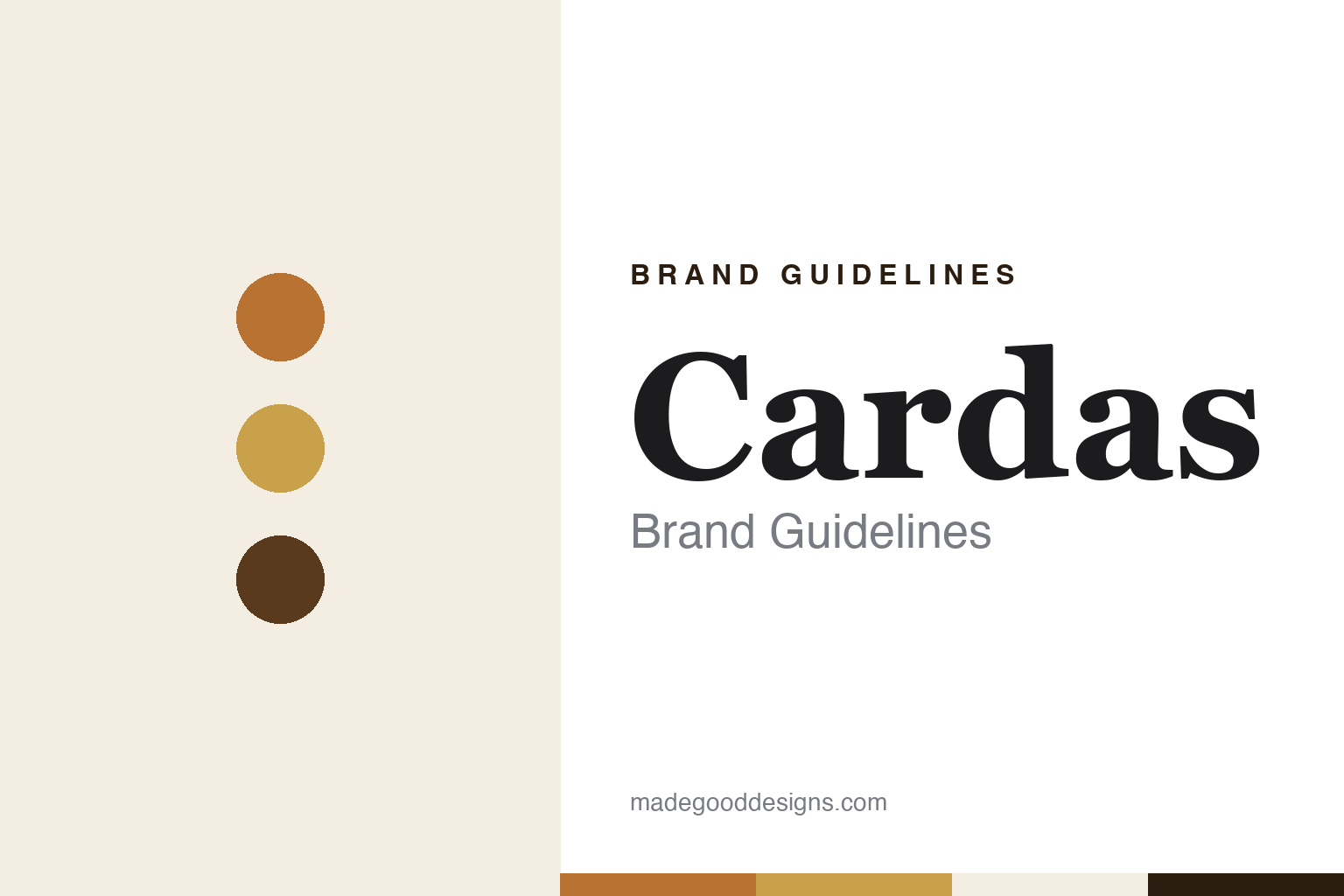
Cardas Brand Guidelines
The golden-ratio cable maker of Bandon, Oregon.
Aa
Two constants: a Cardas copper and gold palette and a Classical serif register. Abstract homage — not a Cardas product or mark; no cable, connector, logo or nameplate is reproduced.
The telephone engineer
From racing engines to cable strands.
Cardas Audio was founded in 1987 in Ontario, California, by George Cardas, the company says. Its own history describes him as a former line engineer with the telephone company, a career that gave him a working knowledge of how signals behave over long runs of cable; hi-fi+, which visited the company in 2019, and SoundStage!, reviewing its cables in 2010, both repeat the telecommunications background.
The idea at the centre of the brand is older than the company. In a 1996 interview with the webzine TNT-Audio, Cardas said he had already used the Golden Ratio “in race car port timing, exhaust systems, track width, weight distribution etc.,” and that he “first assembled the machinery to strand in Golden Ratio back in 1983.” The company’s website adds that he and his machinist, Mike Colver, had applied the same proportions to engine and exhaust design. The company describes the result as a conductor in which the smallest strands sit at the centre and each layer of wire is a Golden Ratio step — 1 to 1.618 — larger than the layer beneath it. It presents this as a way of controlling resonance in the conductor; we give that as the company’s explanation, not as a tested finding.
The idea is also on the public record. United States patent 4,628,151, “Multi-strand conductor cable having its strands sized according to the golden section,” names George F. Cardas as inventor; Google Patents shows it filed on 30 December 1985 and granted on 9 December 1986, to him as an individual — before the company’s stated founding year. A second patent, 4,980,517, for a multi-strand electrical cable, was filed in 1989 and granted on Christmas Day 1990.
In the same 1996 interview Cardas said his cables used “extremely soft and pure copper and a combination Teflon and air dielectric for everything,” and that he was working on connectors and on recordings of big-band music — early signs of the connector and music sides of the business that hi-fi+ would later list among its products.
Colour
Bandon, Oregon.
In 1992 the company moved north to Bandon, a small town on the southern Oregon coast, where it has stayed. One dealer account, published by the retailer Upscale Audio, says the move came when the lease on the California manufacturing space ran out, and that George and Darcy Cardas drove up the West Coast until they stopped in Bandon. The company gives its address as 11th Street SE in the town.
Cardas is more than a cable brand. Its website lists audio cables, connectors, a “Quad Eutectic” solder and ultra-pure copper and silver strand, and says its wire and connectors are bought by other cable makers and used inside loudspeakers and electronics made by other companies. SoundStage!, reviewing the Clear interconnects and Clear Beyond speaker cables in June 2010, wrote that, unlike many cable companies, Cardas draws its own wire and makes its own connectors, and that it works both as a seller of finished cables and as an original-equipment supplier. At the time a one-metre pair of Clear interconnects cost $1,840 and a 2.5-metre pair of Clear Beyond speaker cables $8,668, the magazine reported.
The product names trace the company’s development. Golden Reference, whose power cord Stereophile’s Art Dudley wrote about in 2006, came first; Clear, on sale by the time of the 2010 reviews, added what the company calls Matched Propagation, the subject of a third patent, 7,674,973, granted to George Cardas on 9 March 2010. The rest of the construction vocabulary — Golden Section Stranding, Crossfield, Perfect Mirror — is the company’s own, and so are the claims attached to it. Stereophile listed the Clear cables among its Recommended Components in 2014.
Typography
Cables, power and the record.
High-end cables became a product category of their own in the United States at the end of the 1970s. English Wikipedia dates Monster Cable, founded by Noel Lee, to 1979, and says it grew by demonstrating to the trade that cables made a difference to sound. AudioQuest says its founder, Bill Low, began making custom cables in 1978 and founded the company in 1980.
The cable trade grew up alongside the amplifier makers. In the early 1980s Spectral, the Silicon Valley amplifier maker, worked with Bruce Brisson’s Music Interface Technologies on cables for its amplifiers, Spectral says, and in 1999 The Absolute Sound reported that a Spectral instruction book “mandates the use of MIT cables” to keep its wide-bandwidth circuits stable.
Whether cables sound different has long been argued. English Wikipedia calls the effect of speaker wire on the signal “a much-debated topic,” notes that engineers stress electrical resistance as the property that matters most, and records that tests by Stereo Review in 1983 found Monster’s cable “indistinguishable” from 16-gauge lamp cord. Magazines such as Stereophile and The Absolute Sound still review cables by listening. This guide does not settle the question; it records what each company says.
The seven companies here are spread across the country: Nordost in Holliston, Massachusetts; Transparent Audio in Saco, Maine; AudioQuest in Irvine, California; MIT Cables, long based in Rocklin and later Auburn, California, which said on its website in 2026 that it was no longer operating; Spectral in Santa Clara, California; Cardas Audio in Bandon, Oregon; and Shunyata Research in Poulsbo, Washington, according to their own websites and published listings.
This guide sets out what can be checked about each brand — who founded it, who owns it, and what it says about where its products are made — and marks clearly what rests only on the company’s own word.
Aa
A classical serif — a nod to the proportion the brand is built on. (Specimen set in Cormorant Garamond, a serif STAND-IN; NOT the Cardas logo.)
Cardas
Still a family company.
Unlike many hi-fi names of its generation, Cardas has not been sold. We found no acquisition or outside investor in the sources we checked, and the company says it is now run by Angela Cardas, George and Darcy Cardas’s youngest daughter, while George remains its head product designer. hi-fi+, which published a profile of the company in December 2020, also describes her as running the business, and counted about fifteen employees at the time of its 2019 visit, some of whom had moved with the company from California.
The company says its cables are terminated by hand at its Bandon factory and that its products are made there; the copper it uses, it says, comes from an American producer working to its specification. We give those as its claims. Besides cables and connectors, Cardas sells in-ear monitors, earbuds and music, hi-fi+ reported, and at the time of that article offered a lifetime warranty on everything except earbuds.
The brand’s identity is unusually tied to a single number. The Golden Ratio is the subject of its first patent, the language of its product descriptions and the centre of the story it tells about its founder — and the name on every product is his own.
For a design guide, Cardas shows how one founder’s idea, and a small-town address, can carry a brand for nearly four decades. Compare AudioQuest, another American cable company, and Nordost. For this guide we use copper, gold and a deep brown with a serif, an unofficial interpretation; no product or logo is reproduced.
Explore & save
Keep Cardas’s identity on hand — save it to a board in the Made Good inspiration library.
Cardas identity set
Pin the Cardas copper and gold palette and the Classical serif register to your own board.