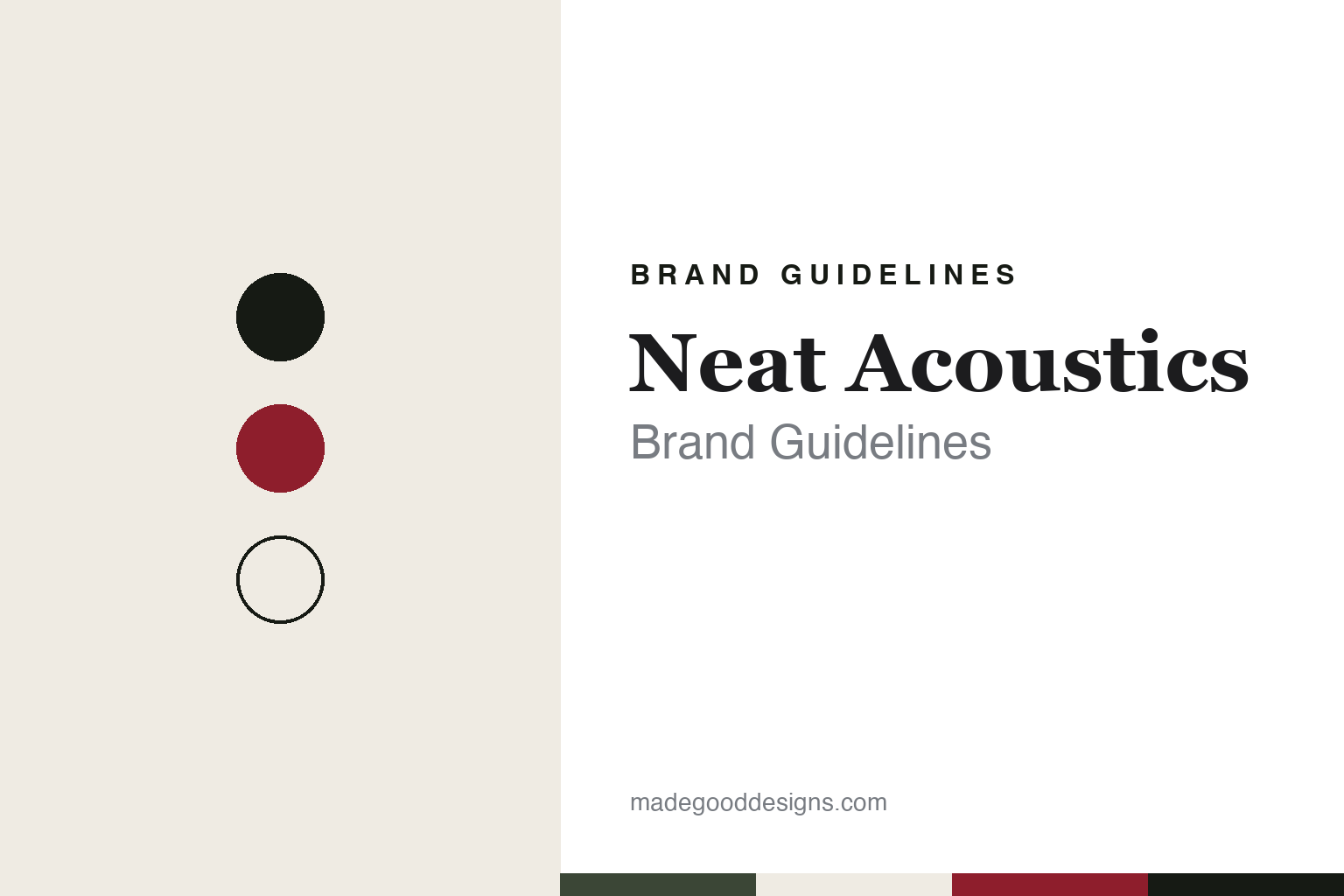
Neat Acoustics Brand Guidelines
The musician’s loudspeaker maker of Teesdale.
Aa
Two constants: a Neat green, oak and ruby palette and a warm book serif register. Abstract homage — not a Neat Acoustics product or mark; no loudspeaker, logo or nameplate is reproduced.
North East Audio Traders
A shop, a musician and a small speaker.
Neat Acoustics began in 1989 as a hi-fi shop, not a factory. Its founder, Bob Surgeoner, was then a full-time musician, Stereophile wrote in 2017, and the name is an acronym: Stereophile spells it out as North East Audio Traders, while a 2022 article by the British retailer Audio T gives it as North Eastern Audio Traders and says the shop was in Darlington, County Durham. The company’s own account says only that it started as “a small hi-fi shop in the North East of England,” and that Surgeoner has been “a performing and recording musician for more than twenty years.”
That matters because the story often told — a speaker company founded in Barnard Castle in 1989 — compresses two stages. The shop came first; the loudspeakers followed. Neat says its first design, the Petite, dates from 1989, went into full production in 1991, and that by 1993 the business had become “a full-time loudspeaker manufacturer.” The town where Neat builds its speakers today, Barnard Castle, is about 15 miles west of Darlington; we did not find a date for the move.
The Petite set the pattern. Audio T says it was voiced through “extensive listening tests as opposed to the more usual measurements emphasis used by most speaker manufacturers,” was criticised for that at first, and then became the company’s launching pad, running through Mk2 and Mk3 versions, an SX range and a Special Edition 30 before the current Petite Classic of 2022. Neat’s website still describes the Petite as the speaker that “proved that true musical scale and depth could come from a modest enclosure.”
Colour
Six people, three workstations and a lot of gigs.
Neat is small and says so. When hi-fi+ editor Alan Sircom visited in May 2017, he found it in Barnard Castle, the Teesdale town “near where the Yorkshire Dales meet the North Pennines,” with “a team of just six in its own factory.” Five of the six were practising musicians, he wrote; Surgeoner himself played folk music, the company ran a recording studio used by local artists and even had its own record label, and part of the workforce left early on the day of his visit to play a gig in Newcastle. The speakers, he reported, were “all hand-assembled at one of three workstations at the centre of the factory.” Stereophile, the same year, also described the speakers as manufactured in Barnard Castle, and said Neat’s biggest markets were Britain, Germany, Austria and Russia.
The company’s method is listening first. “We tend not to work in a theoretical way,” Surgeoner told hi-fi+; “we tend to work intuitively.” Neat’s website says measurements “inform the process, but the final judgement is always made by ear,” and an archived 2019 version said a new design “invariably involves hundreds of hours of listening tests.” The engineering can still be unusual. hi-fi+ noted that the Momentum SX3i standmount hides a second, isobarically loaded mid-bass unit behind the first. The Iota, a speaker so small that What Hi-Fi? counted among the smallest hi-fi speakers it had ever encountered, grew into the Iota Alpha, a floorstander about 19 inches tall that, Stereophile reported, pairs a planar-magnetic tweeter and a small midrange on a sloping top panel with a woofer firing at the floor. Sircom wrote that it came about because Surgeoner wanted a speaker for his own small living room.
The reception has been warm. Stereophile called the Iota Alpha “a freak — a heroic-sounding speaker that looks like it shouldn’t, an overachieving mighty mite.” In February 2025 What Hi-Fi? reported that Neat had shown a successor, the Iota II, at the Bristol Hi-Fi Show, at £1,095 a pair, against the £650 the original cost when the magazine tested it in 2012.
Typography
British loudspeakers and turntables.
Britain’s loudspeaker tradition owes much to the BBC. The LS3/5A, a small monitor for outside-broadcast vans, was developed by the BBC Research Department at Kingswood Warren, and the BBC licensed a handful of British firms that began making it in 1975, English Wikipedia says; sales estimates run from 60,000 to 100,000 pairs.
That licensing model survives: Graham Audio says it hand-builds BBC-licensed models, including the LS3/5 and LS5/9. PMC was formed by Peter Thomas, formerly of the BBC, and Adrian Loader, and sold its first BB5 monitors to the BBC and Metropolis Studios; ATC, founded by Billy Woodman in 1974, counts Abbey Road Studios and the BBC among its users, English Wikipedia says.
Smaller regional makers grew alongside. Castle was started in Skipton in 1973 by engineers from Wharfedale, the company says, and Michell Engineering, the turntable maker founded by John Michell, worked from Borehamwood from 1968 until it moved to Stevenage in 2019, SoundStage! reported.
Ownership is not always British. Castle has belonged since 2007 to IAG, a Chinese group based in Shenzhen, and Epos, founded in 1983 by Robin Marshall, says it was bought in 2020 by the loudspeaker designer Karl-Heinz Fink; its website gives an address in Essen, Germany.
The others are spread across England: PMC at Biggleswade in Bedfordshire, ATC near Stroud in Gloucestershire, Neat Acoustics at Barnard Castle in County Durham, Graham Audio at Newton Abbot in Devon, and Castle, today, at IAG’s address in Huntingdon.
This guide sets out what can be checked about each brand — who founded it, who owns it, and what it says about where its products are made — and marks clearly what rests only on the company’s own word.
Aa
A warm book serif — “built by hand in England.” (Specimen set in Fraunces, a serif STAND-IN; NOT the Neat Acoustics logo.)
Neat Acoustics
Built by hand in England, it says.
Neat has been a private company throughout. Companies House records a company named Neat Acoustics Limited incorporated in January 1996, with Surgeoner as a director from February 1996 and, on its register of people with significant control, as the holder of more than half the shares. Its registered office is the same unit on the Harmire Enterprise Park in Barnard Castle that the brand’s website gives as its address today.
The register also shows a change in 2025 that we could not explain from public sources. On 22 September 2025 that 1996 company changed its name to Infinite Sounds Limited, and on the same day a separate company, incorporated in September 2024 with a registered office in Crewe, Cheshire, took the name Neat Acoustics Limited; both are registered as manufacturers of consumer electronics. We found no announcement or press report of a sale or restructuring, so we record the filings and draw no conclusion from them.
What the brand says about itself is consistent: its loudspeakers are “designed and built in England” and “built by hand in England, tuned by musicians.” Its current website lists four families — the Iota models, a Classic range of Petite, Mystique and Elite, the Strata floorstanders that began with the slim Ekstra, and the Momentum range — in real-wood veneers and finishes including a gloss Ruby Flame. The longer-running Motive and Ultimatum names that the company listed in 2019 do not appear in the current range.
For a design guide, Neat Acoustics shows a brand built around a person and a practice — a musician’s ear and a small hand-built cabinet — rather than a look. Compare Epos, another British speaker brand born from a minimal, listening-led idea, and Rega, an English hi-fi maker sold through the same specialist shops. For this guide we use Teesdale green, natural oak and a ruby red with a serif, an unofficial interpretation; no product or logo is reproduced.
Explore & save
Keep Neat Acoustics’s identity on hand — save it to a board in the Made Good inspiration library.
Neat Acoustics identity set
Pin the Neat green, oak and ruby palette and the warm book serif register to your own board.