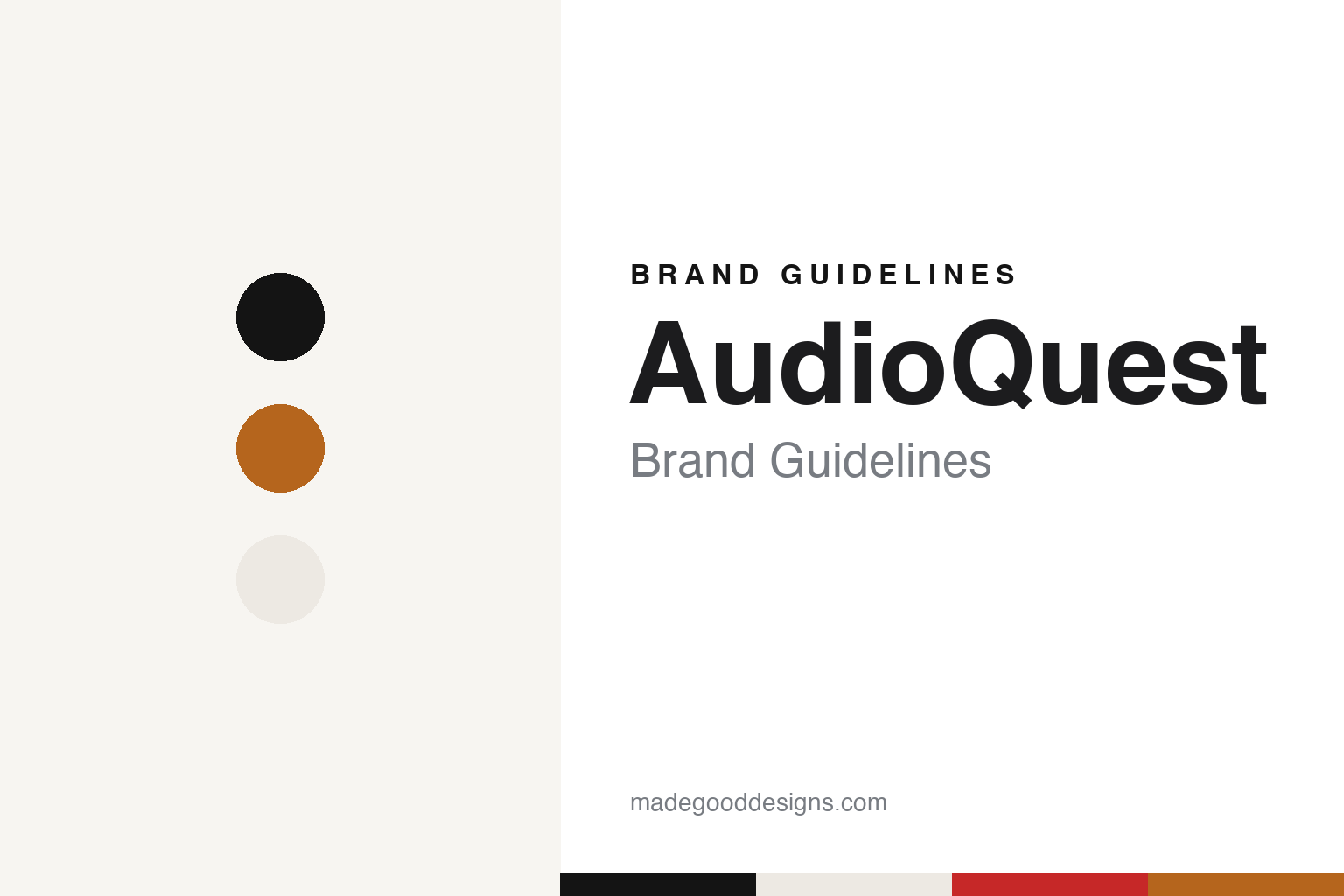
AudioQuest Brand Guidelines
Bill Low’s cable company, from a Santa Monica apartment to Irvine.
Aa
Two constants: an AudioQuest black, red and copper palette and an American grotesque register. Abstract homage — not an AudioQuest product or mark; no cable, logo or packaging is reproduced.
Encore Audio
An appointment-only shop and two speaker cables.
AudioQuest was founded in 1980 by William E. “Bill” Low, and is based today in Irvine, California. The company’s own timeline says that in 1978 Low began making custom audio cables for “his new one-man hi-fi shop,” and that two years later he founded AudioQuest to make cables “for the rest of the world.”
The longer version comes from the trade press. The German magazine Fidelity, in a profile written around 2015, says Low first sold hi-fi by appointment from his apartment in Oregon, under the name Executive Audio, moved to California in 1976, and about a year later started another appointment-only business, Encore Audio, from an apartment in Santa Monica, adding speciality cable to what he sold. Sandy Gross, the co-founder of Polk Audio, remembered the Oregon years in 2020, recalling that Low “had a small high-end audio store in Portland, Oregon.” Some retailer histories place the original shop in Irvine; the sources above put it in Santa Monica, and the company moved to Irvine later.
Low gave the details himself in a 2016 interview with SoundStage! Ultra. The shop was in “apartment 607” of a Santa Monica high-rise, and then 706; in 1980 he moved to Pacific Palisades. The first products were two speaker cables, followed by interconnects. Joe Harley, a customer who came to buy a record mat, began assembling cable at home in the evenings and later became a senior executive. “My original plan was simply just wanting to be self-employed,” Low said.
By the end of 1980, Fidelity reports, 42 shops in Southern California and one in Texas were selling his cables, and by the following year they were sold in Europe and Asia. The company stayed in Low’s apartment until 1985, when it moved to San Clemente, and later to Irvine. In the early 1980s AudioQuest also sold phono cartridges: the company dates them to 1982 and its AQ-404 moving-coil model, while Low told SoundStage! Ultra they came in 1983 and made up half the business in 1984 and 1985.
Colour
From speaker wire to HDMI and DragonFly.
AudioQuest grew from a hi-fi cable company into a much broader one. Its timeline lists a patented “HyperLitz” construction in 1988, video cables in 1989, a record label, AudioQuest Music, in 1990, its patented Dielectric-Bias System in 2004 and its first HDMI cables in 2005. Low told SoundStage! Ultra that only with HDMI did video exceed half of the company’s cable business, much of it sold as “attachment” cable alongside new televisions. “We are a tail being wagged by a much bigger dog,” he said.
The product that brought it the most attention outside the cable world was the DragonFly, a USB digital-to-analogue converter and headphone amplifier the size of a memory stick, launched in 2012 and designed by Gordon Rankin. Stereophile named it both its 2012 Computer Audio Component of the Year and its Budget Component of the Year. Later versions — Black, Red, Cobalt and Copper — followed. AudioQuest entered headphones with the NightHawk, designed by Skylar Gray and shown at CES in January 2015, which the company announced as a CES Innovation Awards honoree, and added the NightOwl. In 2015 it also launched the Niagara power conditioners.
Cable names give the brand its voice: digital cables called Vodka, Cinnamon, Carbon and Diamond, analogue cables named after places such as Yosemite, Big Sur and Golden Gate, and a top “Mythical Creatures” range with Dragon, FireBird and ThunderBird. The company sums up its approach as “Do No Harm.”
AudioQuest’s technical claims are where it meets the most criticism. The company says drawn conductors have a “fish-scale-like grain structure” that makes them directional, and that it tests every conductor so it is used in the right direction. English Wikipedia notes that this claim, applied to Ethernet cable, goes against the IEEE 802.3 Ethernet standard. In 2015 Ars Technica took two of AudioQuest’s $340 Vodka Ethernet cables to The Amazing Meeting in Las Vegas, an event of the James Randi Educational Foundation, where listeners in a blind test were unable to tell one apart from a $2.50 cable. Kurt Denke of Blue Jeans Cable then measured the Vodka for Ars in July 2015 and found it passed the Category 6a patch-cord standard only “within the tester’s margin of error,” mainly because of near-end crosstalk; he noted he could not test to the Category 7 rating on its label. That was one sample in one test, and AudioQuest’s website still describes its conductors as directional.
Typography
Cables and claims.
High-end cables became a product category of their own in the United States at the end of the 1970s. English Wikipedia dates Monster Cable, founded by Noel Lee, to 1979, and says it grew by demonstrating to the trade that cables made a difference to sound. AudioQuest says its founder, Bill Low, began making custom cables in 1978 and founded the company in 1980.
The cable trade grew up alongside the amplifier makers. In the early 1980s Spectral, the Silicon Valley amplifier maker, worked with Bruce Brisson’s Music Interface Technologies on cables for its amplifiers, Spectral says, and in 1999 The Absolute Sound reported that a Spectral instruction book “mandates the use of MIT cables” to keep its wide-bandwidth circuits stable.
Whether cables sound different has long been argued. English Wikipedia calls the effect of speaker wire on the signal “a much-debated topic,” notes that engineers stress electrical resistance as the property that matters most, and records that tests by Stereo Review in 1983 found Monster’s cable “indistinguishable” from 16-gauge lamp cord. Magazines such as Stereophile and The Absolute Sound still review cables by listening. This guide does not settle the question; it records what each company says.
The seven companies here are spread across the country: Nordost in Holliston, Massachusetts; Transparent Audio in Saco, Maine; AudioQuest in Irvine, California; MIT Cables, long based in Rocklin and later Auburn, California, which said on its website in 2026 that it was no longer operating; Spectral in Santa Clara, California; Cardas Audio in Bandon, Oregon; and Shunyata Research in Poulsbo, Washington, according to their own websites and published listings.
This guide sets out what can be checked about each brand — who founded it, who owns it, and what it says about where its products are made — and marks clearly what rests only on the company’s own word.
Aa
An American grotesque for a Southern California company. (Specimen set in Libre Franklin, a sans STAND-IN; NOT the AudioQuest logo.)
AudioQuest
Owned by its founder.
AudioQuest is still controlled by the man who started it. When it agreed to buy the loudspeaker maker GoldenEar Technology in January 2020, audioXpress described the buyer, The Quest Group, as “a California corporation wholly owned by AudioQuest founder and CEO Bill Low,” and as the owner of the AudioQuest cables, Niagara power products and DragonFly DACs. “I am acquiring GoldenEar Technology because nothing is broken and nothing needs to be fixed,” Low said.
Where AudioQuest’s products are made involves more than one country. The site describes it as a “developer, manufacturer, and distributor” headquartered in Irvine, and a company post from 2023 shows a manufacturing facility there. Fidelity reports that the company opened its first subsidiary outside the US, in Europe, in 2009, with warehousing, support and part of its cable-making, and a Hong Kong office the same year; a 2020 factory-tour post by the French retailer Son-Vidéo places the European workshop at Roosendaal in the Netherlands, where reels of cable are cut and assembled. The same Fidelity profile says components designed in California are made by suppliers in the United States, Europe, Taiwan and China. English Wikipedia says the company distributes to about 65 countries; Fidelity gives about 70.
English Wikipedia’s article on AudioQuest has carried a warning that it reads like an advertisement since December 2015, so we have used it only for facts it attributes to named sources.
For a design guide, AudioQuest shows how a cable company can build a brand from a founder’s voice and memorable names, from Vodka to DragonFly. Compare Nordost, the Massachusetts cable maker, and Cardas. For this guide we use black, red and copper with a sans, an unofficial interpretation; no product or logo is reproduced.
Explore & save
Keep AudioQuest’s identity on hand — save it to a board in the Made Good inspiration library.
AudioQuest identity set
Pin the AudioQuest black, red and copper palette and the American grotesque register to your own board.