Dual Brand Guidelines
The Black Forest turntable maker that became a licensed name.
Aa
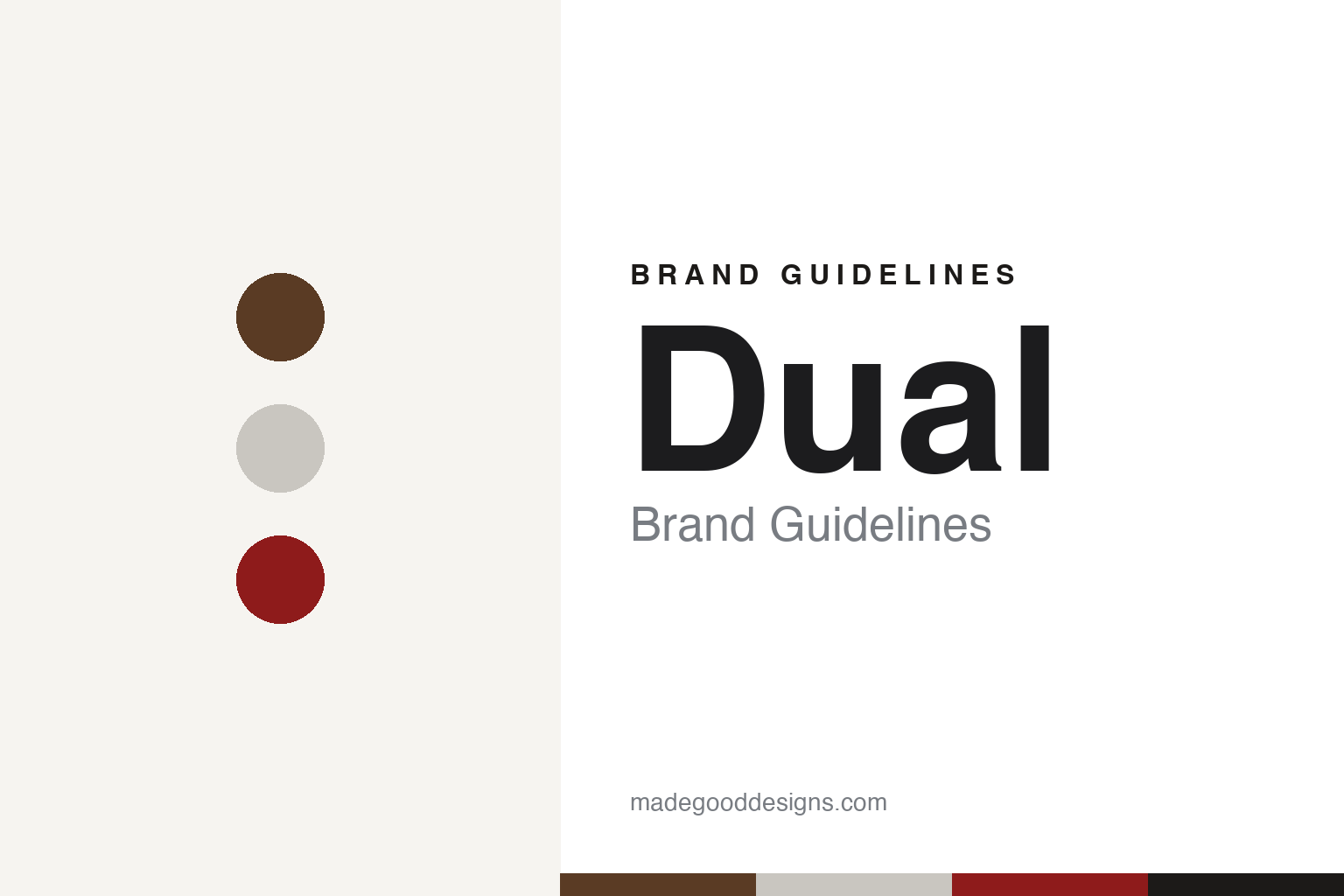
Two constants: a walnut, silver and red palette and an engineered sans register. Abstract homage — not a Dual product or mark; no turntable, logo or nameplate is reproduced.
Gebrüder Steidinger
Two brothers, a clock-parts workshop and a spring motor.
Dual’s story starts in St. Georgen im Schwarzwald, a clockmaking town in the Black Forest. Around 1900 Christian Steidinger (1873–1937) began making small clock parts in a workshop there, and his elder brother Josef (1867–1925) set up at the same time in the basement of a local inn, German Wikipedia says, citing the Südkurier. The often-repeated “1900” is therefore the start of the workshops, not of the company: on 1 February 1907 the brothers founded Gebrüder Steidinger – Fabrik für Feinmechanik, which made watchmakers’ tools and, from the start, spring-driven gramophones, with about 25 staff at first.
The partnership was short. Josef left in 1911 or 1912 — German Wikipedia gives both years — and founded his own firm, Perpetuum, a few streets away; it later became Perpetuum-Ebner. In 1927 Christian presented a combined spring and electric motor called the “Dual”, and the name later passed to the company. From 1933 his sons ran the business, and from the mid-1930s it concentrated on the new electric record players.
Colour
The record changer that filled German living rooms.
After the Second World War Dual made record changers, first for shellac discs and, from the early 1950s, for the new microgroove records, followed by portable “phono cases” with a built-in amplifier and speaker. It added plants in Meßkirch in 1956, nearby Mönchweiler in 1958 and a fourth in St. Georgen in 1964. German Wikipedia credits the Dual 1009 of the early 1960s as the first fully hi-fi-capable record changer made in Germany and says the company became the country’s largest maker of record players; until the late 1970s its decks also went into consoles and compact systems sold under names including Grundig, SABA and Wega.
In the early 1970s Dual absorbed Perpetuum-Ebner, the rival Josef Steidinger had founded — German Wikipedia dates the takeover to 1971 in one place and to the turn of 1972–73 in another — and broadened into tuners, amplifiers, cassette decks and loudspeakers. Around its 75th anniversary it employed about 3,500 people, a figure German Wikipedia attributes to the Frankfurter Allgemeine and the Südwest Presse. Its head, Edgar Steidinger, is quoted as saying the firm made everything itself, “from the spacer bolt to the plastic part.”
That make-everything model proved costly once Japanese brands arrived. After American customers and Grundig cancelled supply contracts in 1979, sales fell sharply; the banks installed a former Thomson-Brandt manager as restructuring chief in April 1981, and on 26 November 1981 Dual stopped all payments, German Wikipedia says. Der Spiegel reported on 6 December 1981 that the Black Forest firm, “the third-largest turntable maker in the world,” was bankrupt. About 700 of 1,800 jobs in St. Georgen were lost, German Wikipedia says, while the factory land and buildings, held in a separate property company set up in 1972, stayed with the Steidinger family.
The scale had been considerable: German Wikipedia puts the workforce in 1977 at 3,800 across nine plants, two of them in France and Spain, and says large customers such as Grundig, ITT and Schneider still took about a third of output.
Typography
Design and documentation.
In the decades after the Second World War, Europe’s radio, television and hi-fi makers were household names. By the 1970s several were losing money. Norwegian Wikipedia says Tandberg faced strong competition from Japanese and other Asian producers and made losses from 1976; German Wikipedia ties Dual’s decline to Japanese competition, and English Wikipedia describes Far East competition in Lenco’s.
Some names were absorbed by larger groups. The French Thomson group took over SABA in 1980, after GTE left consumer electronics, then Dual in 1982 and Telefunken’s television and radio business in 1983–84. Philips took a 31.6 per cent stake in Grundig, with management control, in 1984.
Others failed. Lenco went bankrupt at the end of the 1970s, Tandberg in December 1978 and Dual in 1981; Grundig filed for insolvency in April 2003. Studer, a maker of studio equipment, took another path: Willi Studer sold it in 1990, and it passed to Harman in 1994.
Many of the names lived on as brands rather than factories. Grundig belongs to Turkey’s Arçelik; the Telefunken brand, licensed through Telefunken Licenses GmbH in Frankfurt, was bought by Gordon Brothers in 2023; SABA is a licensing brand of Talisman Brands; the Dual name in Europe belongs to Dual GmbH of Fuchstal, in Bavaria; Lenco to the Dutch Commaxx group; Studer to Canada’s Evertz; and the Tandberg video-conferencing company to Cisco.
This guide sets out what can be checked about each brand — who founded it, who owns it, and what it says about where its products are made — and marks clearly what rests only on the company’s own word.
Aa
An engineered sans for a precision-mechanics maker. (Specimen set in Archivo, a sans STAND-IN; NOT the Dual logo.)
Dual
A Black Forest name, now run from Bavaria.
In 1982 the French Thomson group, which also held Telefunken, SABA and Nordmende, took Dual over; German Wikipedia says only 650 of the remaining 2,000 jobs survived. In 1988 it passed to Schneider Rundfunkwerke, which kept only turntable production in St. Georgen until the site was given up in 1993; a local firm, Alfred Fehrenbacher GmbH, then took over the turntable line. Under Schneider the other Dual-branded tuners, amplifiers and cassette decks came from suppliers including Rotel and Inkel, German Wikipedia says. In 1994 Schneider sold the brand to the department-store group Karstadt, keeping the rights for analogue turntables; Karstadt sold a retro-styled Dual range without turntables through its stores from 1995–96, which German Wikipedia says had little success. In 2004 KarstadtQuelle sold the European rights to Linmark Electronics, while the rights for Asia-Pacific and North America went to Namsung of South Korea — the origin of the separate Dual Electronics in Florida. After Linmark’s insolvency in 2009, the European rights went to what is now Dual GmbH of Fuchstal, near Landsberg am Lech in Bavaria, which traded as DGC until 2019.
Dual GmbH filed for insolvency on 15 November 2022. In March 2023 STEREO reported that an investor group led by its managing director, Josef Zellner, had bought the business, kept all staff and planned to focus on turntables and DAB+ radios. Most new Dual turntables are “designed in Germany” and made in China by the Taiwanese specialist Hanpin, hifitest.de reported in December 2023; German Wikipedia says the flagship Primus Maximus is built individually in Germany, which we could not confirm independently. The St. Georgen line continues under another name: in September 2021 LowBeats reported that Fehrenbacher, which did not own the Dual trademark, would build the former Dual models for Audio Tuning, the Vienna company behind Pro-Ject, as Rekkord.
For a design guide, Dual shows how a component maker’s name can be split by region, licensed and rebuilt. Compare Thorens, another long-lived turntable name, and SABA, its Black Forest neighbour. For this guide we use walnut, brushed silver and a signal red with a sans, an unofficial interpretation; no product or logo is reproduced.
Explore & save
Keep Dual’s identity on hand — save it to a board in the Made Good inspiration library.
Dual identity set
Pin the Dual walnut, silver and red palette and the engineered sans register to your own board.