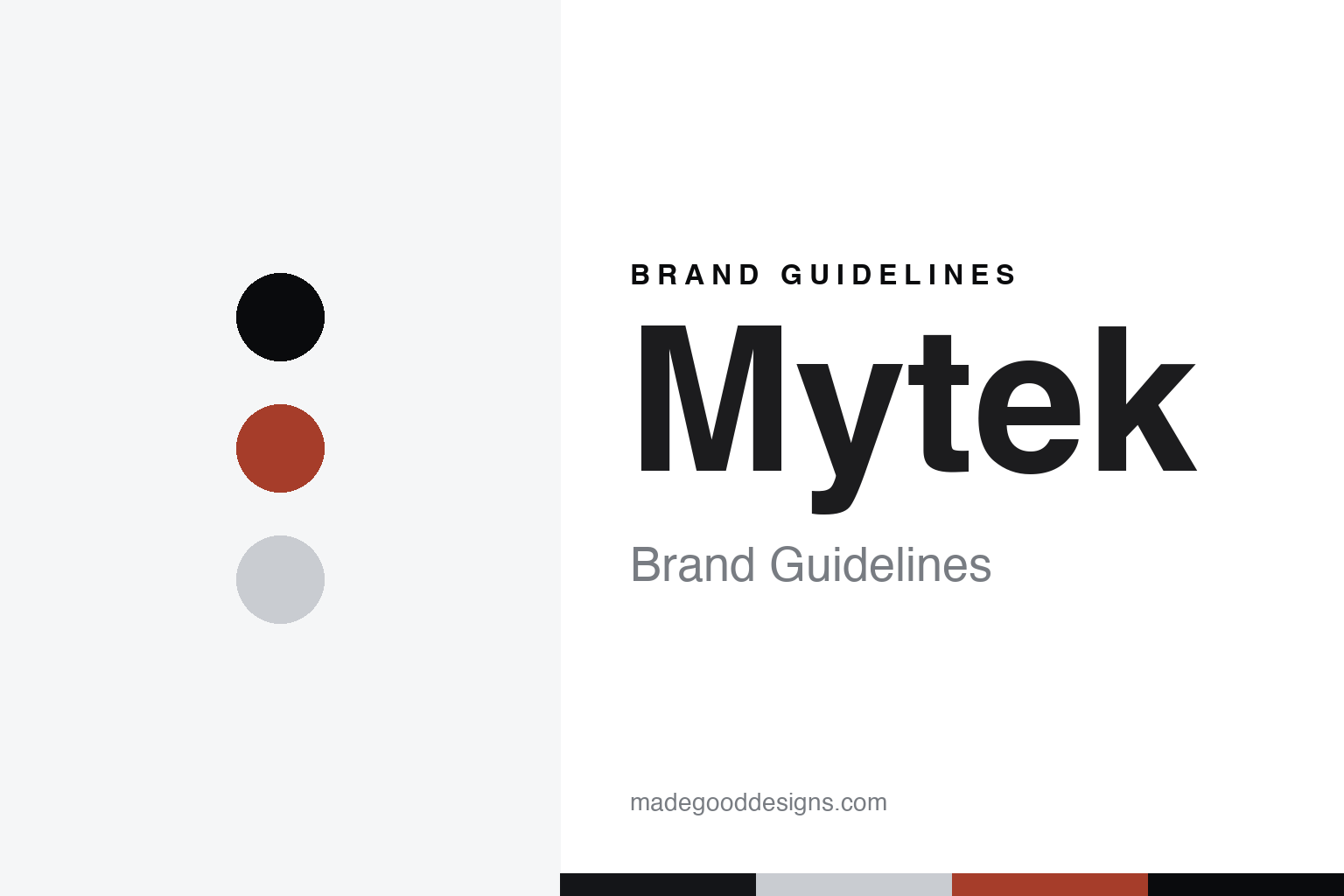
Mytek Brand Guidelines
The New York studio-converter maker that builds in Poland.
Aa
Two constants: a Mytek black, aluminium and brick palette and an engineered sans register. Abstract homage — not a Mytek product or mark; no product, logo or nameplate is reproduced.
From Skyline Studios
A Warsaw-trained engineer in New York’s studios.
Mytek is an American company with Polish roots. It was founded in New York City in 1992 by Michal Jurewicz, an electrical engineer trained at the Warsaw University of Technology, who is still named as its founder and chief designer in the company’s press releases. Its name has shifted over the years — Mytek Digital in its early hi-fi years, Mytek HiFi on some product names, and today Mytek Audio — but in the sources we checked the business has stayed with its founder.
The story starts in recording studios. Jurewicz began working at Manhattan’s Hit Factory in 1989, the company says, when records were still made on analogue tape, and built a reputation for repairing equipment other technicians could not handle. That took him to Skyline Studios as its technical engineer — a studio the company associates with the producer Nile Rodgers and with artists including Mariah Carey and James Taylor. There, it says, he developed tools to improve the workflow and sound of the new digital systems, and Mytek grew out of that work. audioXpress summarised the same path in 2023: a former tech engineer at the Hit Factory and Skyline who founded the company after developing studio headphone-monitoring systems and analogue-to-digital converters.
Those first products were professional tools. The company says its Private Q headphone-monitoring system became a fixture in New York studios and that its early converters avoided the harsh sound of much 1990s digital recording; we report both as its claims. It also says it took part in the “DSD Super Audio CD Project,” working with Sony on Direct Stream Digital recording, and later helped develop mastering and playback for MQA. On its investor page it lists a USB-capable DSD converter in 2009 and a third-party MQA converter in 2015 among its firsts, which we have not checked against other makers.
Colour
Designed in New York, built in Poland.
The Polish side of Mytek grew out of a partnership. In a 2015 interview with the Polish site infoaudio.pl, Marcin Hamerla, owner of HEM Electronics, said he had met Jurewicz in 1998 and that, step by step — because production costs were lower in Poland and because of the team’s skills — much of the company’s work had moved there. He called HEM Mytek’s sister company: the two men drew up each design together, it was developed further in Poland under Jurewicz’s eye, with Jurewicz responsible especially for the analogue circuits, and complete devices were built in Poland, with cases ordered locally and transformers from the Polish maker Toroidy.pl.
By then Mytek had moved firmly into home audio. Its Manhattan and Brooklyn digital-to-analogue converters, named after districts of the company’s home city, were being made in Poland, infoaudio.pl reported. The journalist John Darko, who visited HEM in Pruszków, about 20 kilometres outside Warsaw, in late 2019, put the arrangement in one line: Mytek gear was designed in Brooklyn but made in Poland. He described a firm of just over twenty people handling assembly and software, with circuit boards wave-soldered elsewhere in Poland, then assembled, loaded with firmware and burned in for 24 hours before shipping.
That relationship ended in 2020. In a release dated January 15, 2021, Mytek said production had shifted the previous summer to “the new larger factory in Poland,” a change “originally prompted by a loss of confidence in previous manufacturer and EU distributor, HEM Electronics,” and that HEM was no longer representing the company. audioXpress later wrote that the original factory had decided to launch its own brand and compete with its former client. Mytek set up its own European branch, Mytek Europe, in Warsaw, which became its EU distributor from November 1, 2020. The release did not name the new factory, and we have not identified it.
Typography
Central European hi-fi.
Central Europe’s audio industry has a long state-era record. In Poland, Unitra, the association of consumer-electronics makers, was set up in 1961 and kept its original structure until 1989, English Wikipedia says; the Tonsil loudspeaker works in Września, founded in 1945, ran as a state enterprise until 1990, according to Polish Wikipedia. In Czechoslovakia, Tesla was the state conglomerate that monopolised electronic appliances and components from 1946 until its privatisation in 1991.
The region has since become a workshop for Western brands as well as its own. Pro-Ject, founded in 1991 in Mistelbach, Austria, designs at home and makes its products in Germany, the Czech Republic and Slovakia, English Wikipedia says; the German magazine lowbeats reported after a factory visit that Canor’s plant in Prešov makes all of Pro-Ject’s electronic components, and those of IsoTek and Musical Fidelity.
The trade meets in Warsaw, where the Audio Video Show holds its 28th edition in October 2026; its organisers call it the world’s second-largest audio show.
The seven makers in this guide are spread across the region, according to their websites and business listings: Pylon Audio in Jarocin and Fezz Audio near Białystok, in Poland; Ancient Audio in Kraków; Mytek, founded in New York in 1992, with a European branch in Warsaw; Xavian at Hostivice, outside Prague; Canor in Prešov, in eastern Slovakia; and Ayon at Gratkorn, near Graz, in Austria.
This guide sets out what can be checked about each brand — who founded it, who owns it, and what it says about where its products are made — and marks clearly what rests only on the company’s own word.
Aa
An engineered sans for a studio-equipment maker. (Specimen set in Archivo, a sans STAND-IN; NOT the Mytek logo.)
Mytek
A catalogue rebuilt in 2021.
The change of factory came with a clean break in the catalogue. Mytek said in January 2021 that most of its existing products had been discontinued and that nine new models would follow in four series: the compact Liberty line, the Brooklyn line, the full-size Manhattan line and the flagship Empire line, running a Linux-based Mytek operating system and using gallium-nitride transistor power modules. The new Polish factory would build all of them except the Empire Streamer, which was then being assembled at Mytek’s Brooklyn facility. The Empire Streamer and Empire monoblock amplifiers were shown at the High End show in Munich in May 2022, audioXpress reported, and the Brooklyn Bridge II Roon Core, unveiled at the same show, began shipping in March 2023. In May 2025 StereoNET reported a firmware update for the Brooklyn Bridge II and Empire streamers.
Today the company describes two locations for sales, research and development, support and distribution: its headquarters in Brooklyn, New York, and Mytek Europe in Warsaw. Its own short formula — designed in the United States, made in Poland — matches the independent reporting of 2015, 2019 and 2023, with the caveat that the Polish manufacturer changed in 2020. We found no record of Mytek being sold. Nor did we find published brand colours or a typeface; the equipment comes in black and silver anodised aluminium, and the company says the Empire chassis is milled from a single block of aluminium.
For a design guide, Mytek shows how a brand can carry its home city — Liberty, Brooklyn, Manhattan, Empire — even when its products are built an ocean away. Compare Ancient Audio, a one-designer Kraków workshop, and Mola Mola, another maker of high-end digital converters. For this guide we use studio black, brushed aluminium and a Brooklyn brick red with a sans, an unofficial interpretation; no product or logo is reproduced.
Explore & save
Keep Mytek’s identity on hand — save it to a board in the Made Good inspiration library.
Mytek identity set
Pin the Mytek black, aluminium and brick palette and the engineered sans register to your own board.