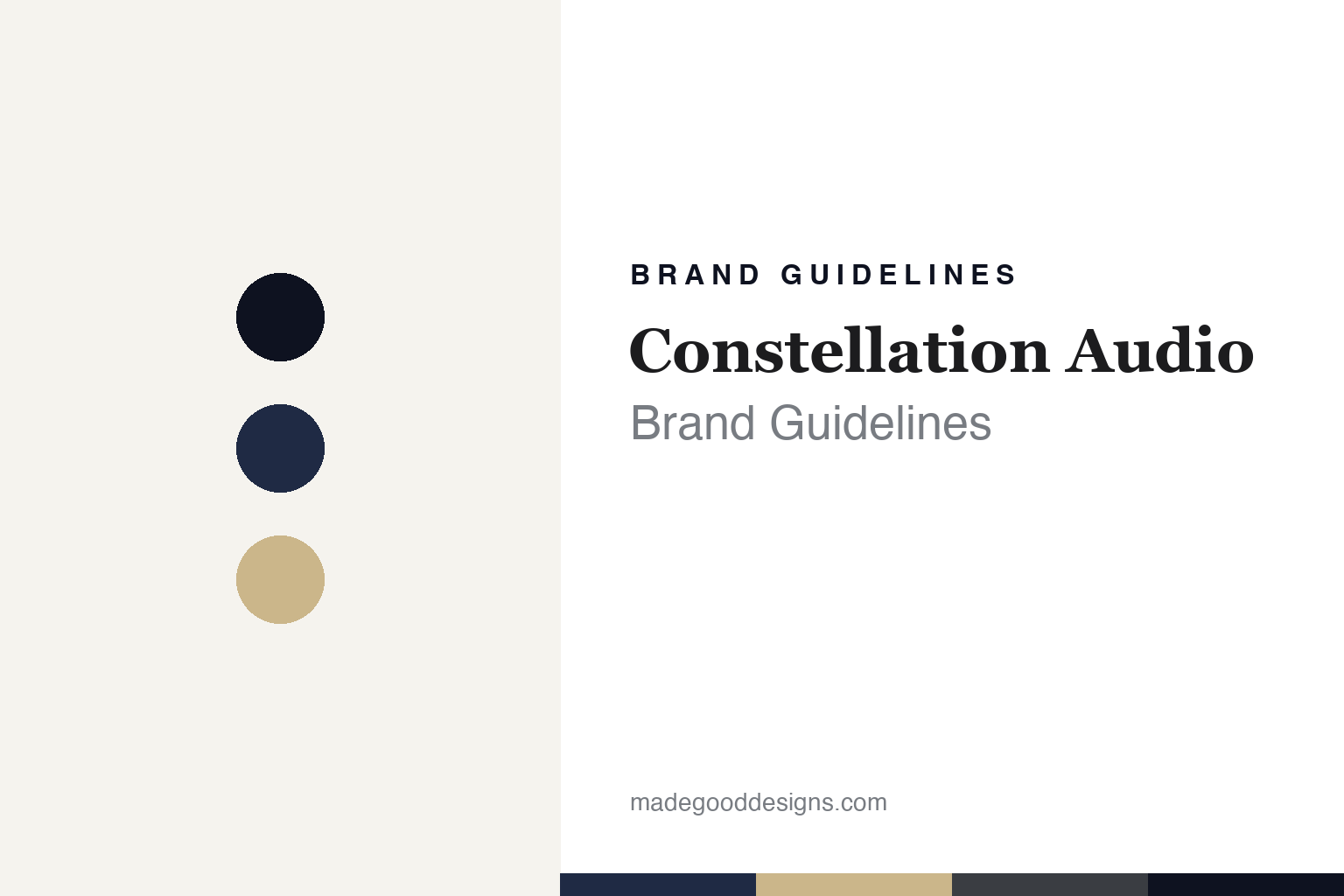
Constellation Audio Brand Guidelines
The star-named amplifiers of an Australian-founded dream team.
Aa
Two constants: a Constellation night blue, graphite and champagne gold palette and a classical serif register. Abstract homage — not a Constellation Audio product or mark; no component, logo or nameplate is reproduced.
The founders
Two Australians, a turntable and a team.
Constellation Audio was formed in 2008, according to a July 2011 profile in the Robb Report and the copyright line on its own website. Its founders were two Australians, Dr Murali Murugasu and David Payes, whom the Robb Report called “Australia-based financiers.” They were already known in high-end audio for Continuum Audio Labs, the Australian turntable maker whose reference system the magazine priced at $150,000.
Versions of the story that circulate online sometimes name other people as founders. The record is consistent. In interviews with Michael Fremer for The Audio Beat in March 2010, Murugasu and Payes spoke as the founders, with a third, unnamed investor; the Robb Report named Murugasu chief executive and president and Payes chairman; and Hi-Fi News still called Murugasu “co-founder and CEO” in January 2025. The Audio Beat introduced Payes as a businessman, lawyer and property developer, and Murugasu as a Glasgow-trained doctor who had spent about eleven years in the audio trade. “If you’re going to do something do it properly or not at all,” Murugasu told Fremer.
The engineering was assembled rather than inherited. Peter Madnick, known for his work at Audio Alchemy and Dennesen, was brought in to build a design team — as project manager in 2009, Hi-Fi News says — and the Robb Report counted about a dozen designers and engineers, among them John Curl, known for his phono circuits, and the amplifier specialist Bascom King. The Audio Beat added Michael Latvis of Harmonic Resolution Systems, for vibration control, and the Neal Feay Company, for industrial design.
Colour
Hercules, Altair, Orion and Sirius.
The first products formed the Reference Line, which began shipping in phases in January 2011, the Robb Report said, and every model was named for a star or a constellation. There was the Hercules monoblock power amplifier, rated at 1,000 watts, weighing 275 pounds and priced at $70,000; the Altair line-stage preamplifier, at $60,000, with a touchscreen remote called Pyxis; the Orion phono preamplifier, designed by Curl, also at $70,000; and the Sirius digital source. The founders’ brief, Murugasu told the magazine, was to build the best system possible and only then ask what it cost: “Like building a house, everything quickly inflated out of proportion. But we just went with the flow.”
Less costly ranges followed under the same naming, reviewed in the trade press: the Performance series, with Centaur power amplifiers and Virgo preamplifiers, the Revelation series, with the Taurus amplifier and Pictor preamplifier, and an entry-level Inspiration series.
The company’s website describes a consistent look: “simple, elegant lines, subtly accented with whimsical touches such as our trademark heat sink vents,” in industrial designs meant to “please the eye, but never distract the eye.” It says its chassis parts come from “the world’s finest, most meticulous machine shops” and that its products are “built by hand, by highly experienced technicians.”
From 2024 the whole range was replaced by a “series 2.” Hi-Fi News reported in January 2025 that Inspiration 2 and Revelation 2 came first — the Revelation 2 pre/power pairing made its debut at the UK Hi-Fi Show Live in 2024 — to be followed by Performance 2 and Reference 2, with the flagship Statement amplifiers, first shown at the High End show in Munich in 2023, at the top. The main change was a custom switch-mode power supply, which the company calls C-SMPS, developed over five years with an outside specialist; the finish also moved from natural aluminium to champagne gold. Murugasu told the magazine he had been “personally rather wary” of switch-mode supplies until “the science and sonic improvements convinced me.” The company’s website says the Statement began around 2017–18, after an earlier flagship effort, the “LEO project,” proved too costly and impractical to manufacture.
Typography
Design and documentation.
Colorado’s Front Range, around the city of Boulder, is home to several of America’s high-end audio makers. Avalon Acoustics builds loudspeakers in Boulder; Ayre, founded in Boulder in 1993 according to English Wikipedia, now gives its address at Niwot, just north-east of the city; Boulder Amplifiers moved to Louisville, east of Boulder, in 2016; and YG Acoustics gives its headquarters and machining plant as Denver.
The others are spread more widely: MartinLogan in Lawrence, Kansas, where it was founded — in 1979 according to English Wikipedia, in 1983 according to the company — and where it still has its design centre; Rockport Technologies in South Thomaston, Maine, where SoundStage! found it in 2012; and Constellation Audio in California, which Hi-Fi News called a “Californian amplifier specialist” in 2025.
The shows have changed too. For years the Consumer Electronics Show in Las Vegas gave high-end audio rooms of its own, latterly at the Venetian hotel, and Boulder showed its 3050 amplifiers there in January 2011; at CES 2019, Stereophile wrote that the curtain had closed on the show as the place for high-end launches. Denver had its own event, the Rocky Mountain Audio Fest, first held in 2004; its organisers cancelled the 2021 show and all future ones. AXPONA, held at Schaumburg near Chicago, now describes itself as North America’s largest high-end audio show.
Prices at this level can be startling: Boulder’s 3050 mono amplifiers cost about $195,000 a pair in 2011, Enjoy the Music reported. Several of these makers remain small and privately held.
This guide sets out what can be checked about each brand — who founded it, who owns it, and what it says about where its products are made — and marks clearly what rests only on the company’s own word.
Aa
A classical serif — for a catalogue named after the night sky. (Specimen set in Cormorant Garamond, a serif STAND-IN; NOT the Constellation Audio logo.)
Constellation Audio
A Californian maker with Australian founders.
Where Constellation sits is less obvious than with most American makers. The Robb Report called it a Southern California company in 2011, and Hi-Fi News listed it at Newbury Park, California, in 2025. Its website names the business Constellation Audio, Inc. but gives no factory address and does not say where its products are assembled. In 2010 its founders told The Audio Beat that the products were designed and built in America; we give that as their account.
Ownership is a similar case. We found no report of a sale or of a new controlling investor in the sources we checked, and Hi-Fi News’s 2025 description of Murugasu as co-founder and chief executive points to continuity at the top. In Asia the brand is sold through distributors, among them Richcom Audio Video in Hong Kong, which its website lists for China and Hong Kong. Madnick, Hi-Fi News added, had more recently been designing for MoFi with Andrew Jones but remained involved with Constellation; Bascom King has since died. For series 2, Murugasu said, “There is no one person who designs any single product and it is always a group effort.”
None of the sources we checked documents the company’s logo, typeface or official colours, so the palette here is our own. Note the trap in the name: Constellation Brands, Constellation Energy and Constellation Software are unrelated companies.
For a design guide, Constellation Audio shows how a naming system can hold a brand together — every amplifier and preamplifier named for something in the sky. Compare Boulder Amplifiers, another American maker of very large amplifiers, and Wilson Audio, whose loudspeakers Hi-Fi News has used with Constellation’s amplifiers. For this guide we use a night blue, graphite and champagne gold with a serif, an unofficial interpretation; no product or logo is reproduced.
Explore & save
Keep Constellation Audio’s identity on hand — save it to a board in the Made Good inspiration library.
Constellation Audio identity set
Pin the Constellation night blue, graphite and champagne gold palette and the classical serif register to your own board.