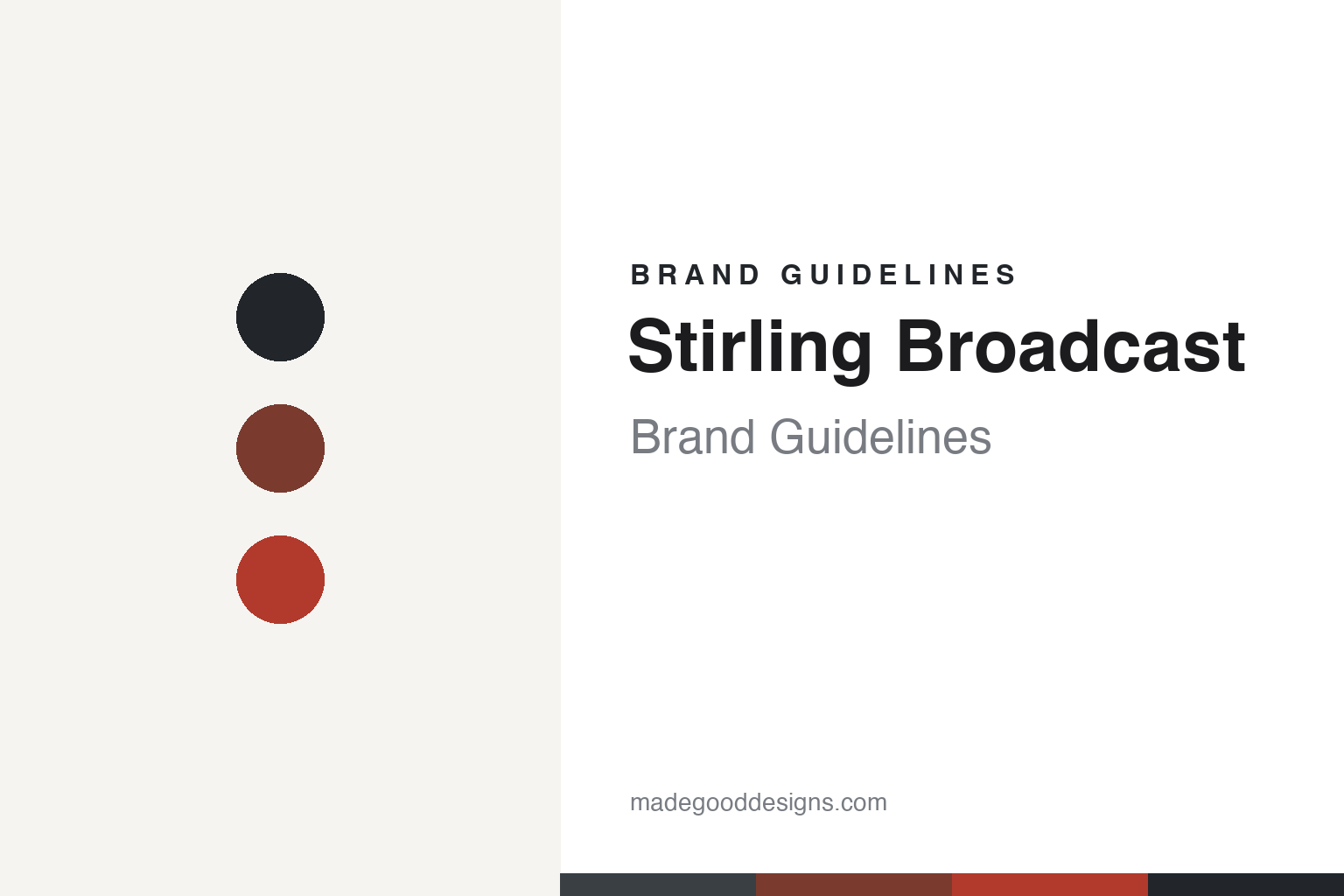
Stirling Broadcast Brand Guidelines
The broadcast-equipment dealer that kept the BBC’s little monitor in production.
Aa
Two constants: a Stirling studio grey, cherry and red palette and an Engineering sans register. Abstract homage — not a Stirling Broadcast product or mark; no loudspeaker, logo or nameplate is reproduced.
Broadcast equipment
A dealer in used studio gear.
Stirling Broadcast did not start as a loudspeaker maker. Its own history says its roots are in the resale of used, ex-demonstration and end-of-line broadcast equipment, followed by the manufacture of furniture for professional broadcast and radio studios. Its website, archived in August 2001, described the business as having the “largest stock of used/ex-demo/end of line broadcast equipment in Europe,” a claim we give as its own. We found no founding date in any source we checked, and no source that names a founder.
The name points to a person rather than to the Scottish city. The Absolute Sound referred in 2008 to “Doug Stirling’s U.K.-based Stirling Broadcast” and quoted him on the company’s designs, and the company’s own website quoted Doug Stirling in 2014. We describe him as the man behind the company, as that review did, rather than as its founder, which no source we found states.
The company has moved once that we can trace. Stereophile gave its location as Somerset in 2007, and archived versions of its website from 2007 to 2017 give an address at Lydford-on-Fosse, in Somerset. By December 2019 its website gave an address near Carmarthen, in west Wales, which is where it remains.
Colour
From repairs to a BBC licence.
Its route into manufacturing ran through repairs. Stirling says it spent a long time repairing and servicing LS3/5As — the small monitor the BBC designed in the 1970s for outside-broadcast vans — and then bought and resold the stock of the bankrupt Rogers as new old stock. After obtaining a BBC licence, it commissioned new B110 and T27 drive units from KEF and put the 11-ohm LS3/5a back on sale. Its website in December 2001 announced “The LS3/5a loudspeaker is back!”, made in batches of 50 pairs, and said that as far as it knew it was the only active licensee; the unofficial timeline at ls35a.org also dates Stirling’s 11-ohm production to 2001. It then added better crossovers, which it called “SuperSpec,” and thin-walled cabinets with screwed backs, modelled on the BBC’s prototype pair numbered 001 and 002.
Then the drivers ran out. KEF stopped making the B110 and T27 around the turn of the century, according to Stereophile and The Absolute Sound; Stirling dates the end of its own supply to 2004. Its answer was the LS3/5a V2, designed by Derek Hughes — the son of Spencer and Dorothy Hughes, who founded Spendor, and once Spendor’s technical director. Hughes used SEAS and Scan-Speak drive units with a new crossover designed to mimic the response of the KEF originals. Stereophile reported news in late 2005 that Stirling had begun making it, and in April 2007 John Atkinson, reviewing it at $1,695 a pair, concluded that it “lives up to the reputation of its illustrious ancestor and even, perhaps, improves on what the original LS3/5a had to offer.” Stereophile noted that, like the original, it kept a rectangle of thick felt around the tweeter and a grille of the same Tygan fabric, and that the American distributor Acoustic Sounds had begun selling it in 2006. The company says the pair of BBC prototypes it studied, 001 and 002, was lent by Paul Whatton, the son of one of the BBC engineers who wrote the 1976 report on the design. Doug Stirling told The Absolute Sound that they had wanted the authentic LS3/5a sound, “warts and all.” The company says the V2 kept its BBC licence, and English Wikipedia says the broadcaster endorsed it; the “V2” in the name marks the change of parts.
Typography
Design and documentation.
Britain’s smaller loudspeaker makers draw on a tradition set by the BBC, whose Research Department at Kingswood Warren in Surrey designed monitors and licensed others to build them. Sound On Sound names the first three LS3/5A licensees as Rogers, Audiomaster and Chartwell; English Wikipedia says Falcon Acoustics now holds the licence for the 15-ohm version.
Their websites and Companies House place the makers in this guide across Britain: Kudos at Willington, County Durham; Acoustic Energy at Trull, near Tetbury, Gloucestershire; Fyne Audio at Bellshill, North Lanarkshire; Russell K at a registered address in Dunstable, Bedfordshire; Falcon Acoustics at Stanton St John, near Oxford; Stirling Broadcast near Carmarthen in Wales, though Stereophile listed it in Somerset in 2007; and the Chartwell name with Graham Audio in Newton Abbot, Devon.
Several have changed hands. Chartwell was sold from receivership to Rogers’ owner in 1978; Graham Audio revived the name by 2016. Falcon says its founder, Malcolm Jones, transferred the business to Jerry Bloomfield in 2009. Companies House shows Acoustic Energy’s original 1987 company, dissolved in 2022, was controlled by the Malaysian-listed Formosa Prosonic Industries; a Tetbury company that calls itself British owned and run now trades as Acoustic Energy.
On manufacturing, the makers speak for themselves. Kudos says each loudspeaker is assembled by hand in its factory in North East England; Fyne Audio says its F700 series is built in the UK; Graham Audio says its loudspeakers are hand-assembled on site.
This guide sets out what can be checked about each brand — who founded it, who owns it, and what it says about where its products are made — and marks clearly what rests only on the company’s own word.
Aa
An engineering sans — “in the BBC tradition.” (Specimen set in IBM Plex Sans, a sans STAND-IN; NOT the Stirling Broadcast logo.)
Stirling Broadcast
“Designers and builders of loudspeakers in the BBC tradition.”
Hughes designed everything that followed, the company says: in 2011 the AB-2 bass extender, an improved version of the Rogers AB-1, and a BBC-licensed version of the LS3/6, a three-way BBC monitor design; in late 2013 the SB-88, a smaller two-way speaker aimed at homes; in 2019 an LS3/5a V3 with large air-cored inductors, which it called “Ultra Low Distortion”; and in 2024 a V3.2 with a hand-built crossover. Its cabinets use thin, 9mm birch plywood, following what it calls the BBC’s “lossy” thin-walled approach. It also says the V2 won a 2005 Hi-Fi News award in its category; we give that as the company’s claim. Its website describes the firm as “Designers and builders of Loudspeakers in the BBC tradition.”
That story is now ending. The company’s website says that Stirling Broadcast is closing down, and that remaining stock is being sold at reduced prices. The notice was not on the website in an archived copy from February 2025 and was there by May 2026. Only LS3/5as built from parts already in stock remain; the company says there are no more cabinets, and that its AB-2, SB-88 and LS3/6 stock has sold out. A former customer and LS3/5a enthusiast is preparing the last pairs, it says, some converted to V3.2 with new crossovers hand-built in the UK.
For a design guide, Stirling Broadcast shows how a brand can be built on keeping someone else’s classic design alive. Compare Spendor, the company Derek Hughes’s parents founded, and Falcon Acoustics, which revived the 15-ohm LS3/5a. For this guide we use a studio grey, a cherry and an on-air red with a sans, an unofficial interpretation; no product or logo is reproduced.
Explore & save
Keep Stirling Broadcast’s identity on hand — save it to a board in the Made Good inspiration library.
Stirling Broadcast identity set
Pin the Stirling studio grey, cherry and red palette and the Engineering sans register to your own board.