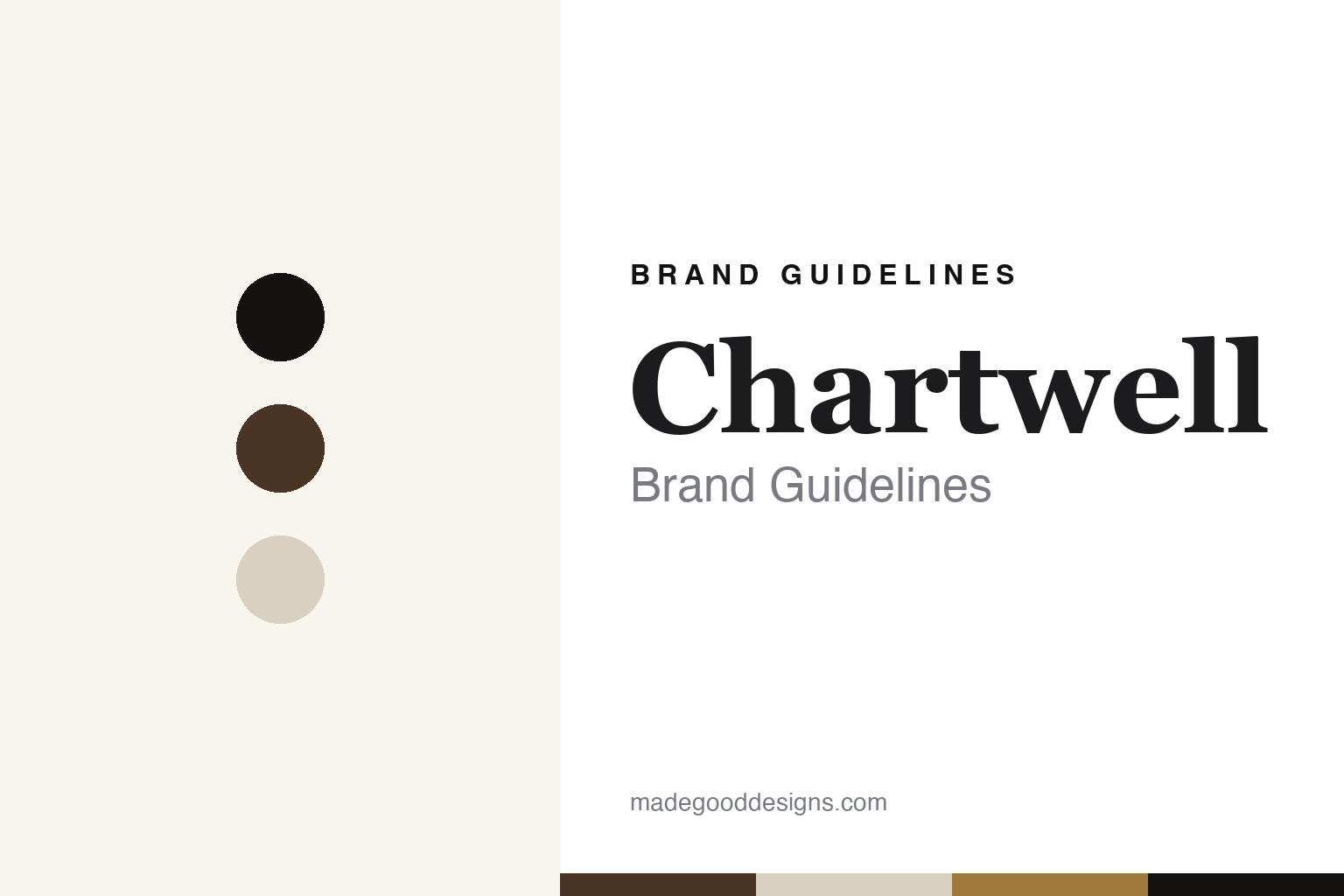
Chartwell Brand Guidelines
The 1970s BBC monitor licensee and its Devon revival.
Aa
Two constants: a Chartwell walnut, oatmeal and brass palette and a Broadcast serif register. Abstract homage — not a Chartwell or Graham Audio product or mark; no loudspeaker, logo or badge is reproduced.
Chartwell Electro Acoustics
A BBC engineer’s company, 1976–1978.
Chartwell was one of the short-lived companies that grew out of the BBC’s loudspeaker research in the 1970s. A timeline published by the LS3/5A enthusiast site ls35a.org, which English Wikipedia cites, says that in 1976 Dave Stebbings, who had worked for the BBC at Kingswood Warren — the Surrey home of its Research Department — set up Chartwell Electro Acoustics in partnership with Joseph Pao. The timeline spells his name Pao; a memoir by a former managing director of Rogers, published on the same site, spells it Pau and describes him as a director of Chartwell and its main source of finance.
Chartwell’s claim to a place in hi-fi history is the LS3/5A, the small BBC monitor designed for outside-broadcast vans. In 2016 Sound On Sound listed the first three companies licensed to make it as Rogers, Audiomaster and Chartwell. The Rogers memoir recalls the BBC telling Rogers that it was granting the same licence to “a Company started by former BBC employees called Chartwell.”
The same memoir, by Brian Pook, managing director of Rogers from 1976 to 1982, places Chartwell on Mitcham Common in south London, led by Stebbings, and says it set up its own drive-unit production, vacuum-forming cones in both Bextrene and the newer polypropylene. It adds that the company found “to their considerable cost” that one-off research and reliable volume production are very different things. These are a competitor’s recollections, so we give them as his.
One Chartwell product is well documented by enthusiasts: Project Symphony, LS3/5A kits supplied to BBC staff to assemble themselves. ls35a.org says the kits cost £100 plus purchase tax a pair and were not meant for the public, and that they carry a small label reading “Chartwell Electro Acoustics Ltd., Alric Avenue, London, NW10” — a north-west London address, unlike the Mitcham works Pook describes.
Colour
Receivership, and a name sold by the receiver.
Chartwell lasted about two years. Pook recalls hearing in 1978 that the company’s bank had placed it into receivership, and the ls35a.org timeline records that Chartwell ceased trading that year. The buyer was the company behind Rogers: in 1978, the timeline says, Swisstone, which had traded as Rogers since buying that business from its own receiver in 1975, bought Chartwell from the official receiver. English Wikipedia’s article on Rogers gives the same account.
Pook writes that the purchase let Rogers recover the original BBC-profile cone moulding tools from Hyder Cones and make high-power Bextrene-coned drive units in-house, which went into the Rogers Studio 1. ls35a.org adds that a small number of pairs were made under the Chartwell name after the takeover, recognisable by silver labels and serial numbers prefixed SC.
Some of Chartwell’s parts found other homes. An archived page of the LS3/5A site says that when Chartwell went into receivership its cabinet maker sold about 100 pairs of LS3/5A cabinets to Linn, which used them for the first batch of its Kan loudspeakers in 1979. The BBC licence moved on too: the timeline says RAM began making the LS3/5A in 1979 “having obtained a BBC licence after Chartwell stopped production.”
Much is not on record. We found no account of David Stebbings’s later career, no full list of Chartwell’s own models and no description of its badge or lettering, so we do not supply them. The original company’s story ends in 1978; what follows is the story of the name.
Typography
Britain’s smaller loudspeaker makers.
Britain’s smaller loudspeaker makers draw on a tradition set by the BBC, whose Research Department at Kingswood Warren in Surrey designed monitors and licensed others to build them. Sound On Sound names the first three LS3/5A licensees as Rogers, Audiomaster and Chartwell; English Wikipedia says Falcon Acoustics now holds the licence for the 15-ohm version.
Their websites and Companies House place the makers in this guide across Britain: Kudos at Willington, County Durham; Acoustic Energy at Trull, near Tetbury, Gloucestershire; Fyne Audio at Bellshill, North Lanarkshire; Russell K at a registered address in Dunstable, Bedfordshire; Falcon Acoustics at Stanton St John, near Oxford; Stirling Broadcast near Carmarthen in Wales, though Stereophile listed it in Somerset in 2007; and the Chartwell name with Graham Audio in Newton Abbot, Devon.
Several have changed hands. Chartwell was sold from receivership to Rogers’ owner in 1978; Graham Audio revived the name by 2016. Falcon says its founder, Malcolm Jones, transferred the business to Jerry Bloomfield in 2009. Companies House shows Acoustic Energy’s original 1987 company, dissolved in 2022, was controlled by the Malaysian-listed Formosa Prosonic Industries; a Tetbury company that calls itself British owned and run now trades as Acoustic Energy.
On manufacturing, the makers speak for themselves. Kudos says each loudspeaker is assembled by hand in its factory in North East England; Fyne Audio says its F700 series is built in the UK; Graham Audio says its loudspeakers are hand-assembled on site.
This guide sets out what can be checked about each brand — who founded it, who owns it, and what it says about where its products are made — and marks clearly what rests only on the company’s own word.
Aa
A broadcast-era serif for a 1970s monitor name. (Specimen set in Libre Baskerville, a serif STAND-IN; NOT the Chartwell logo or badge lettering.)
Chartwell
A name revived in Devon.
The Chartwell name returned through Graham Audio, a loudspeaker maker in Newton Abbot, Devon, founded by Paul Graham, who its website says spent more than 20 years in professional audio, including recording, broadcast and live sound. Companies House lists Graham Audio Limited as incorporated in 2011 and a second company, Chartwell Electro-Acoustics Limited — the old company’s name — as incorporated in Newton Abbot on 13 January 2015, with Paul Graham as director.
In June 2016 Sound On Sound reviewed the Chartwell LS3/5, a revival of the earlier BBC design that became the LS3/5A, and called naming it a Chartwell “a nice touch… in acknowledgement” of one of the original licensees. It was designed by Derek Hughes, son of the BBC engineer Spencer Hughes, who founded Spendor, with a SEAS tweeter from Norway and a bass unit made by Volt in Dorset; it cost £1,650 a pair. In November 2017 the magazine reviewed the Chartwell LS6, which it described as an original Hughes design rather than a BBC reinterpretation, at £2,195 a pair. Graham Audio now lists a Chartwell LS3/5 and LS3/5A, which it calls BBC-licensed, plus the LS6, the floor-standing LS6F and the Sub 6.
In the sources we checked, nothing links the revival to the people of the 1970s firm; it is a tribute to the name, and reviewers have called the speakers “Graham Chartwell.” Graham Audio says it manufactures in the UK and that all its loudspeakers are hand-assembled on site, with one person responsible for each one and a second checking it; we give that as its claim.
For a design guide, Chartwell shows how a defunct broadcast-era name can be revived as a badge. Compare Graham Audio, the company that uses the name today, and Stirling Broadcast, another LS3/5A maker working with Derek Hughes. For this guide we use walnut, oatmeal and brass with a serif, an unofficial interpretation; no product or logo is reproduced.
Explore & save
Keep Chartwell’s identity on hand — save it to a board in the Made Good inspiration library.
Chartwell identity set
Pin the Chartwell walnut, oatmeal and brass palette and the Broadcast serif register to your own board.