Pear Audio Brand Guidelines
The Ljubljana turntables that carry on a Nottingham designer’s ideas.
Aa
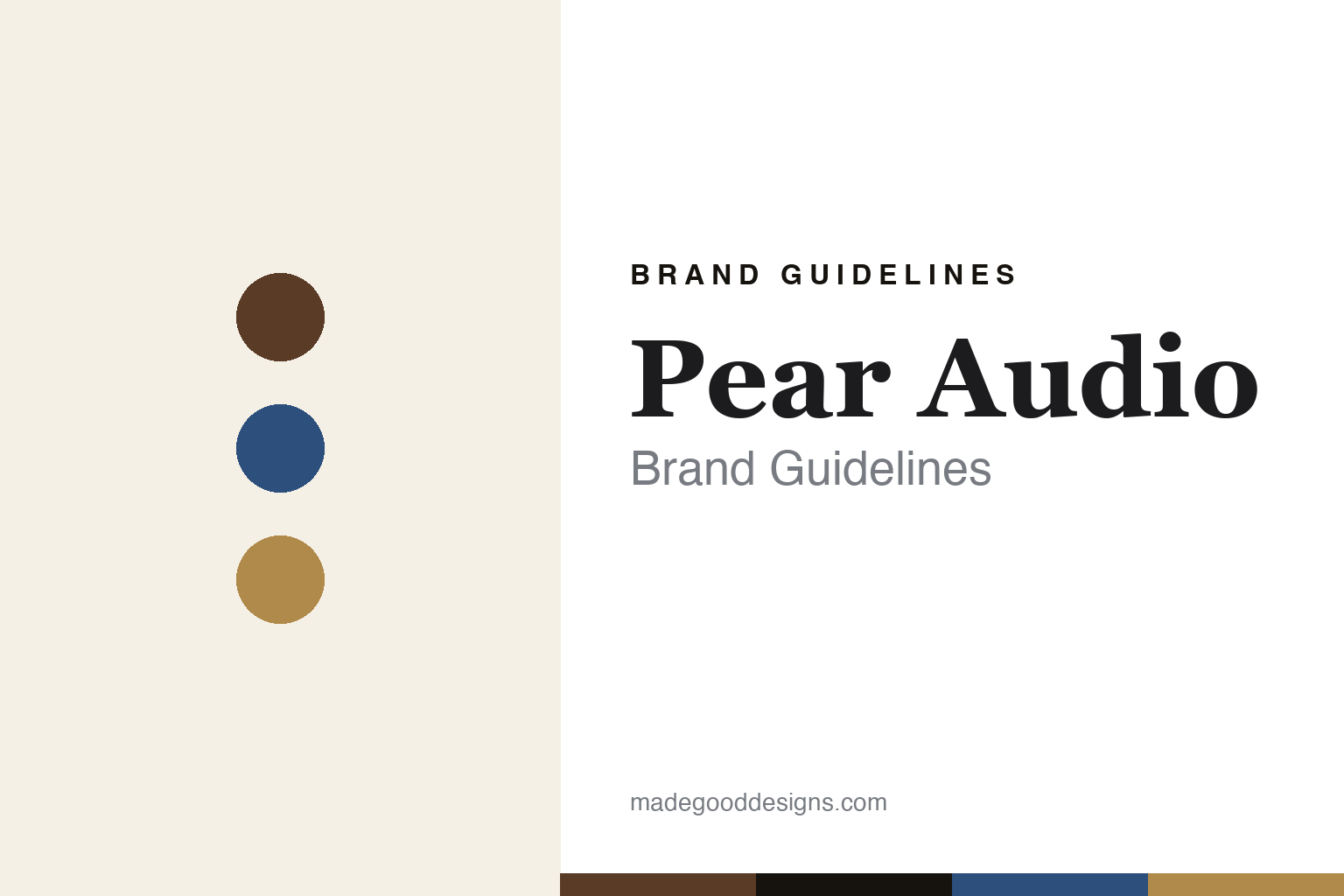
Two constants: a Pear Audio walnut, black and blue palette and a slab serif register. Abstract homage — not a Pear Audio product or mark; no turntable, logo or nameplate is reproduced.
After Nottingham
A distributor, a designer and a turntable built for one man.
Pear Audio — also called Pear Audio Analogue and, for its turntables, Pear Audio Blue — is a Slovenian maker, not a British one, although its roots are in Nottingham. Its company is Pear Audio Europe d.o.o., on Cankarjevo nabrežje, the riverside street in the centre of Ljubljana. Slovenia’s business register, as summarised by the directory Bizi.si, shows the company was registered in December 1999, long before the turntables. The brand’s website was a placeholder in July 2013, according to the Internet Archive, and the line made its American debut at CES in Las Vegas in January 2014.
Its founder, Peter Mezek, was a distributor before he was a maker. Stereophile’s Michael Fremer reported in 2015 that Mezek had distributed the Linn Sondek LP12 in Czechoslovakia until the early 1980s — the company says the late 1980s — and in the mid-1980s was involved with the Rational Audio turntable, designed for him by Jiří Janda and built in Czechoslovakia with a tangential-tracking arm. He was also a long-time distributor of Well Tempered turntables.
The link to Nottingham came through Tom Fletcher, the designer behind Nottingham Analogue. When Well Tempered changed hands and parts and support dried up, Fletcher designed a new turntable for Mezek, Stereophile reported, and the first Pear Audio Blue decks were made at the Nottingham factory. The company says the two worked together for many years and that before Fletcher died he “passed the torch” to Mezek. By January 2014 AnalogPlanet was writing of “the late Tom Fletcher.”
Colour
Named after New Orleans.
The models carry jazz names. Fletcher and Mezek “often listened to New Orleans jazz together,” the company says, so its turntables are named after New Orleans musicians: Kid Thomas, Kid Punch, Kid Howard and Captain John Handy. At CES 2014 AnalogPlanet listed the Kid Thomas at $5,995, the Kid Punch at $4,495 and the single-plinth Kid Howard at $2,850, alongside the Fletcher-designed Cornet 1 and Cornet 2 tonearms, which the company calls the culmination of Fletcher’s work on Nottingham’s Space Arm. A cheaper model, the Robin Hood, followed at the Rocky Mountain Audio Fest in October 2014. Stereophile listed the Cornet 2 as a 10-inch unipivot arm with an effective length of 239 mm.
The engineering follows Nottingham. Reviewing the Kid Thomas for Stereophile in January 2015, Fremer described a 25 lb aluminium-alloy platter with rubber damping rings in its rim, “as in the Nottingham turntables,” driven by a deliberately low-torque AC motor he called “puny,” with a spiral tube applying a slight brake beneath the platter and an optional power supply built by Martin Bastin. The motor principle is Fletcher’s too, the company says, and the platter still has to be given a nudge by hand to start it turning, as AnalogPlanet noted in 2014.
Later models are Mezek’s own. The company credits him with the Little John, now listed as unavailable, and the flagship Odar, which takes 10- or 12-inch arms on two armboards and has a 14-inch platter; the company says The Absolute Sound’s Robert E. Greene gave the Odar with the Cornet 3 arm a Golden Ear award in 2022, calling it “a turntable at the outer limits of the possible, without a stratospheric price.” The newest model, the Aras, a smaller Odar, was added to the range in 2026, according to the website.
Typography
Turntables and their makers.
The turntable makers in this guide span more than a century. The oldest name is Garrard: Wikipedia says its engineering company was formed in 1915 and moved to Swindon in 1919, and that its 401 turntable was used by the BBC. Since 2018 the brand has belonged to the owners of SME, and Garrard’s website says each revived 301 is rebuilt from an original drive at SME’s works in Steyning, West Sussex.
The other British maker is younger. Vertere is run from north-west London by Roksan co-founder Touraj Moghaddam; its company was registered in 2006, and Hi-Fi News reported that its first turntables followed in 2013.
Two makers share a city: Ljubljana, in Slovenia. Holbo, Boštjan Holc’s air-bearing turntable, debuted at a Ljubljana hi-fi show in 2017, HighFidelity reported. Pear Audio trades there as Pear Audio Europe d.o.o.; AnalogPlanet reported in 2014 that its designs grew from Peter Mezek’s work with the late Tom Fletcher of Nottingham Analogue.
In Germany, Sperling Audio is Ansgar Sperling’s business at Welver, in North Rhine-Westphalia; it showed its first high-mass turntable at the High End show in Munich in 2013 and says its products are made by hand in Germany.
Australasia supplies the rest. Wand comes from Design Build Listen Ltd, incorporated in New Zealand in 2004, which says its products are handmade there; Dohmann Audio, Mark Dohmann’s company, is based in Melbourne and says every product is made in Australia.
This guide sets out what can be checked about each brand — who founded it, who owns it, and what it says about where its products are made — and marks clearly what rests only on the company’s own word.
Aa
A sturdy slab serif — for hand-built decks with jazz names. (Specimen set in Bitter, a serif STAND-IN; NOT the Pear Audio logo.)
Pear Audio
No brass violins.
Pear Audio says every turntable is hand-built “one-by-one” by Peter Mezek in Slovenia, and Stereophile repeated that in 2015; we found no report contradicting it, but no independent account of a visit to the workshop either. Its philosophy page, written by Mezek, quotes Fletcher likening most modern audio products to a brass violin — “Pretty to look at but not something you’d want to try to play music on!” — and describes the aim as “a magnificent marriage of materials.” The turntables reach buyers through distributors: Audio Skies of Los Angeles in North America since at least 2014, IBEX Audio of Heidenheim for Germany, Austria and Switzerland, and others in Scandinavia, Italy, France, Poland, Taiwan, South Korea and Australia, the website lists. No British distributor is listed. Stereophile’s 2015 review gave the same Cankarjevo nabrežje address the company uses today, so the business has stayed put for at least a decade.
Readers should watch for a name clash. pearaudio.com belongs to Pear Audio Ltd, a British distributor in Alnmouth, Northumberland, which its website says was formed in 1991 and which sells Dynavector, Shahinian and Well-Tempered Lab products; we found no connection between it and the Slovenian turntables. The turntable maker’s site is pearaudio-analogue.com. The company publishes no brand guidelines, typeface or colour values; its website loads the slab serif Bitter as a web font.
For a design guide, Pear Audio shows how a brand can carry a designer’s ideas forward after his death — through its product names, a stated philosophy and the engineering itself. Compare Linn, whose LP12 Mezek once distributed, and Kuzma, another Slovenian turntable maker. For this guide we use walnut brown, satin black and a deep blue with a slab serif, an unofficial interpretation; no product or logo is reproduced.
Explore & save
Keep Pear Audio’s identity on hand — save it to a board in the Made Good inspiration library.
Pear Audio identity set
Pin the Pear Audio walnut, black and blue palette and the slab serif register to your own board.