Kripton Brand Guidelines
The Tokyo speaker maker inside an imaging and e-learning company.
Aa
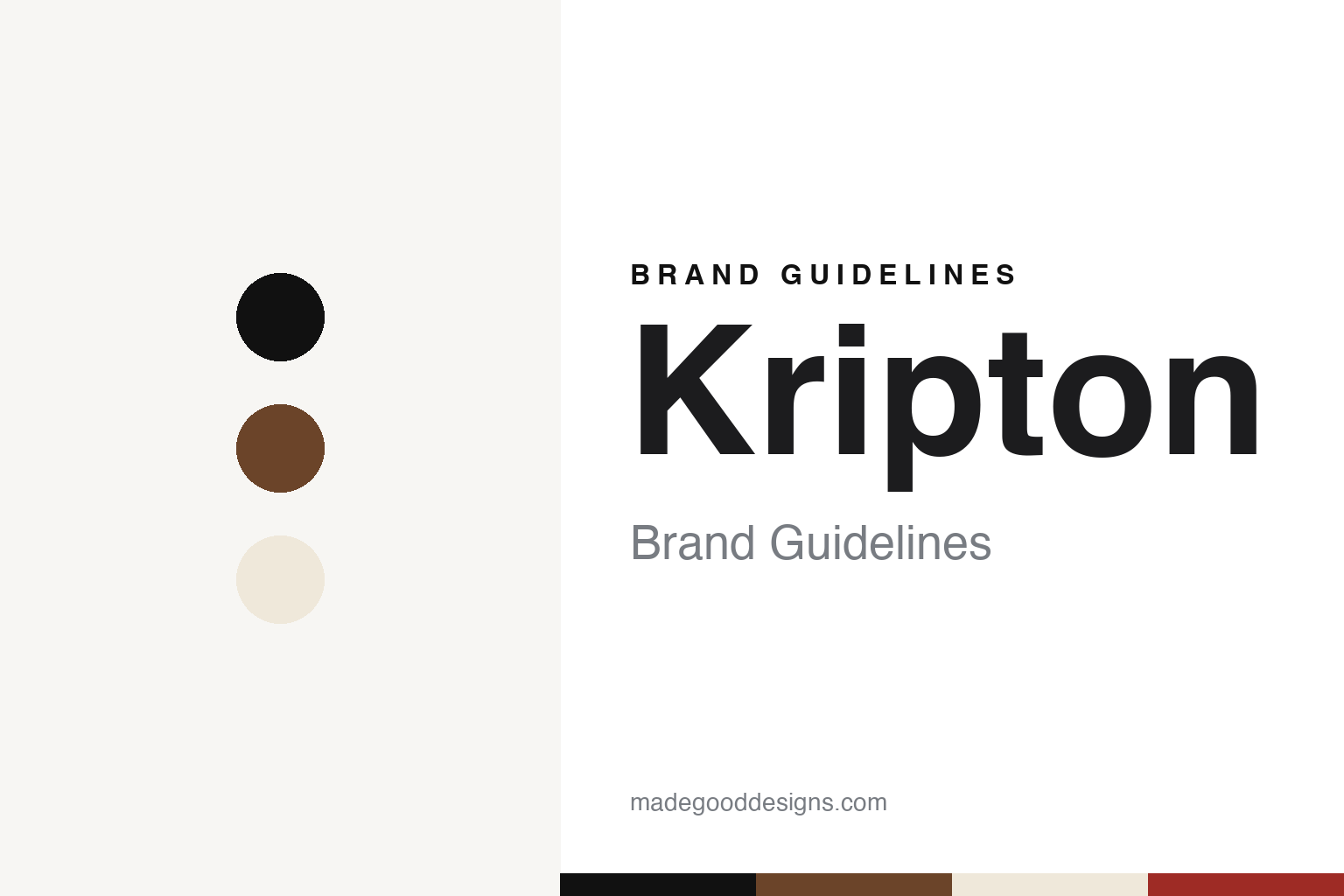
Two constants: a Kripton piano black, moabi and silk ivory palette and a Clean Japanese sans register. Abstract homage — not a Kripton product or mark; no speaker, logo or nameplate is reproduced.
Not that Crypton
A Shinjuku company with several businesses.
Kripton is easily confused with another company. The Japanese firm that makes the KX loudspeakers is Kripton Co., Ltd. — 株式会社クリプトン — of Yotsuya, in Tokyo’s Shinjuku ward. It has nothing to do with Crypton Future Media, the Sapporo software company behind the Hatsune Miku singing voice, which Japanese Wikipedia lists separately. Japanese Wikipedia has no article on the audio company; its disambiguation page describes it only as “an audio equipment maker.”
Its corporate profile gives the basic facts: it was founded on 3 April 1984, has capital of ¥25 million and a head office in Yotsuya 4-chome, and its representative director is named Hamada (浜田正久; an archived 2008 profile writes the surname with the older character 濱). We found no source that names a founder, so we do not name one. The company says on its philosophy page that since its founding in 1984 it has worked to create new markets in video, music and information networks, under the slogan 「唯一無二のおもしろいことを、それがクリプトン」 — roughly, “something one of a kind and interesting: that is Kripton,” in our translation.
Audio is one division among several. The corporate website lists a video-systems division, which makes medical-imaging and education-imaging systems, large-screen displays for simulators and security systems; an e-learning division that writes courses in subjects from TOEIC preparation to medical English; a nationwide installation and maintenance service; and the audio division, which sells speakers, accessories and high-resolution music. Its research page also lists government-funded work: a 2007 e-learning contract for Japan’s Information-technology Promotion Agency, and medical-device development projects for the Ministry of Economy, Trade and Industry in 2012, 2013 and 2014. AV Watch described it in 2009 as a maker of audio accessories and speakers that also develops e-learning systems for universities and companies.
Colour
Accessories first, then the KX-3.
Kripton came to hi-fi through accessories. An archived copy of its website from February 2001 already has an “AV accessory” section and the English tagline “Creative Information Instruments,” and its contact page that year said the company did not sell direct, sending buyers to dealers. The award lists Kripton keeps on its online store begin with an acoustic panel, the AP-10, in Audio Accessory magazine’s 2003 awards, followed by the PB-500 power box and the AP-5 panel in 2004. Its 2004 news pages record audio boards, titanium insulators, a sound-absorbing material called Mystic White and, unusually for a hardware firm, xrcd24 CD reissues of RCA classical recordings featuring Arthur Rubinstein, Emil Gilels and Henryk Szeryng.
Loudspeakers followed in 2005. The KX-5PX product page says Kripton “entered the speaker system market in 2005” and produced 16 models in 14 years, and Phile-web reported in 2009 that the KX-3 was the company’s first speaker. By Kripton’s own list, the KX-3 won Stereo magazine’s 2005 Best Buy in its price class and a prize in MJ’s Technology of the Year awards. Its successor, the KX-3M, sold for ¥252,000 a pair in 2008, with a German-made Kurt Müller paper-cone woofer, alnico magnets, a silk-dome tweeter and a sealed cabinet veneered in moabi wood, according to an archived product page.
The flagship came in 2009. Phile-web reported on 30 March 2009 that the KX-1000P, the top model in a series Kripton called Vigore, would go on sale in early June at ¥997,500 a pair. It was a sealed three-way floorstanding speaker with alnico magnets in every driver, a 35mm silk ring-diaphragm tweeter and a grille cloth woven from Nishijin silk, the Kyoto weaving tradition, built, the site wrote, under a “Made in Japan” concept. It quoted Masaru Watanabe (渡邉勝; our reading of the name), head of the technical development office, who led speaker development, calling it a confident work that fused traditional skill with advanced technology. That week AV Watch reported that Kripton would open its HQM store in late June 2009, selling 24-bit/96kHz FLAC downloads without copy protection from the Camerata Tokyo label.
Typography
Japan and its hi-fi makers.
Japan’s audio industry is best known for its large electronics groups, but much of its valve-amplifier and cable trade belongs to small specialist companies. The seven in this guide are all based in or around Tokyo, according to the addresses on their own websites.
Three are valve-amplifier makers. Shindo Laboratory lists its address in Hongo, in Tokyo’s Bunkyo ward. Audio Note, the Japanese company behind the Kondo name, says it was founded in 1976 and has worked with silver since then; it is based in Kawasaki, Kanagawa. Triode, set up in 1994 as Triode Supply Japan, is based in Koshigaya, Saitama; it says it designs its products itself and has them built by partner factories in China, and that its TRV-CD6SE CD player of 2020 was its first product made in Japan.
Two more make a wider mix of equipment. Fidelix, in Kiyose, western Tokyo, gives its founding year as 1976. Kripton, whose range runs from loudspeakers to cables and power accessories, lists its address in Yotsuya, Shinjuku.
The last two are cable and connector specialists. Furutech says it was established in April 1988 and designs and manufactures cables, connectors and power products from Togoshi, Shinagawa. Oyaide Electric began as an Akihabara wire seller in 1952, still runs a shop beneath the JR Sobu line, and has its head office in Yushima, Bunkyo.
This guide sets out what can be checked about each brand — who founded it, who owns it, and what it says about where its products are made — and marks clearly what rests only on the company’s own word.
Aa
A clean Japanese sans — KRIPTON in capitals. (Specimen set in Zen Kaku Gothic New, a sans STAND-IN; NOT the Kripton logo.)
Kripton
“Made in Japan pride.”
The current range still uses sealed cabinets. On its online store Kripton sells the KX-5PX — the third generation of its KX-5 bookshelf speaker, with alnico pot magnets and a mirror-polished piano finish, at ¥558,000 a pair before tax — as well as the KX-1X at ¥325,000 and the KX-0.5U. It also sells the KS series of powered desktop speakers, from the KS-11G to the KS-55HG, which was released in a red version in December 2025, along with power boxes, cables, audio boards, insulators and acoustic panels. The KX-5PX page carries the line “Made in Japan pride” (メイドインジャパンの誇り). The company describes its audio business as the manufacture and sale of speakers and accessories, but names no factory, so we treat Japanese manufacture as its own claim.
Its recognition comes mostly from Japanese magazine awards, which Kripton lists year by year: AV Review’s Visual Grand Prix, Audio Accessory’s annual awards and HiVi’s Best Buys, among others. The KX-1X page, for example, cites a silver prize in Audio Accessory’s 2021 awards. These are the company’s own lists, which we have not checked against each magazine. Kripton still exhibits at Japanese shows, including OTOTEN in Tokyo in June 2024 and Audio Festa in Nagoya in February 2026, and holds listening sessions at its Kripton Labo studio near Yotsuya-sanchome station. We found no published brand guidelines; the website writes the name in capitals, as KRIPTON.
For a design guide, Kripton shows how a hi-fi brand can be built inside a company whose other businesses look nothing like it, and given a consistent look through sealed cabinets, natural veneers and a quiet sans. Compare Fostex, another Japanese loudspeaker maker, and Audio-Technica, the Tokyo maker best known for cartridges and headphones. For this guide we use piano black, moabi brown and silk ivory with a sans, an unofficial interpretation; no product or logo is reproduced.
Explore & save
Keep Kripton’s identity on hand — save it to a board in the Made Good inspiration library.
Kripton identity set
Pin the Kripton piano black, moabi and silk ivory palette and the Clean Japanese sans register to your own board.