Fostex Brand Guidelines
The OEM speaker maker that put its own name on drivers, recorders and headphones.
Aa
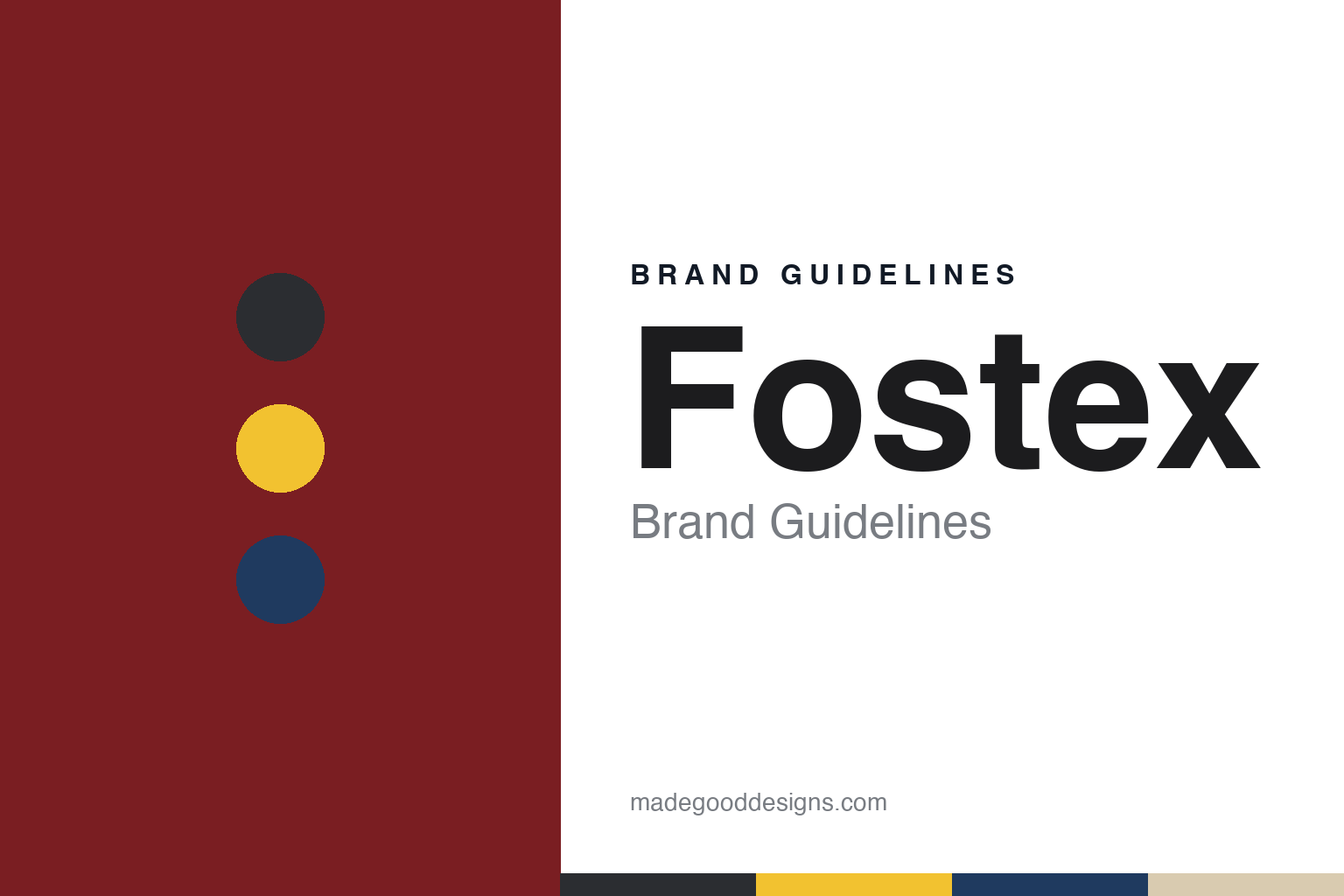
Two constants: a graphite, navy and cone-yellow palette and an Industrial sans register. Abstract homage — not a Fostex product or mark; no headphone, speaker, logo or nameplate is reproduced.
Foster Electric
A component maker that wanted to be seen.
Fostex is not a stand-alone company but the house brand of Foster Electric, a Tokyo-listed maker of loudspeakers and headphones that mostly builds products for other companies. Foster Electric’s own history says it was founded in June 1949 in Shibuya, Tokyo, as the Shinano Acoustic Research Laboratory, by Shigehiro Nishimura and Hiroaki Shinohara, who had found that they both came from Nagano — the old province of Shinano — and set out to make speakers. It became Shinano Acoustic in 1953, registering the “Foster” trademark, and took the name Foster Electric in 1959. English Wikipedia gives a founding date of 1948 and names the second founder as “Hagiwara”; we follow the company’s own record.
The early business was components. A Foster speaker unit went into Sony’s TR-55 transistor radio, the company’s history notes, and in 1960 it built a factory at Akishima, in western Tokyo. A Fostex sales manager told the Tokyo retailer Rock oN in 2017 that he had heard the site was chosen for its groundwater, since paper cones are formed in water; we give that as hearsay. Foster Electric moved its head office to Akishima in 1969, and to its present site in the city’s Tsutsujigaoka district in 2012.
The Fostex name arrived in 1973, and the brand celebrated its 50th anniversary in 2023, its website says. Japanese Wikipedia records a subsidiary, Fostex Co., Ltd., set up that year; Foster Electric’s history records that it absorbed that company in April 2003. In the 2017 interview, the sales manager explained the reasoning: OEM work meant staying out of sight, and an own brand gave the products a chance to be seen. The first successes were FE-series full-range drive units for people building their own speakers, a hobby he linked to the critic Tetsuo Nagaoka’s cabinet designs; Fostex said then that the 10cm FE unit was still selling in the tens of thousands a year.
Colour
From multitrack cassettes to planar headphones.
Fostex then moved into recording. English Wikipedia dates the A-2 and A-4 reel-to-reel machines to 1981 and describes the A-8 as the first eight-track recorder to use affordable quarter-inch tape; the X-15, a battery-powered four-track cassette recorder, followed in 1983 alongside the B-16, which put 16 tracks on half-inch tape. Fostex told Rock oN in 2017 that the X-15 was a worldwide hit whose sales record the company had still not beaten — a claim we cannot check. The line ran on through the G-16S of 1990, with Dolby S noise reduction, to the DMT-8 of 1995, which Wikipedia calls the first portable and affordable digital recorder. Today the Fostex website lists its recorders and mixers, from the MR-8 to the DV824 and FR-2, among discontinued products, and its current range has no recorder; we found no dated announcement of that exit.
Studio monitors followed. The NF-1 near-field monitor — named, the company says, for “near field” and for being the first model — came out of a decision in the 1990s to build up the brand; Fostex said in 2017 that the NF series sold 15,000 units and arrived just as Yamaha’s NS-10M was being discontinued. Its yellow woofer cone is often credited to banana pulp in the paper; the pulp mix did include banana fibre, carbon and aramid, the company said, but the yellow was a dye chosen to stand out. The NF series ended by 2014 — meeting new electrical-safety and environmental rules would have changed the sound, Fostex said — and returned as the NF01R in 2017, now itself discontinued.
The headphones carry the longest thread. Fostex says Foster Electric was the first company in Japan to commercialise a full-surface-drive transducer, which it calls RP, for “Regular Phase,” in 1974: a flat film diaphragm with a printed conductor, held between magnets, of the kind usually called planar magnetic. Its product pages date the third-generation RP driver to 1998, while an article by the critic Takashi Iwai on its website in 2026 places that driver’s debut in the T50RP in 2001. English Wikipedia notes the T50RP’s popularity with modifiers. The fourth-generation driver, completed in 2024 and now patent-pending, the company says, powers the T50RPmk4 and the closed-back T50RPmk4CL of 2025, which Fostex says benefit from “integrated manufacturing at the company’s own factory.”
Typography
Japan’s audio industry.
Japan’s hi-fi industry grew out of the postwar years. Onkyo was founded in Osaka in 1946, Sansui in Tokyo in 1947, Nakamichi in 1948 and Foster Electric in 1949, and the first of the companies that became TEAC dates from 1953. Foster made the speaker for Sony’s TR-55 transistor radio, its history notes; today it describes itself as an OEM and ODM maker with factories across Asia, the Americas and Europe.
The big electronics groups ran audio brands of their own. Matsushita, now Panasonic, introduced Technics in 1965, dropped the name for most products in 2010 and revived it in 2014.
Many independent names did not last. Sansui’s company was declared bankrupt in 2014; its name has since been licensed out, and in Japan Doshisha, which had used it, switched to its own Orion brand in 2021. Nakamichi left the Japanese market in 2008, and who owns its name today is reported inconsistently. Onkyo sold its home audio business to Sharp and Voxx in 2021, and in May 2022 the Osaka District Court opened bankruptcy proceedings against it, AV Watch reported.
The seven makers in this guide now sit in very different places. TEAC is listed in Tokyo and based in Tama, where it absorbed its Esoteric subsidiary in April 2024; Gibson, which bought a majority of TEAC in 2013, sold it in 2020. Technics belongs to Panasonic. Stax, in Fujimi, Saitama, has been owned by China’s Edifier since 2011. Fostex is a division of Foster Electric in Akishima, Tokyo.
This guide sets out what can be checked about each brand — who founded it, who owns it, and what it says about where its products are made — and marks clearly what rests only on the company’s own word.
Aa
An industrial sans — for a brand built on parts. (Specimen set in Archivo, a sans STAND-IN; NOT the Fostex logo.)
Fostex
A brand division inside an OEM giant.
At the top of the range Fostex mixes acoustics with Japanese craft. The TH900, released in 2012 and the brand’s flagship since, the company says, had Mizume-zakura wood cups finished in “Urushi Bordeaux” lacquer by Sakamoto Otozo Shoten, a lacquer firm founded in 1900, with the Fostex logo in platinum foil. Its successors, the TH910 and TH919, announced for September 2025, use hard maple under black lacquer and a collage of sulfur-smoked silver foil. The TH1000RPmk2, released in October 2025, has housings dyed with Awa indigo and is assembled “one by one at a domestic factory,” its Japanese product page says. Those are the company’s claims. Foster Electric’s own production runs largely across Asia, from China and Vietnam to Myanmar, its history shows, so we do not assume where any other Fostex model is made.
Today Fostex is run as the Fostex Company inside Foster Electric, with its office in the parent’s headquarters at Tsutsujigaoka, Akishima, according to its website. A September 2025 notice on that site headed “Notice of Closing” referred to a single office holiday on 22 September, not to the business. We found no announcement of a sale or wind-down of the Fostex brand among Foster Electric’s news releases for 2024 to 2026, and the brand launched new headphones in 2025 and 2026.
For a design guide, Fostex shows how a component maker can build a public name from the parts it already makes. Compare Stax, the electrostatic headphone maker in Saitama, and Audio-Technica, another Tokyo audio maker. For this guide we use graphite, cone yellow and a deep navy with a sans, an unofficial interpretation; no product or logo is reproduced.
Explore & save
Keep Fostex’s identity on hand — save it to a board in the Made Good inspiration library.
Fostex identity set
Pin the Fostex graphite, navy and cone-yellow palette and the Industrial sans register to your own board.