Fezz Audio Brand Guidelines
The Podlasie transformer family that built a valve-amplifier brand.
Aa
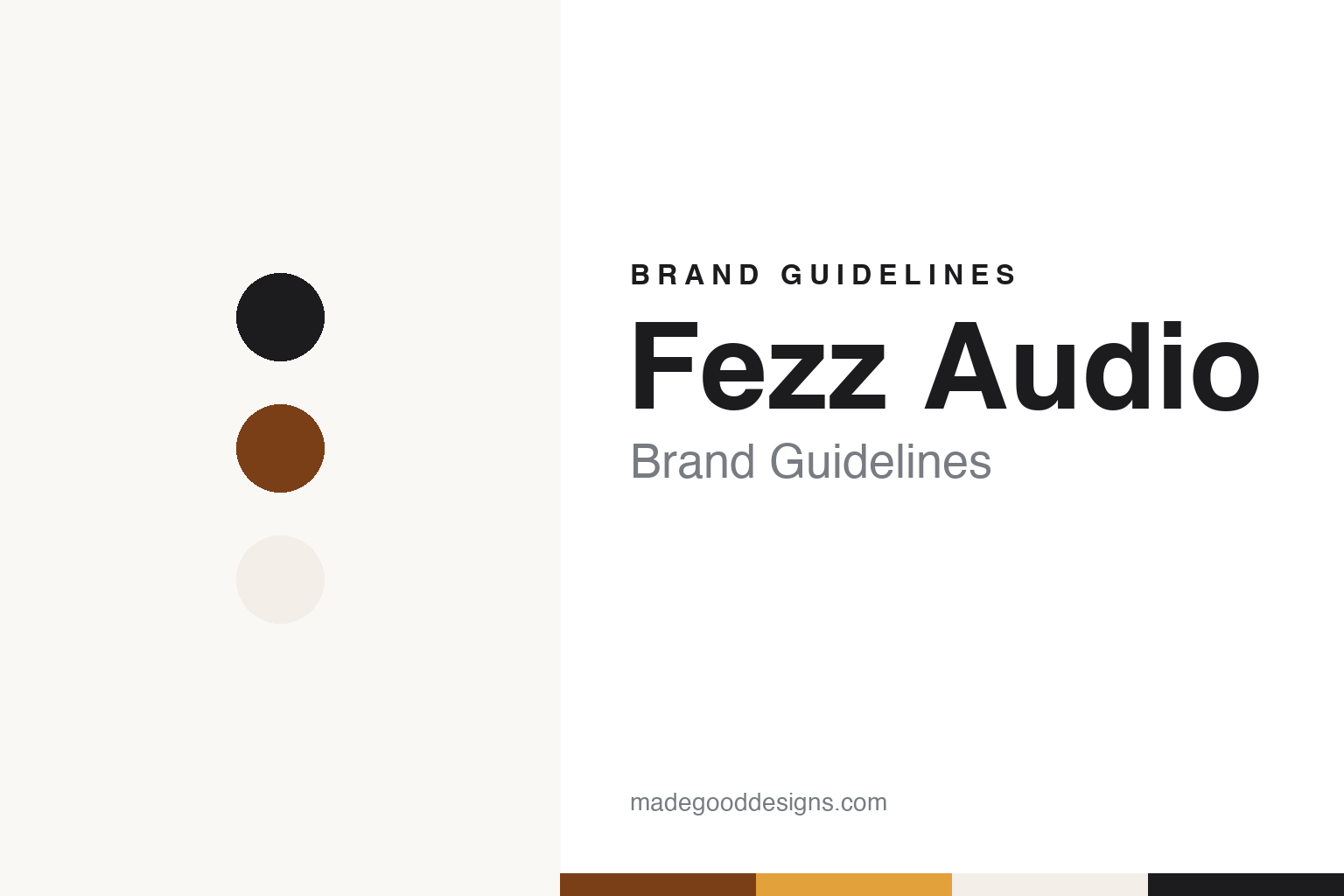
Two constants: a Fezz Audio copper and valve-glow palette and an Industrial sans register. Abstract homage — not a Fezz Audio product or mark; no amplifier, logo or nameplate is reproduced.
From television coils to transformers
A family transformer works outside Białystok.
Fezz Audio is the valve-amplifier brand of a family transformer maker in Podlasie, north-eastern Poland. Its website names the company behind it as TOROIDY.PL Transformatory L. Lachowski, a limited partnership, and gives its address as Kolonia Koplany, a village in the Juchnowiec Kościelny district just outside Białystok. So “Białystok,” often given as Fezz’s home, is close but not exact. Early reviews listed an earlier address in Księżyno, another village nearby.
The story begins with transformers rather than amplifiers. The Polish magazine StereoLife says the Lachowski family began working professionally with transformers in 1992, at first on a small scale in a home workshop; another account gives 1991. According to StereoLife, Lech Lachowski, an aeronautical engineer by training, had been associated with Unitra-Biazet, Białystok’s television-components factory, and when that factory declined and its old machines were being sold off cheaply, he adapted them to wind transformers instead of television deflection coils. The present partnership was registered in 2015, according to business registers; the trade is much older.
When High Fidelity reviewed Fezz’s first amplifier, it described Toroidy.pl as a family business run by Lech Lachowski and his two sons, Tomasz and Maciej. Industrial transformers, Tomasz told the Polish site InfoAudio in 2015, remained “our main source of income.” But the firm had long sold to audio companies too. Maciej Lachowski named partners including Mytek, LampizatOr, Amare Musica, Audio Valve, Ancient Audio, Wile and Baltlab; High Fidelity noted that Toroidy transformers were used by Ancient Audio of Kraków and by Mytek, which makes its converters in Poland.
Colour
A toroid where convention said it would not work.
Fezz began as an argument with convention. Most valve amplifiers use traditional E-I laminated output transformers; toroidal output transformers are rare, and in single-ended designs they were widely held not to work at all. Maciej Lachowski told High Fidelity that the company spent three years developing a toroidal output transformer suitable for single-ended amplifiers, and that at the Audio Video Show in Warsaw in 2014 it showed “Laura,” a non-commercial single-ended amplifier built purely to make the point. StereoLife has described Fezz as the first company in the world to put toroidal output transformers into single-ended amplifiers, a claim we could not check independently.
The interest that followed led to a brand. “Let’s create a new brand,” Maciej Lachowski recalled thinking — an affordable valve amplifier that would be “the Polish alternative” to Chinese ones. The result, the Silver Luna, premiered at the Audio Video Show in November 2015: an EL34 push-pull integrated amplifier with toroidal output transformers, priced at 3,999 złoty, with its chassis offered in four colours. Tomasz Lachowski told InfoAudio that the company did “everything ourselves, except individual electronic components and tubes,” including the enclosures on its own machines, and that sales of its loudspeaker output transformers had risen 400 percent in a year. The plan, he said, was to start at the budget end and add cheaper and dearer tiers later.
That is roughly what happened. The current range includes the Evolution series — Luna, Luna Mini, Silver Luna Prestige, Titania, Mira Ceti in 2A3 and 300B versions and the Lybra mono power amplifier — along with headphone amplifiers, phono stages and a transistor amplifier, the Torus 5060. In 2026 the Titania MK2 won the EISA Tube Amplifier 2026–2027 award. The jury’s citation describes a KT88-based integrated amplifier of up to 60 watts per channel, “designed and made in Poland,” with optional DAC and phono modules, a “sleek, modern industrial design” that works with or without its tube cage, and seven finishes at no extra cost.
Typography
Central European hi-fi.
Central Europe’s audio industry has a long state-era record. In Poland, Unitra, the association of consumer-electronics makers, was set up in 1961 and kept its original structure until 1989, English Wikipedia says; the Tonsil loudspeaker works in Września, founded in 1945, ran as a state enterprise until 1990, according to Polish Wikipedia. In Czechoslovakia, Tesla was the state conglomerate that monopolised electronic appliances and components from 1946 until its privatisation in 1991.
The region has since become a workshop for Western brands as well as its own. Pro-Ject, founded in 1991 in Mistelbach, Austria, designs at home and makes its products in Germany, the Czech Republic and Slovakia, English Wikipedia says; the German magazine lowbeats reported after a factory visit that Canor’s plant in Prešov makes all of Pro-Ject’s electronic components, and those of IsoTek and Musical Fidelity.
The trade meets in Warsaw, where the Audio Video Show holds its 28th edition in October 2026; its organisers call it the world’s second-largest audio show.
The seven makers in this guide are spread across the region, according to their websites and business listings: Pylon Audio in Jarocin and Fezz Audio near Białystok, in Poland; Ancient Audio in Kraków; Mytek, founded in New York in 1992, with a European branch in Warsaw; Xavian at Hostivice, outside Prague; Canor in Prešov, in eastern Slovakia; and Ayon at Gratkorn, near Graz, in Austria.
This guide sets out what can be checked about each brand — who founded it, who owns it, and what it says about where its products are made — and marks clearly what rests only on the company’s own word.
Aa
An industrial sans for a redesigned range. (Specimen set in Manrope, a sans STAND-IN; NOT the Fezz Audio logo.)
Fezz Audio
A logo facelift, paid for in part by the EU.
Fezz’s visual identity is documented in a public funding record. On its website the parent company says that on 22 December 2020 it signed an agreement for EU funding under the Eastern Poland programme’s “Design for competition” measure. The listed results included new and improved valve amplifiers, an app for remote control, “a logo facelift and new visual identity for the Fezz Audio brand,” and a rebranding of Toroidy itself. The project was valued at about PLN 2.79 million, with an EU contribution of about PLN 1.59 million. The company says it created the Evolution line with Kabo & Pydo, the design and strategy studio run by Katarzyna Borkowska and Tomasz Pydo, which it describes as a winner of Red Dot, iF and Dobry Wzór awards. The brand’s slogan is “Made of Music.”
On where things are made, the company says that more than 80 percent of the production process takes place at its Kolonia Koplany plant; the EISA jury, as noted, called the Titania MK2 designed and made in Poland. When the Polish site AudioMuzoFans visited in 2025, it was shown round by Maciej Lachowski as president of Fezz Audio, saw the transformer works and a new metalwork building meant to bring production onto one site, and was told about research into making valves in Poland — with first rectifier tubes possible within three years. That is a plan, not yet a product.
Fezz also travels with a neighbour. Pylon Audio, the loudspeaker maker from Jarocin, says it shared its stand with Fezz at the HIGH END show in Vienna in June 2026 and at the Hong Kong Audio Visual Show that August, and Pylon has suggested its Jade speakers be paired with a Fezz Titania.
For a design guide, Fezz Audio shows how a component supplier can turn its specialist part into a brand story: the toroidal transformer is the reason the company exists. Compare Pylon Audio, its frequent show partner, and Pro-Ject, another Central European maker on the same 2026–2027 EISA list. For this guide we use copper, valve amber and chassis black with a sans, an unofficial interpretation; no product or logo is reproduced.
Explore & save
Keep Fezz Audio’s identity on hand — save it to a board in the Made Good inspiration library.
Fezz Audio identity set
Pin the Fezz Audio copper and valve-glow palette and the Industrial sans register to your own board.