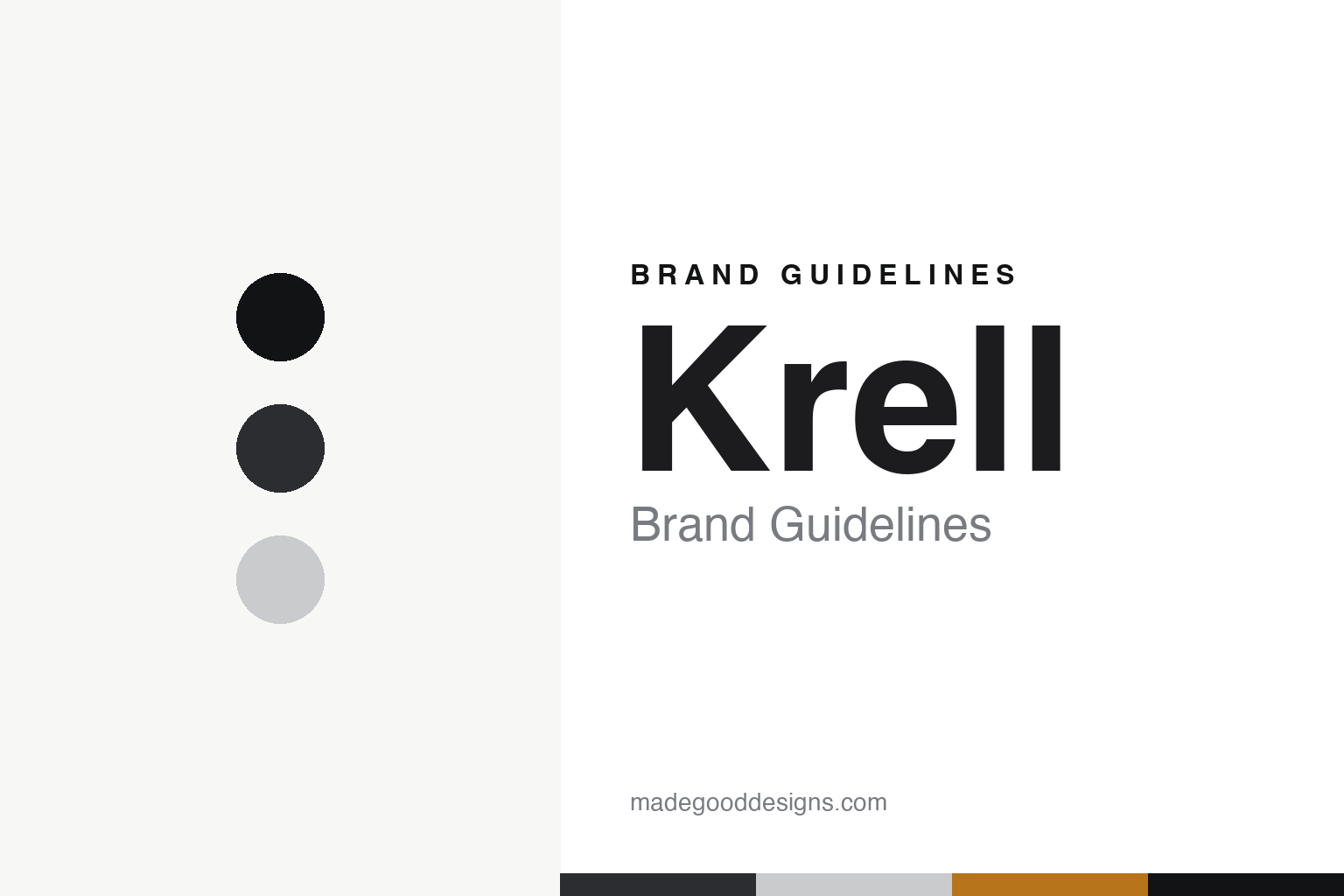
Krell Brand Guidelines
The Forbidden Planet name behind Connecticut’s high-power Class A amplifiers.
Aa
Two constants: a Krell graphite, silver and amber palette and an Industrial sans register. Abstract homage — not a Krell product or mark; no amplifier, logo or nameplate is reproduced.
Krell
Two Mark Levinson colleagues and a science-fiction name.
Krell began in Connecticut in 1980. English Wikipedia says it was founded by Dan D’Agostino and Rondi Halling, later Rondi D’Agostino, both former colleagues at Mark Levinson, the high-end electronics maker then based near New Haven. The trade site Strata-gee wrote in 2024 that Rondi began her career at Mark Levinson, met Dan there, and that the couple started Krell together in 1980.
The name, the company says, was “inspired by the classic 1956 MGM science fiction film, Forbidden Planet,” in which the Krell are an extinct race of highly advanced beings who are never seen on screen. Its website paired the name with a trademarked slogan, “The Leader in Audio Engineering.”
Krell’s first product was a power amplifier. The company has described the KSA-100 as “the first high power, high-current, true Class A biased stereo power amplifier available to audiophiles,” a claim we give as its own. Class A circuits keep their output transistors conducting all the time, which avoids a kind of switching distortion but produces a great deal of heat. A retrospective in Tone Audio notes that solid-state Class A amplifiers from makers such as Sugden and Mark Levinson had usually been rated below about 25 watts, and that Krell’s contribution was to offer the approach at the power levels of conventional amplifiers.
The same article calls the smaller KSA-50 the company’s third amplifier, after the KSA-100 and the KMA-200 monoblocks, and says it brought Krell to a much wider audience; other accounts number it second, so we note the difference. It recounts that John Atkinson, then editor of Hi-Fi News & Record Review, reviewed the KSA-50 in August 1983 and later moved to the United States to edit Stereophile, and argues that British listeners took to Krell before American ones — a view it attributes to Dan D’Agostino himself. Early Krell amplifiers, it adds, were among the few able to drive the very low impedance of Apogee’s ribbon loudspeakers.
Colour
Current, heat and an address in Orange.
Krell’s reputation rests on large amplifiers with heavy power supplies and high current. Its 2024 website, archived that August, listed stereo and multichannel amplifiers under the Duo and Chorus names, the KSA-i400 stereo and KMA-i800 mono amplifiers, and preamplifiers, processors and digital sources, and described its iBias circuitry as delivering Class A operation at high power. In 2018 the company introduced what it called XD, a revision of its output stage; Strata-gee reported that September that Krell said every amplifier leaving the factory now carried it, and that owners of older models could pay to have it fitted.
For decades the company was based in Orange, Connecticut, a few miles west of New Haven; its 2024 website gave its headquarters as 45 Connair Road, and the founders’ 2009 lawsuit, described below, concerned the Orange offices. Krell called itself a design and manufacturing brand, but we found no detailed statement of where its parts and chassis were made, so we give Orange as its base rather than as a documented factory for every component.
Krell also licensed its name beyond the living room. Its archived automotive page said it partnered with car makers, “licensing its audio technology,” and named the Acura RLX and NSX and the Hyundai Nexo, the hydrogen fuel-cell car, quoting a review that praised the RLX system’s dynamic range. Its former employer, Mark Levinson, built a much larger business on the same idea through its long partnership with Lexus.
Typography
Design and documentation.
American high-end audio grew into a movement in the 1960s and 1970s, with its own press: Stereophile, founded in 1962 by J. Gordon Holt, and The Absolute Sound, founded in 1973 by Harry Pearson, according to English Wikipedia.
The makers grew up far apart. In Minnesota, William Z. Johnson founded Audio Research in Minneapolis in 1970, and Jim Winey’s Magnepan loudspeaker dates from 1969. In Connecticut, Mark Levinson started his company in 1972, and Dan and Rondi D’Agostino founded Krell in 1980. In Kentucky, Thiel began in Lexington in 1976; and in California, Richard Vandersteen took his Model 2 to the 1977 Consumer Electronics Show.
Several later changed hands. The Mark Levinson name passed to Madrigal Audio Laboratories at a bankruptcy auction in 1985, and Harman acquired Madrigal in 1995, Harman says; Samsung bought Harman in 2017. Audio Research was bought in 2008 by the Italian investor Quadrivio, whose Fine Sounds group was later renamed McIntosh Group, and was sold on in 2020 and 2023. Thiel was sold to a Nashville investor in 2012 and stopped operating in 2018. Krell closed after Rondi D’Agostino’s death in 2024; its repair service restarted in 2025, trade reports say.
Today Audio Research is in Maple Grove and Magnepan in White Bear Lake, Minnesota; Mark Levinson is part of Harman, based in Stamford, Connecticut; Krell remains in Connecticut; conrad-johnson builds by hand in Virginia; and Vandersteen is in Hanford, California, according to their websites and English Wikipedia.
This guide sets out what can be checked about each brand — who founded it, who owns it, and what it says about where its products are made — and marks clearly what rests only on the company’s own word.
Aa
An industrial sans for a heavy-metal amplifier maker. (Specimen set in Archivo, a sans STAND-IN; NOT the Krell logo.)
Krell
A private equity stake, a closure and a dispute.
Krell’s ownership has been contested more than once. In 2009, with the company in what Strata-gee later called “severe financial distress,” the founders sold a 40 percent stake to KP Capital Partners, a New York private-equity fund, while keeping 60 percent, the trade paper TWICE reported. Within months they sued, saying they had been locked out of the Orange offices after trying to dismiss an executive backed by the fund; those were their allegations, and Strata-gee has written that as many as four lawsuits followed. A Connecticut Superior Court ruling in the dispute is dated September 2010. Dan D’Agostino left Krell in 2009 and later founded his own amplifier company, Dan D’Agostino Master Audio Systems. Rondi D’Agostino “regained the company,” PS Audio’s Copper magazine reported in 2018, without giving a date, and she ran it as owner and chief executive until her death.
Krell’s own announcement called it “one of the last privately owned and family-operated companies in the high-end audio industry” when Rondi D’Agostino died on 18 June 2024, and said it would close “for the next few weeks.” It did not reopen on that timetable. In February 2025 Stereophile reported that JF Bicking & Co., a family holding company, claimed 30 percent of Krell — the Italian magazine TNT-Audio put the figure at 40 — and that her son, Kristofer D’Agostino, held at least 70 percent through her estate, with the remaining dispute to be settled in Delaware, where Krell Industries is registered. On 19 February 2025 a Connecticut probate court gave him control of the trust, Headphonesty reported.
A Krell dealer, Steven Javaherian, had formed a Connecticut company called Krell Audio in November 2024, and a repair shop at a new Connecticut site was declared open on 19 March 2025. In July 2025 Javaherian said Krell was “not making any new models yet.” A restart of manufacturing in 2026 has been reported second-hand and on a Krell web page, but in the sources we checked we found no confirmation that production has resumed. Krell’s former domain, krellhifi.com, now redirects to an unrelated company.
For a design guide, Krell shows how a brand built on one engineering idea — high-power Class A amplification — depends on continuity of ownership as much as on its products. Compare Mark Levinson, where its founders met, and Pass Labs, another American amplifier maker known for Class A designs. For this guide we use graphite, brushed silver and an amber with a sans, an unofficial interpretation; no product or logo is reproduced.
Explore & save
Keep Krell’s identity on hand — save it to a board in the Made Good inspiration library.
Krell identity set
Pin the Krell graphite, silver and amber palette and the Industrial sans register to your own board.