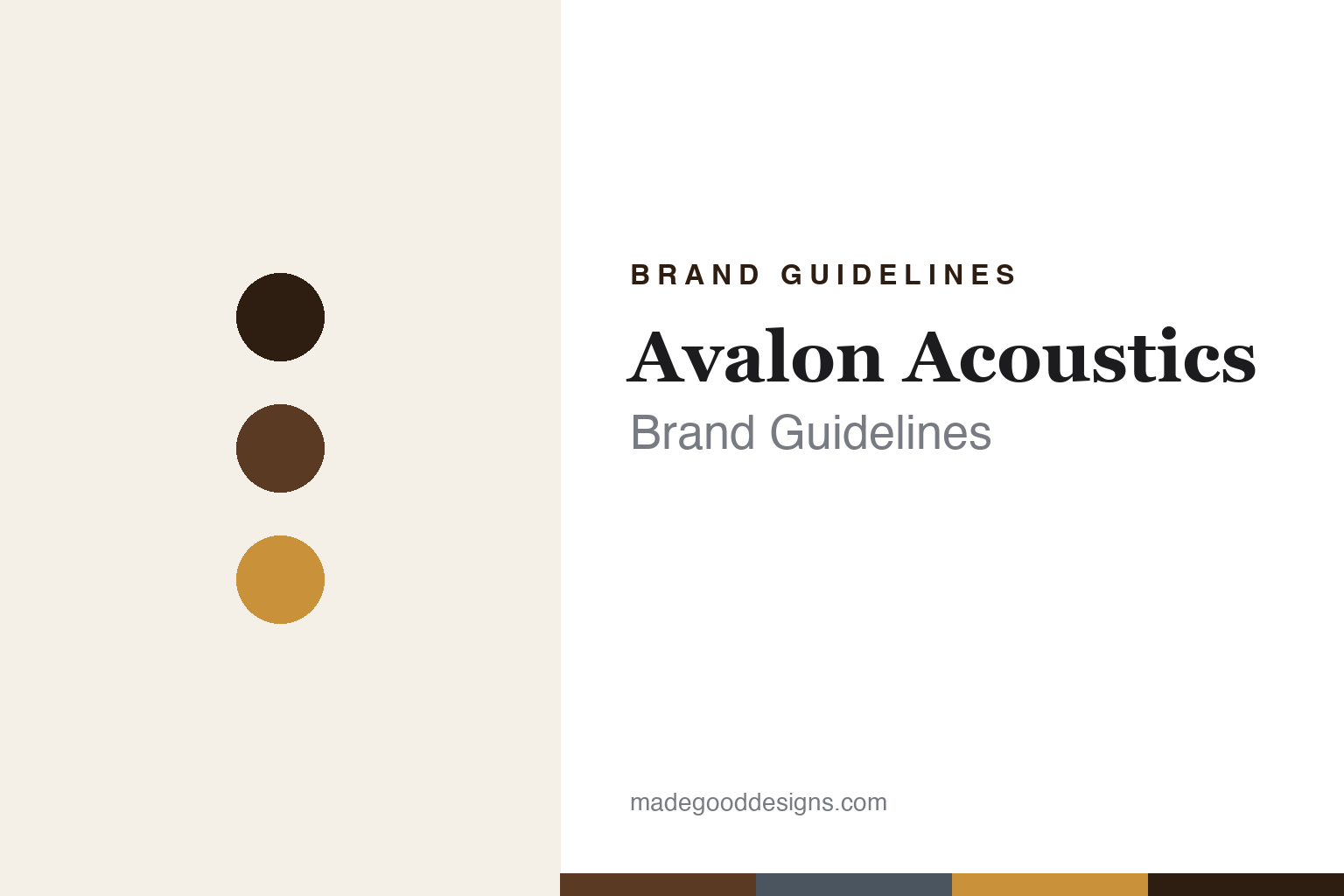
Avalon Acoustics Brand Guidelines
The Boulder loudspeaker maker known for faceted cabinets.
Aa
Two constants: a walnut, slate and amber palette and a faceted serif register. Abstract homage — not an Avalon Acoustics product or mark; no loudspeaker, logo or nameplate is reproduced.
Boulder
A founder, a partner and an amplifier maker.
Avalon Acoustics is a loudspeaker maker in Boulder, Colorado, and its early history is often told more simply than the sources allow. It is sometimes described as founded by Charles Hansen and Neil Patel together; the documented account is different. Writing in Stereophile in October 2008, Wes Phillips called Charles Hansen the company’s founder and said that Hansen’s partner sold his half of Avalon to the amplifier designer Jeff Rowland. “In 1989, Rowland sold his half of the company to its current owner, Neil Patel, who subsequently bought out Charlie Hansen’s half,” Phillips wrote. PS Audio’s Copper magazine, marking Hansen’s death in November 2017, described him as “one of the founders” of Avalon.
Avalon’s own website gives no founding year, and we have not found one in a source we could check. Phillips recalled first hearing Avalon’s Ascent loudspeakers about twenty years before his 2008 article, when Rowland sent a pair to the shop where Phillips worked, which sold Rowland’s electronics; he remembered their “gem-like, faceted cabinets and remarkable soundstaging.” Hansen went on to co-found the electronics maker Ayre Acoustics in 1993, English Wikipedia says.
Colorado’s business register records Avalon Acoustics, Inc. as registered in the state on 20 November 1989 — the year of Patel’s purchase — as a corporation formed in Pennsylvania, with its principal address on Wilderness Place in Boulder.
Colour
Facets, wood and a monitor for engineers.
The look has stayed constant. Avalon’s cabinets are raked back and cut into facets, removing the corners at the top and bottom of the baffle; Stereophile explained in 2008 that the shaping, like a felt pad in the grille, is meant to reduce diffraction, and quoted Patel describing the facets as “a functional construct that aids in the transition from 2 pi to 4 pi space of the driver vibrations.” He told the magazine that the match between crossover design and cabinet shape is what produces the speakers’ imaging: “One without the other is ineffective.”
The company’s archived websites credit every product to Patel — “All products designed by Neil Patel for Avalon Acoustics,” the footer read in the early 2000s, when he was listed as president and Lucien Pichette as vice-president. Model names over the years include the Ascent, Eclipse, Avatar, Arcus, Radian, Eidolon, Osiris and Diamond, and later the Indra, Isis, Saga and Tesseract. In 2008 Stereophile counted 13 models in production and priced the Indra at $19,995 a pair. In 2015 SoundStage! Ultra gave the price of the top model, the Tesseract, as $325,000 a pair, though its writer, Jeff Fritz, questioned the company’s technical claims for it.
Avalon has also built studio monitors. Its website in 2005 described a Mixing Monitor sold under an AvalonPro name, alongside a multichannel range for home theatre that included an in-wall speaker, and English Wikipedia says the engineers of Casa Guidi, Frederica von Stade’s 2002 album with the Minnesota Orchestra, used reference monitors “designed by Neil Patel and Keith O. Johnson, and built by Avalon Acoustics of Boulder, Colorado.”
Typography
Design and documentation.
Colorado’s Front Range, around the city of Boulder, is home to several of America’s high-end audio makers. Avalon Acoustics builds loudspeakers in Boulder; Ayre, founded in Boulder in 1993 according to English Wikipedia, now gives its address at Niwot, just north-east of the city; Boulder Amplifiers moved to Louisville, east of Boulder, in 2016; and YG Acoustics gives its headquarters and machining plant as Denver.
The others are spread more widely: MartinLogan in Lawrence, Kansas, where it was founded — in 1979 according to English Wikipedia, in 1983 according to the company — and where it still has its design centre; Rockport Technologies in South Thomaston, Maine, where SoundStage! found it in 2012; and Constellation Audio in California, which Hi-Fi News called a “Californian amplifier specialist” in 2025.
The shows have changed too. For years the Consumer Electronics Show in Las Vegas gave high-end audio rooms of its own, latterly at the Venetian hotel, and Boulder showed its 3050 amplifiers there in January 2011; at CES 2019, Stereophile wrote that the curtain had closed on the show as the place for high-end launches. Denver had its own event, the Rocky Mountain Audio Fest, first held in 2004; its organisers cancelled the 2021 show and all future ones. AXPONA, held at Schaumburg near Chicago, now describes itself as North America’s largest high-end audio show.
Prices at this level can be startling: Boulder’s 3050 mono amplifiers cost about $195,000 a pair in 2011, Enjoy the Music reported. Several of these makers remain small and privately held.
This guide sets out what can be checked about each brand — who founded it, who owns it, and what it says about where its products are made — and marks clearly what rests only on the company’s own word.
Aa
A classical serif for a maker that treats each cabinet as a cut stone. (Specimen set in Cormorant Garamond, a serif STAND-IN; NOT the Avalon Acoustics logo.)
Avalon Acoustics
Made by hand in Boulder.
Where the speakers are made is one of the better-documented points. Stereophile visited Avalon’s workshop in Boulder in 2008 and reported that the cabinets are built by hand, from multiple layers of MDF under wood veneer, on custom jigs designed by Pichette, with new jigs and clamps for each model. The company’s current website says its loudspeakers are “built entirely by hand, one left and right matched pair at a time,” by a team “in the foothills of the Colorado Rocky Mountains,” and that “we craft our loudspeakers as musical instruments, not appliances.” Drive units are another matter: the Indra used concave ceramic tweeter and midrange domes and Nomex-Kevlar woofers, Stereophile reported, and Fritz wrote in 2015 that Avalon appeared to use other manufacturers’ drivers; we have not found the company saying where they come from.
The address has not moved in a long time. The company’s archived website gave 2800 Wilderness Place, Boulder, in 2003; Stereophile printed the same address in 2008; and it is the principal address in the state register today. In 2017 the website said Avalon’s designs had set a reference standard “for over 25 years” and quoted Patel: “Music is the passion in our blood and the muse of our intellect.”
Avalon appears still to be trading. Its website, last dated 2023, says “our journey of more than 30 years continues” and lists three series — Legacy, Precision and Signature, the last comprising the Isis Signature, Saga Signature and Tesseract — and Colorado’s register listed Avalon Acoustics, Inc. in good standing when we checked in October 2026. Stereophile wrote in 2008 that under Patel’s direction Avalon had “built a reputation for corporate stability.”
For a design guide, Avalon Acoustics shows how a single shape — the faceted, gem-like cabinet — can carry a brand for decades. Compare Ayre Acoustics, the company its founder started next, and Wilson Audio, another American maker of sculpted loudspeakers. For this guide we use walnut brown, Rocky Mountain slate and a warm amber with a serif, an unofficial interpretation; no product or logo is reproduced.
Explore & save
Keep Avalon Acoustics’s identity on hand — save it to a board in the Made Good inspiration library.
Avalon Acoustics identity set
Pin the Avalon Acoustics walnut, slate and amber palette and the faceted serif register to your own board.