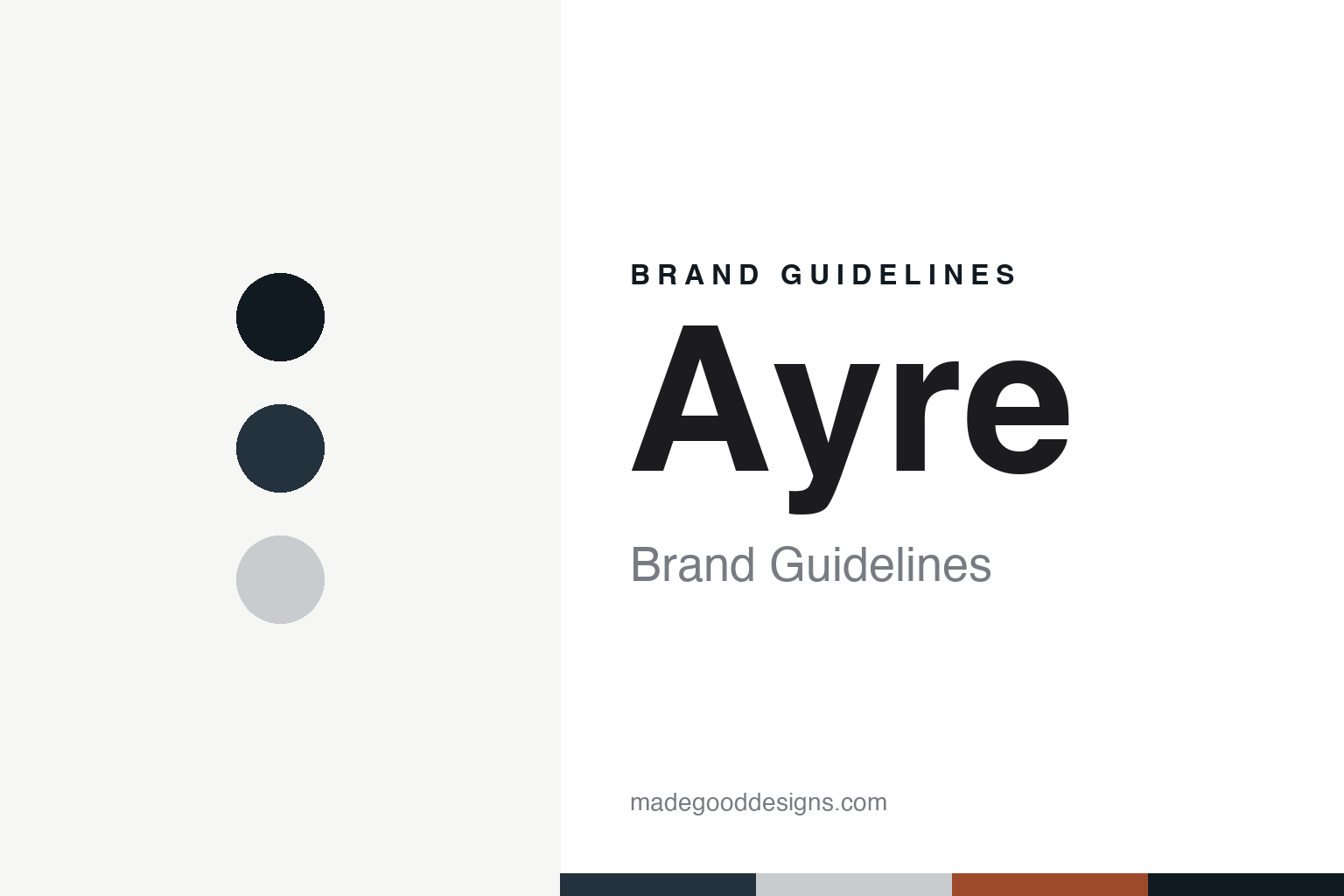
Ayre Brand Guidelines
Charles Hansen’s zero-feedback amplifier maker in Boulder.
Aa
Two constants: an Ayre slate, silver and copper palette and an engineered sans register. Abstract homage — not an Ayre product or mark; no component, logo or nameplate is reproduced.
Boulder, 1993
A loudspeaker designer turns to amplifiers.
Ayre Acoustics was founded in Boulder, Colorado, in January 1993, the company says. Its founder, Charles “Charley” Hansen (1956–2017), had studied physics at the University of Colorado Boulder, according to an obituary by Bill Leebens in PS Audio’s Copper magazine, and had co-founded the Boulder loudspeaker maker Avalon Acoustics; Ayre’s own history says simply that he founded it. Stereophile’s obituary says he left Avalon in 1992 and, after a year’s sabbatical, started Ayre to make amplifiers.
Accounts of who founded the company differ. English Wikipedia lists two co-founders alongside Hansen, Katie Lehr and Peter Bohacek; the company’s own timeline names only Hansen, so we give both versions.
The first product, the company says, was the V-3 power amplifier of 1993, followed by the K-3 preamplifier in 1997, the V-1 amplifier in 1998 and the D-1 DVD player in 1999; its timeline also marks the MX-R monoblock amplifiers of 2006. From the start the circuits were fully balanced and used no overall negative feedback — “zero-feedback,” in Ayre’s phrase — an approach the company still describes as the basis of its “house sound,” which it sums up as “resolution, clarity, and drive with smooth refinement.”
In 1996 Hansen hired Ariel Brown, then a student at the Colorado School of Mines. The company says Brown hand-built early K-3 preamplifiers and V-1 amplifiers beside Hansen and went on to become its lead designer, the role he held for most of the following two decades.
Colour
From DVD players to Neil Young’s Pono.
Hansen was as interested in digital playback as in amplifiers. In a 2015 interview reprinted by The Absolute Sound in December 2017, he said the finalising of the DVD specification in late 1996, with 96kHz/24-bit capability included, was “the trigger point” for his work in digital audio. He had first, he said, explored the analogue record-and-replay chain in the late 1980s, and found limits there — such as the resonances of the cutting heads used to cut LP acetates — that he saw no practical way to cure. Ayre’s disc players were followed by USB converters such as the QB-9 and by a digital filter of its own design, which the company calls MP.
Its best-known piece of digital work reached well beyond the hi-fi shop. When Neil Young’s PonoPlayer, a high-resolution portable music player, was being developed, early announcements named the British company Meridian as the partner; in 2014 Meridian was replaced by Ayre, whose engineers designed the player’s audio output circuitry, English Wikipedia says. Press coverage that year described Ayre as an 18-person company that had worked quietly in Boulder since 1993, and English Wikipedia gives the same headcount for 2014.
Hansen kept working through serious injury. In 2006, Copper reported, he was struck by a motorcyclist who had crossed the centre line while he was cycling near Boulder, and was left paralysed from the chest down. He died on 28 November 2017, aged 61, according to Ayre and The Audio Beat.
The range he left runs from the flagship R series to smaller, cheaper lines. Stereophile’s Recommended Components lists the KX-R Twenty preamplifier at $29,950 and describes it as using Ayre’s “AyreLock” power-supply regulation and the “diamond” output circuit first used in its 5 series. The “8 series” came later: the VX-8 power amplifier made its debut at the AXPONA show in April 2023, priced at $6,800, and was reviewed in Stereophile that October. Ayre says the magazine placed it in Class A of its Recommended Components.
Typography
Design and documentation.
Colorado’s Front Range, around the city of Boulder, is home to several of America’s high-end audio makers. Avalon Acoustics builds loudspeakers in Boulder; Ayre, founded in Boulder in 1993 according to English Wikipedia, now gives its address at Niwot, just north-east of the city; Boulder Amplifiers moved to Louisville, east of Boulder, in 2016; and YG Acoustics gives its headquarters and machining plant as Denver.
The others are spread more widely: MartinLogan in Lawrence, Kansas, where it was founded — in 1979 according to English Wikipedia, in 1983 according to the company — and where it still has its design centre; Rockport Technologies in South Thomaston, Maine, where SoundStage! found it in 2012; and Constellation Audio in California, which Hi-Fi News called a “Californian amplifier specialist” in 2025.
The shows have changed too. For years the Consumer Electronics Show in Las Vegas gave high-end audio rooms of its own, latterly at the Venetian hotel, and Boulder showed its 3050 amplifiers there in January 2011; at CES 2019, Stereophile wrote that the curtain had closed on the show as the place for high-end launches. Denver had its own event, the Rocky Mountain Audio Fest, first held in 2004; its organisers cancelled the 2021 show and all future ones. AXPONA, held at Schaumburg near Chicago, now describes itself as North America’s largest high-end audio show.
Prices at this level can be startling: Boulder’s 3050 mono amplifiers cost about $195,000 a pair in 2011, Enjoy the Music reported. Several of these makers remain small and privately held.
This guide sets out what can be checked about each brand — who founded it, who owns it, and what it says about where its products are made — and marks clearly what rests only on the company’s own word.
Aa
An engineered sans — plain, technical, Boulder-built. (Specimen set in Archivo, a sans STAND-IN; NOT the Ayre logo.)
Ayre
Still independent, still in Boulder.
Ayre has not been sold, as far as the sources we checked show. English Wikipedia describes it as a privately held company, and we found no acquisition reported in the trade press we consulted. After Hansen’s death, Ariel Brown, by then lead designer, became chief technology officer and vice president, the company says, and a press release dated 30 March 2023 announced him as president, with sales and marketing director Jake Forsyth as vice president. Ayre’s own website gives the titles a house twist: “Ayrehead-In-Chief” and “Lieutenant Ayrehead.”
On manufacturing, the company is direct. “Ayre products are manufactured in Boulder, Colorado,” its website says, adding that “each component is carefully hand-assembled on-site by a dedicated technician.” We give that as the company’s claim; we did not find an independent account of the factory. The range on its website in October 2026 included the MX-R Twenty monoblock amplifiers, the VX-8 amplifier, the PX-8 phono stage, the EX-8 2.0 integrated amplifier and streaming hub, and the QB-9 Twenty converter.
None of the sources we checked documents Ayre’s logo, its typeface or any official colours, so the palette here is our own. The name is spelled with a “y”; the company trades at ayre.com, where its home page leads with the line “World Class Performance” and an emphasis on “no-compromise stereo equipment.”
For a design guide, Ayre shows how a small company can keep a single engineering idea — balanced circuits without feedback — as its identity for more than three decades, and through the loss of its founder. Compare Pass Labs, another American amplifier maker built around one designer’s philosophy, and Boulder Amplifiers, its Colorado neighbour. For this guide we use slate, brushed silver and a copper accent with a sans, an unofficial interpretation; no product or logo is reproduced.
Explore & save
Keep Ayre’s identity on hand — save it to a board in the Made Good inspiration library.
Ayre identity set
Pin the Ayre slate, silver and copper palette and the engineered sans register to your own board.


