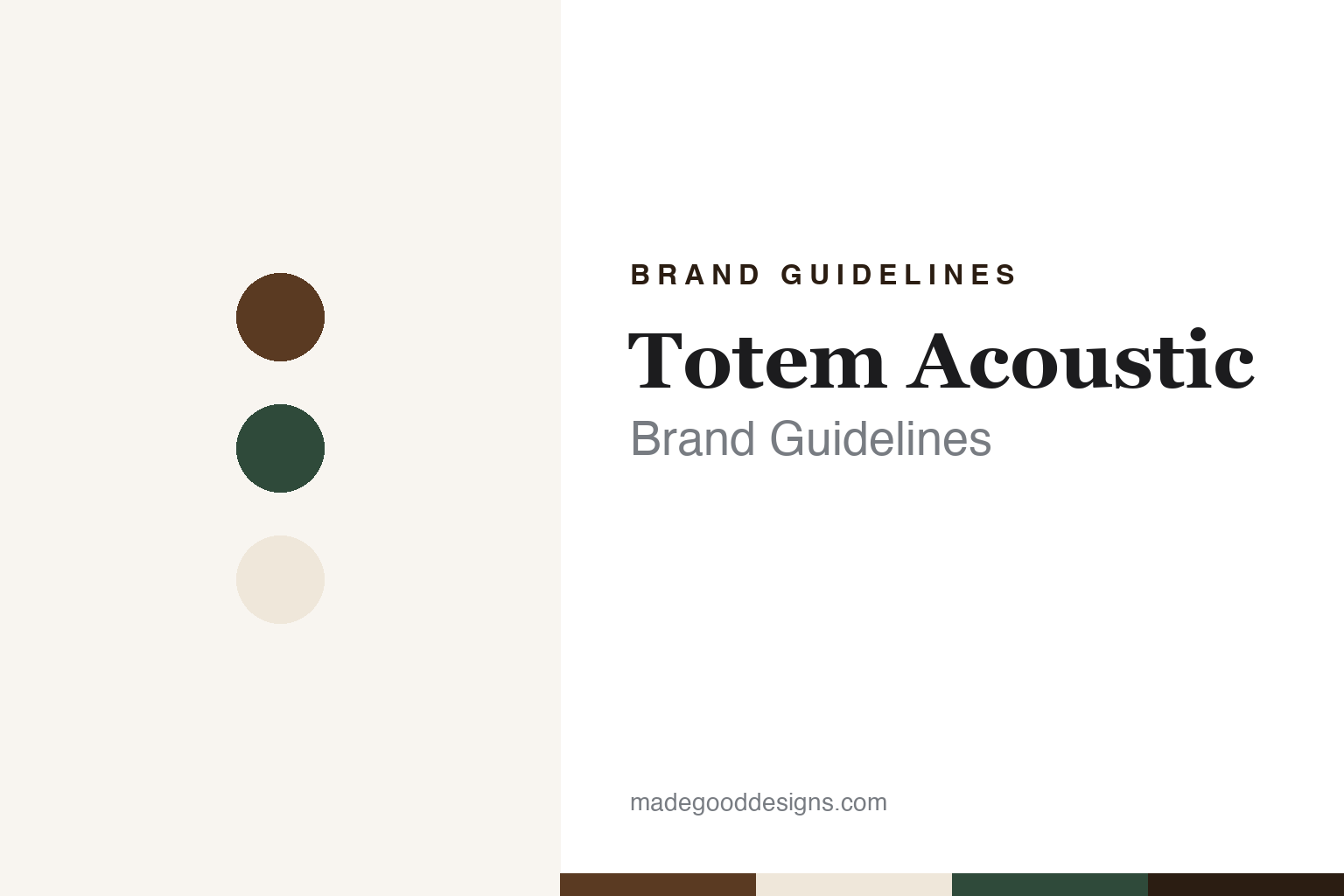
Totem Acoustic Brand Guidelines
The Montreal speaker maker founded by a maths teacher.
Aa
Two constants: a walnut, cream and forest green palette and a warm serif register. Abstract homage — not a Totem Acoustic product or mark; no loudspeaker, logo or nameplate is reproduced.
The Model One
A mathematics teacher’s search for a speaker.
Totem Acoustic was founded in Montreal in 1987 by Vince Bruzzese, who still designs its loudspeakers. The company says he was a high-school mathematics teacher and a music lover who spent the early 1980s listening to loudspeakers without finding one that satisfied him: some were tiring over long sessions, some had a narrow “sweet spot,” and some, he found, got worse with age.
His answer was a small two-way monitor, the Model One, also written Model 1. The company says he developed it in 1987 and that it “sent waves through the Canadian audio industry”; an older version of the Wikipedia article about the company said it was released in 1989 after two years of research, so the speaker may have reached shops after the company was founded. Either way it set the pattern for the brand: small cabinets expected to deliver more bass and a wider soundstage than their size suggests. Stereophile’s online archive shows reviews of it from 1993, with follow-ups in 1998 and 2008.
The company says Bruzzese designs from “his mathematics background and his ears” rather than by conventional engineering methods, and keeps the number of parts in the signal path to a minimum. Its website lists “our own mathematical scales” among the brand’s design principles, alongside customised drivers, handmade crossovers and lock-mitred cabinets.
Colour
From Mani-2 to Torrent.
The range widened through the 1990s. The older Wikipedia text dates the Tott, Rokk and Mani-2 to 1992, and later model names — Arro, Sttaf, Hawk, Forest, Wind, Mite, Dreamcatcher, Thunder, Shaman and Rainmaker — are mostly drawn from nature and weather. Today Totem sells floorstanding, bookshelf and centre speakers, “solution bars” and subwoofers, as well as in-wall, in-ceiling and on-wall models for custom installation; current lines include the Bison series and the Loon monitor. Stereophile’s archive also lists follow-up reports on the Mani-2 in 2001 and on a Signature version in 2009.
Looks are part of the pitch. The company says that “looks matter equally as much” as sound, that most of its speakers have “a classic, timeless design,” and that its Element and Wind series offer “exotic, geometric designs and luxurious finish options” for buyers who want something more unusual. Its cabinets are finished in wood veneers, with borosilicate used in some cases, it says.
Its main technical claim is the Torrent woofer, a driver with a ring of neodymium magnets around the voice coil that, the company says, is designed to work without a crossover in the woofer section. According to Totem, the first, 4-inch Torrent arrived in 2007, its 20th anniversary year, in the Tribe III on-wall speaker; a 7-inch version followed in the Element series in 2011, and Torrent V2 drivers in the Element V2 series in 2018. It says each 7-inch driver takes more than nine hours to assemble and weighs almost 5 kilograms.
Where the speakers are made needs a distinction. Totem’s website calls the Bison series “Made in Canada” and the Loon “Engineered and Handcrafted in Canada.” Doug Schneider of SoundStage! Hi-Fi reported in 2020 that Totem does not build its own cabinets but buys them from cabinetmakers “in and around Montreal” and assembles the speakers at its Montreal factory, and that it had earlier run a small factory in China before scaling back overseas production. His example was the Skylight minimonitor, priced at US$1,000 a pair and, he wrote, made entirely in Canada — part of an argument that some Canadian makers were choosing to keep even affordable models at home.
The lower-priced KIN line is different: a US dealer described it in 2026 as designed in Canada but made overseas. Totem’s first powered speaker, the KIN Play, appeared at the end of 2018, reviewers reported, and the company says TONEAudio named it its Budget Loudspeaker of the Year for 2018.
Typography
Design and documentation.
Canada’s loudspeaker industry owes an unusual debt to a government laboratory. The engineer Floyd Toole joined the National Research Council (NRC) in Ottawa in 1965 and, SoundStage! Hi-Fi wrote in 2024, carried out “seminal research in acoustics and psychoacoustics” there in the 1970s, before leaving in 1991 to join Harman International.
The same magazine called that work “pivotal to the remarkable growth of the Canadian loudspeaker industry in the 1980s.” Paul Barton, who founded PSB in 1972, began research at the NRC under Toole in 1974, and Axiom’s founder, Ian Colquhoun, said learning Toole’s methods “changed everything.” Axiom says that Canadian makers including itself, Paradigm and PSB jointly funded a further NRC research project, called Athena, from 1988.
The industry clusters in two provinces. In Ontario, Paradigm says it builds its speakers at its headquarters just outside Toronto, Axiom and Bryston share a plant at Dwight, in Muskoka, and Tri-Art Audio works in Kingston. In Quebec, Totem Acoustic is based in Montreal, Classé gives Montréal as its home, according to their own websites; Verity Audio, which announced in 2024 that it was ceasing operations, was based in Quebec City.
Ownership has moved, too. In 2019 Paradigm’s co-founder Scott Bagby and John Bagby bought Paradigm, Anthem and MartinLogan back from the private-equity firm Shoreview Industries. In 2021 Bryston was sold to its vice-president, James Tanner, in partnership with Colquhoun, and moved most of its manufacturing from Peterborough to Axiom’s plant, Global News reported. Classé’s website now carries a Harman International copyright.
This guide sets out what can be checked about each brand — who founded it, who owns it, and what it says about where its products are made — and marks clearly what rests only on the company’s own word.
Aa
A warm serif for a wood-and-veneer brand. (Specimen set in Fraunces, a serif STAND-IN; NOT the Totem Acoustic logo.)
Totem Acoustic
Still in its founder’s hands.
Totem has stayed with its founder. SoundStage! noted in 2020 that it had not been sold or absorbed by a larger company, and we found no record of a sale in the sources we checked. The company’s website still names Bruzzese as founder and chief designer. Lucy Lentini has been the company’s public face for 25 years, the Canadian trade magazine WifiHifi reported in 2022, when Totem marked its 35th anniversary with an event at its Montreal headquarters attended by retailers and distributors from Sweden, Belgium, the United States and Canada. Business directories list Totem Acoustic Inc. in Saint-Léonard, in the east of Montreal.
The company says it sells worldwide through specialist shops and custom installers. In the Benelux countries and France its importer, Joenit, runs its own Totem pages — it says it found the brand at the Consumer Electronics Show in Las Vegas in 1995 and has carried it ever since — but those are not the company’s official site; that is totemacoustic.com. The word “Totem” is shared by many unrelated businesses, so the full name, Totem Acoustic, is the safer search term.
For a design guide, Totem Acoustic shows how a small company can build a whole identity around one idea — a compact speaker that sounds larger than it looks. Compare Paradigm and PSB, two larger Canadian loudspeaker makers. For this guide we use walnut, cream and a forest green with a serif, an unofficial interpretation; no product or logo is reproduced.
Explore & save
Keep Totem Acoustic’s identity on hand — save it to a board in the Made Good inspiration library.
Totem Acoustic identity set
Pin the Totem Acoustic walnut, cream and forest green palette and the warm serif register to your own board.