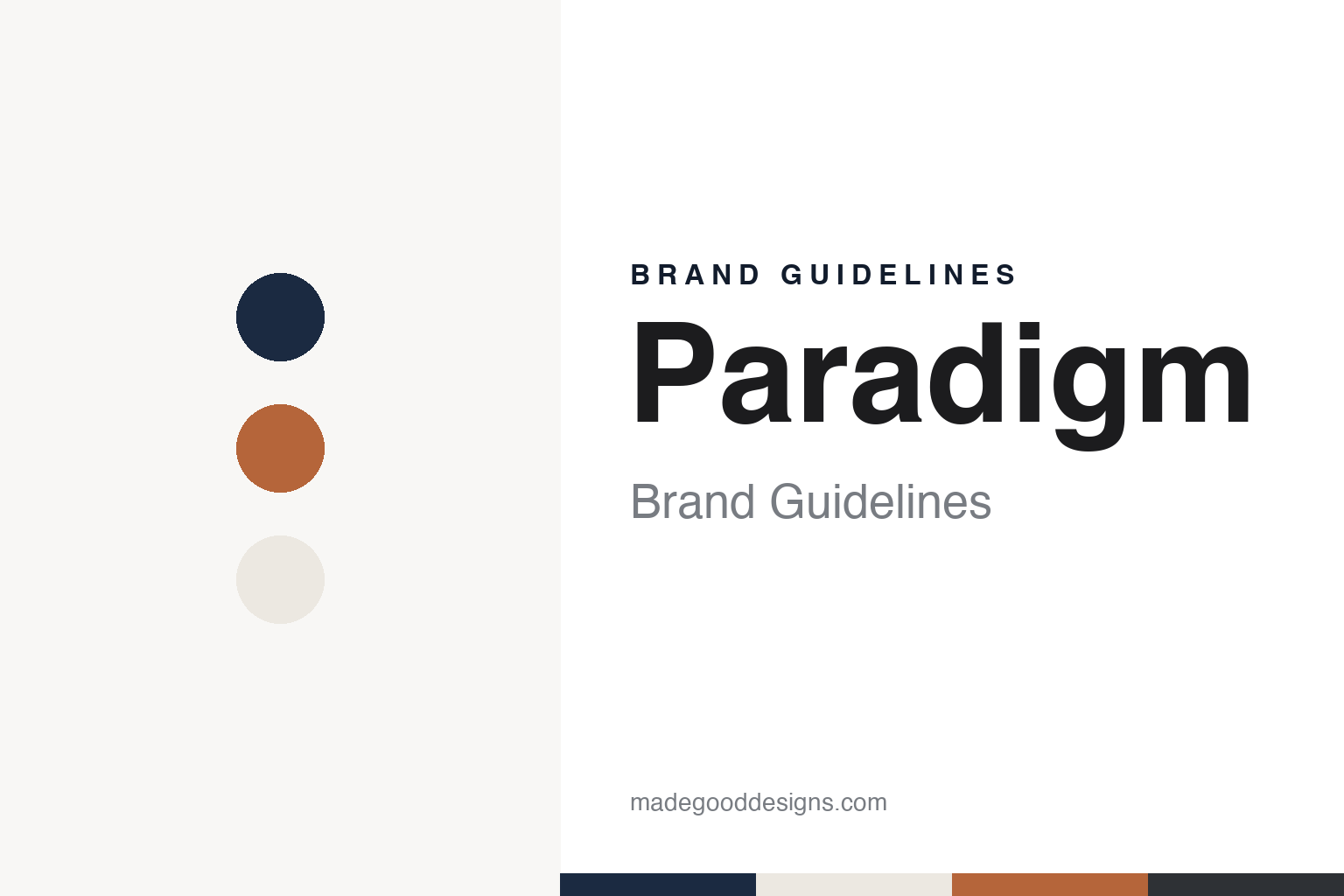
Paradigm Brand Guidelines
The Mississauga speaker maker its co-founder bought back.
Aa
Two constants: a Paradigm navy, graphite and copper palette and an Engineered sans register. Abstract homage — not a Paradigm product or mark; no speaker, logo or nameplate is reproduced.
Changing the paradigm
Two founders, a Toronto show and a dozen dealers.
Paradigm was founded in 1982 by Jerry VanderMarel and Scott Bagby, according to both the company and the Canadian magazine SoundStage!. The company spells its co-founder’s name “VanderMarel,” with a capital M, and we follow it; at least one buyer’s guide gives 1980 as the start date, which we could not confirm against a primary source, so we use the company’s year. Its own history says the two wanted to build high-performance loudspeakers locally, to design their own components “based on science, not speculation,” and to sell them at prices people could afford — and it plays on the name, saying they set out to “change the prevailing industry paradigm.”
The first products were the Models 7 and 9, which the company says were unveiled at a Toronto audio show in 1982, where a dozen dealers signed on. Its timeline lists them as its first bestsellers in 1983, labelled as made in Canada, followed by rapid expansion into the United States from 1985, a die-cast driver chassis in 1986, its first anechoic chamber in 1988 and its first in-wall speaker, the AMS-200, in 1989.
The 1990s brought the speakers that built its name for value. In 1990, the company says, it was voted “#1 Best Price/Value” by Inside Track; the Titan and the Atom became bestsellers in 1991 and 1992. In 1993 it opened the Paradigm Advanced Research Center, or PARC, in Ottawa, which it says was set up by two researchers from the National Research Council of Canada — the federal laboratory in whose anechoic chamber SoundStage! still has loudspeakers measured. Its first powered subwoofer, the PS-1000, followed in 1994, and the Reference Studio series in 1996.
Colour
A factory in Mississauga — and where the speakers are made.
Paradigm’s distinguishing claim is that it builds speakers in Canada. In 2001 it opened a 225,000-square-foot factory in Mississauga, west of Toronto, which it calls one of the largest loudspeaker plants in North America, with computer-controlled woodworking, finishing shops and what it describes as the hemisphere’s largest privately owned anechoic chamber. SoundStage! reported in 2019 that the plant had “several hundred employees.” The company’s address is 205 Annagem Boulevard in Mississauga, and its website says its speakers are “still designed, engineered, and crafted” at its headquarters “just outside Toronto.”
That claim has limits, and the record shows them. In 2013 SoundStage! editor Doug Schneider, who said he had visited the factory many times, wrote that Paradigm had moved some manufacturing to China — including the Monitor series, then still made there, and cabinets for the Reference series — and had later brought more work back to Mississauga after quality problems, using machines shipped over from the Chinese plants. Later reviews were specific: in 2019 SoundStage! Access wrote that all Premier speakers were made in the Mississauga factory, and in 2021 SoundStage! Hi-Fi said the same of the Founder series. We could not confirm where every current range is made; the 2026 announcement of the Premier v2 series says only that it is “designed and engineered in Canada.”
The range has run from budget bookshelf speakers to statement designs. The company’s timeline lists the Signature series of 2004, its first with beryllium tweeters; the SUB 2 subwoofer of 2009; the Prestige series of 2014; the Persona series of 2016, which it calls “bold, colorful” and among the most expensive speakers it has made; and the app-controlled Defiance subwoofers of 2018, which use Anthem’s room-correction software. SoundStage! reviewed the Founder series in 2021. The Premier 820F V2 won the EISA award for floorstanding loudspeakers for 2026–2027, the jury saying it “demonstrates the perfect balance of great sound with impressive, modern appearance.”
Typography
Canada and the high-end trade.
Canada’s loudspeaker industry owes an unusual debt to a government laboratory. The engineer Floyd Toole joined the National Research Council (NRC) in Ottawa in 1965 and, SoundStage! Hi-Fi wrote in 2024, carried out “seminal research in acoustics and psychoacoustics” there in the 1970s, before leaving in 1991 to join Harman International.
The same magazine called that work “pivotal to the remarkable growth of the Canadian loudspeaker industry in the 1980s.” Paul Barton, who founded PSB in 1972, began research at the NRC under Toole in 1974, and Axiom’s founder, Ian Colquhoun, said learning Toole’s methods “changed everything.” Axiom says that Canadian makers including itself, Paradigm and PSB jointly funded a further NRC research project, called Athena, from 1988.
The industry clusters in two provinces. In Ontario, Paradigm says it builds its speakers at its headquarters just outside Toronto, Axiom and Bryston share a plant at Dwight, in Muskoka, and Tri-Art Audio works in Kingston. In Quebec, Totem Acoustic is based in Montreal, Classé gives Montréal as its home, according to their own websites; Verity Audio, which announced in 2024 that it was ceasing operations, was based in Quebec City.
Ownership has moved, too. In 2019 Paradigm’s co-founder Scott Bagby and John Bagby bought Paradigm, Anthem and MartinLogan back from the private-equity firm Shoreview Industries. In 2021 Bryston was sold to its vice-president, James Tanner, in partnership with Colquhoun, and moved most of its manufacturing from Peterborough to Axiom’s plant, Global News reported. Classé’s website now carries a Harman International copyright.
This guide sets out what can be checked about each brand — who founded it, who owns it, and what it says about where its products are made — and marks clearly what rests only on the company’s own word.
Aa
An engineered sans for a speaker maker that leads with its factory. (Specimen set in Archivo, a sans STAND-IN; NOT the Paradigm logo.)
Paradigm
Founder-owned again.
Paradigm’s ownership has gone out and come back. In 1998, SoundStage! reported, it bought Sonic Frontiers and rebranded its electronics as Anthem. In 2003 VanderMarel told Bagby he wanted to explore ventures outside audio. In 2005 the Minneapolis private-equity firm ShoreView Industries bought a controlling interest, with Bagby keeping a minority stake, according to the company’s 2019 announcement; together they formed SVI Holdings, which bought the Kansas electrostatic-speaker maker MartinLogan — in October 2005, English Wikipedia says, adding that its electrostatic production later moved to Mississauga.
With effect from 10 May 2019, according to that announcement, Scott Bagby and John Bagby bought Paradigm, Anthem and MartinLogan outright and ShoreView exited; Scott Bagby became chairman and chief executive and John Bagby managing director. The brands now sit under PML Sound International of Mississauga, which in December 2024 announced it was buying the American speaker maker GoldenEar from The Quest Group, effective 1 January 2025. PML’s 2026 announcement of the Premier v2 named Badar Qureshi as its chief executive and John Bagby as managing director.
For a design guide, Paradigm shows how a value brand can build its identity on where its products are made — and why that claim is worth checking range by range. Compare Anthem, its electronics sibling, and MartinLogan, the electrostatic maker that joined it in 2005. For this guide we use a deep navy, graphite and a warm copper with a sans, an unofficial interpretation; no product or logo is reproduced.
Explore & save
Keep Paradigm’s identity on hand — save it to a board in the Made Good inspiration library.
Paradigm identity set
Pin the Paradigm navy, graphite and copper palette and the Engineered sans register to your own board.