Australian Fashion Week Brand Guidelines
The Sydney week that changed its name with its sponsors and kept its harbour.
Aa
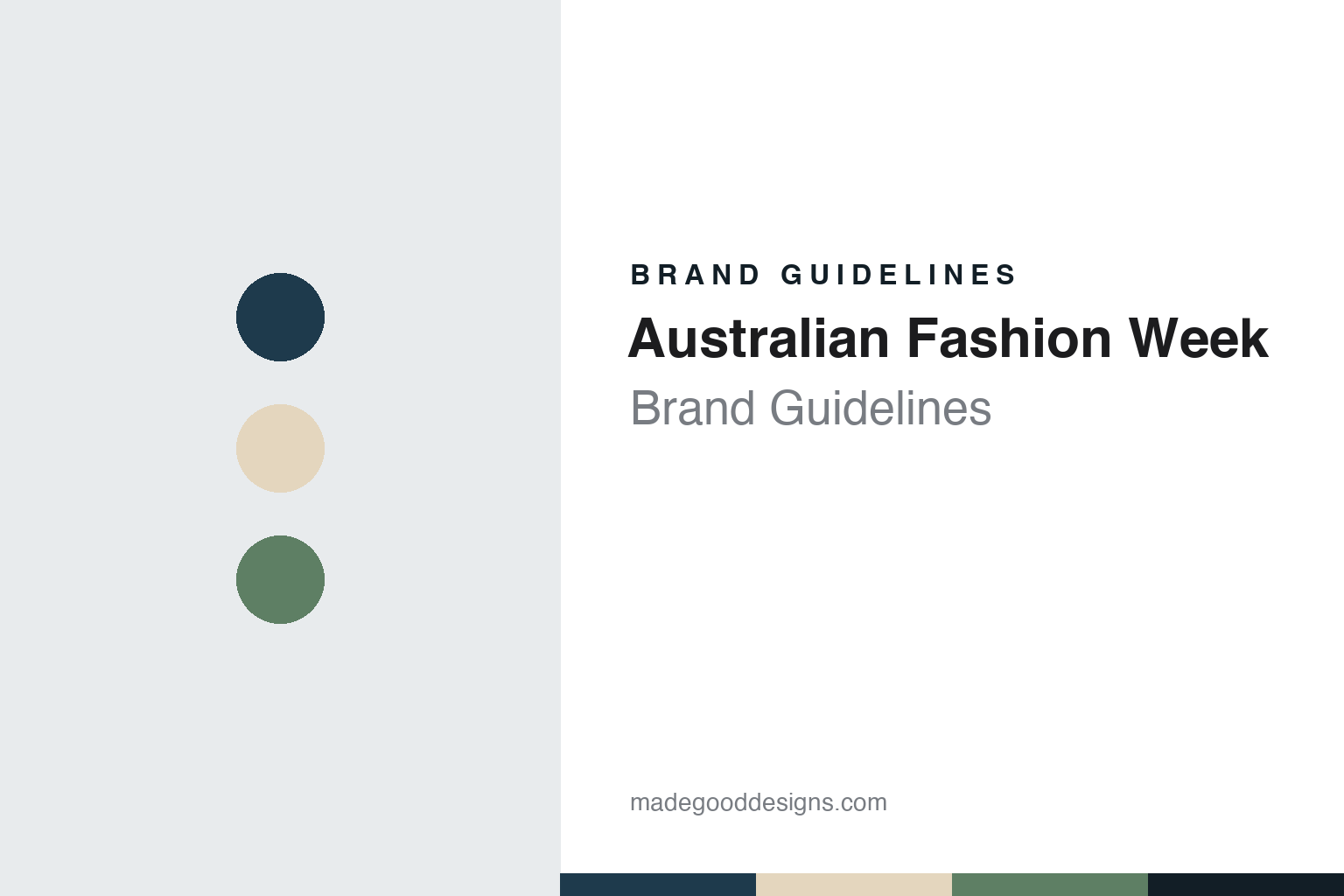
Two constants: an Australian Fashion Week harbour blue, sandstone and eucalyptus palette and a runway grotesque register. Abstract homage — not an Australian Fashion Week mark; no logo, invitation or campaign image is reproduced.
A week in Sydney
Fox Studios, the harbour and a founder’s company, 1996.
Australian Fashion Week began in Sydney in 1996. English Wikipedia credits the idea to Simon Lock, whom it describes as a PR consultant and former ski-magazine reporter. The publicist Murray Bevan, writing in FashioNZ in May 2025, describes Lock as a former concert promoter who set up the event through his company, Spin Communications, and calls the result what would become Mercedes-Benz Fashion Week Australia. Both accounts agree on the year and on the city.
The early venues gave the week its first images. Bevan lists Fox Studios and the harbourside Overseas Passenger Terminal at Circular Quay, and Wikipedia adds Fox Film Studios at Moore Park and, for one period, St Kilda Pier in Melbourne. In those years the shows ran in April or May, Wikipedia says, and the designers who took part were Australian labels presenting their next season to buyers and press, many of them travelling from Europe, Asia and the United States, in Bevan’s account.
Ownership changed in 2005. Wikipedia says Lock sold the event and its parent company, Australian Fashion Innovators, to IMG, the New York sports, fashion and events company, and stayed on with IMG until 2010. ABC News confirmed in May 2025 that IMG had owned the week since 2005, and Bevan describes the IMG years as a move to tighter production and a more structured international marketing approach.
Colour
Mercedes-Benz, Rosemount, Afterpay.
For most of its life the week carried a sponsor’s name in front of its own. Wikipedia says the Rosemount Estate wineries took over the naming rights from Mercedes-Benz in 2006, when the event became Rosemount Australian Fashion Week, shortened to RAFW. The rights passed back to Mercedes-Benz in 2011, and the long form Mercedes-Benz Fashion Week Australia, or MBFWA, ran until the payments company Afterpay took the title in 2020, Wikipedia says. Grazia Australia reported in November 2024 that Afterpay left as lead sponsor in 2023 and that the jewellery brand Pandora joined as official sponsor in 2024.
The venue changed with the decade. Wikipedia says the week moved in 2013 from the Overseas Passenger Terminal in The Rocks to Carriageworks, a former railway workshop in Eveleigh, and Grazia later referred to the “brutalist runways” of the Carriageworks precinct. In 2015 the schedule shifted to May so the week could present Resort collections to international buyers and media, Wikipedia says, and Bevan describes the years from 2015 to 2024 as a period focused on the resort calendar.
The audience was industry first. Grazia wrote in December 2019 that for its first 25 years the week had been an industry-only event, with a separate public extension called Mercedes-Benz Fashion Weekend Edition. In the same article IMG gave its own count of about 1,600 industry professionals from more than 20 countries attending each year, and named Carriageworks as the main venue.
In November 2024 IMG announced that it would stop running the week after 20 years and focus on its talent-representation business, Grazia reported; IMG Models in Sydney was not affected. The not-for-profit Australian Fashion Council stepped in. Fashion Journal reported on 16 December 2024 that the council would produce the 2025 week with Destination NSW, the state government’s tourism and major events agency, at Carriageworks from 12 to 16 May 2025.
Typography
Names, venues and seasons.
A fashion week usually takes its name from a city, and that name is the one part of its identity that rarely changes. The rest follows a calendar. In New York the shows run in February and September, and Wallpaper* described the September 2026 week as the start of a month of shows that moved on to London, Milan and Paris. Each round carries a season label, spring/summer or autumn/winter, set roughly six months ahead of the clothes reaching shops.
Behind most weeks sits an organising council or trade body that keeps the official schedule. In New York that is the Council of Fashion Designers of America, which took over the official schedule in 2014; other cities have their own councils and chambers, each with a formal name that is often longer and less familiar than the week it runs. Production companies, venues and sponsors work alongside them, and the division of roles differs from city to city.
Sponsors have often put their names in front of the city. From 2007 to 2015 the New York shows produced by IMG were billed as Mercedes-Benz Fashion Week New York, and FashionUnited reported in January 2015 that the car maker also backed weeks in Sydney, Istanbul and Berlin. When a title sponsor leaves, the week usually returns to its plain city name, so the same event can appear under several names in its own history.
Venues and visual material change even faster. A week may move from tents in a park to a performing-arts campus to a studio building within a few years, while individual houses stage shows in rooms of their own choosing. Invitations, schedules and season campaign images are made new for each round, and a gala such as the Met Gala sets a fresh theme and dress code every May. The guides in this collection trace those changing parts around a name that stays the same.
Aa
A clean grotesque for a name that has worn several sponsors. (Specimen set in Archivo, a sans STAND-IN; NOT the Australian Fashion Week logo.)
Australian Fashion Week
A council-run week at the MCA.
The first council-run week looked different. ABC News reported on 21 May 2025 that the 2025 edition at Carriageworks had a slimmer schedule and that every show was invite-only, where the public had earlier been able to buy tickets for some events. Kellie Hush, then chief executive of the week, described it to ABC News as a trade event, and said the four-month lead time had led organisers to simplify the programme and concentrate on the industry side.
For 2026 the week moved to the water. Ragtrader reported on 20 February 2026 that the council and Destination NSW had confirmed a new anchor venue, the Museum of Contemporary Art Australia at Circular Quay, after more than a decade at Carriageworks. The 2026 week ran from 11 to 15 May, with a purpose-built runway and presentation space inside the museum, industry talks, media and buyer facilities and satellite events around the city. Ragtrader said the programme would include established, emerging and First Nations designers and a dedicated graduate runway, delivered by the council’s subsidiary AFC Fashion Events. An executive board chaired by Marianne Perkovic oversees the week, and Hush returned in the role of fashion director. RUSSH reported on 18 May 2026 on shows staged at the museum against a white backdrop and others held off-site, from an industrial space on Oxford Street to a sunset show at The Lands by Capella.
The name itself has stayed plain. Each era added a sponsor in front of the same three words, from RAFW to MBFWA, while the Sydney base and, since 2015, the May slot remained. The organisers present the week as an industry platform first, with consumer events alongside it.
For a design guide, Australian Fashion Week shows how an event can keep a generic, place-based name while its sponsor prefix, its owner and its venue all change around it. Compare São Paulo Fashion Week, another southern-hemisphere week founded in 1996, and New York Fashion Week, another week named after its city. For this guide we use a deep harbour blue, warm sandstone and a muted eucalyptus green with a sans, an unofficial interpretation; no product or logo is reproduced.
Explore & save
Keep Australian Fashion Week’s identity on hand — save it to a board in the Made Good inspiration library.
Australian Fashion Week identity set
Pin the Australian Fashion Week harbour blue, sandstone and eucalyptus palette and the runway grotesque register to your own board.
Source & notes
Frequently Asked Questions
What font can I use to match the Australian Fashion Week look?
This guide describes Australian Fashion Week’s type as “A clean grotesque for a name that has worn several sponsors”. Its type specimen is set in Archivo from Google Fonts as a stand-in; Archivo is not Australian Fashion Week’s own lettering.
What colours are in the Australian Fashion Week palette?
This guide’s Australian Fashion Week palette is Harbour blue #1E3A4C, Night ferry #121E26, Sandstone #E4D6BE, Eucalyptus #5E7F64 and Paper #F7F4EE. The tones are the guide’s own unofficial interpretation, not official Australian Fashion Week hex codes.
When was Australian Fashion Week founded?
Australian Fashion Week was founded in 1996, in Sydney, Australia.
Who founded Australian Fashion Week?
Australian Fashion Week was founded by Simon Lock in 1996.