Berlin Fashion Week Brand Guidelines
The Berlin week that began at the Brandenburg Gate in 2007 and was rebuilt around new formats after 2022.
Aa
Two constants: an asphalt, concrete and signal-brick palette and an industrial grotesque register. Abstract homage — not a Berlin Fashion Week mark; no logo or campaign image is reproduced.
A tent at the Brandenburg Gate
July 2007, eleven shows.
Berlin Fashion Week, also called the Berliner Modewoche, has been held twice a year since 2007, according to English and German Wikipedia, in January and July. Der Spiegel reported on 13 July 2007 that the first edition had opened with a show by Hugo, the younger label of Hugo Boss, with the Brandenburg Gate as backdrop. The magazine counted eleven shows over four days and around 800 invited guests, and noted that the mid-July date put Berlin ahead of New York, London, Milan and Paris in the season’s show cycle.
A carmaker’s name sat on the main platform from the start. German Wikipedia says Mercedes-Benz was title sponsor of the twice-yearly Mercedes-Benz Fashion Week Berlin from 2007. In a January 2018 interview with FashionUnited, Bettina Haussmann of Mercedes-Benz said the company entered the Berlin fashion week in 2007 and had begun there with the agency IMG. English Wikipedia says that from July 2011 the event took place partly in front of the Brandenburg Gate.
The early weeks spread across the city. German Wikipedia records that between 2008 and 2013 the designer Michael Michalsky staged his StyleNite during the week, and that shows were held on special trains on U-Bahn line U5 and, from 2013, on line U8 as well. English Wikipedia lists trade fairs that formed part of the week, among them Bread & Butter and Premium, alongside public show floors.
The trade side shaped the week’s reputation. FashionUnited wrote in January 2026 that while the fairs drew large visitor numbers, the shows and the fairs alike came to be seen as too commercial. In December 2020 the same title reported that, after the insolvency of the Panorama fair, the organisers of the Premium and Neonyt fairs had announced a move to Frankfurt, and that the city of Berlin had raised its support for a relaunch in January 2021 that brought back Der Berliner Salon and added a Berlin Fashion Summit.
Colour
New owners of the schedule, 2018–2023.
The Mercedes-Benz platform was itself reworked in 2018. German Wikipedia says the platform for shows in Germany was revised and relaunched that year under the initiative of Mercedes-Benz Deutschland. Haussmann told FashionUnited in January 2018 that the company had decided to take the event more into its own hands, with a new MBFW platform at the E-Werk that favoured quality over quantity, and a separate format, Fashion HAB, in the Halle am Berghain, run with the Fashion Council Germany and the Italian fashion chamber.
Der Berliner Salon has its own history inside the week. German Wikipedia says the curated group exhibition was set up in 2015 on the initiative of the Fashion Council Germany, led by Christiane Arp, and is held in the Gemäldegalerie, Berlin’s picture gallery. It presents a selection of designers with a focus on young talent.
The title sponsorship ended in late 2022. FashionUnited reported on 7 December 2022 that, after 15 years as title sponsor of the Mercedes-Benz Fashion Week, the carmaker would move to a new format called Mercedes-Benz Fashion Moments, working with individual brands rather than sponsoring the week as a whole. Its first edition, on 18 January 2023 at the former Tempelhof Airport, was staged with the German label Marc Cain, and the formats were produced with the Berlin creative agency Nowadays, which had also worked on the Mercedes-Benz Fashion Week.
The organisation passed to a council. FashionUnited wrote in January 2026 that the Senate of Berlin commissioned the Fashion Council Germany to organise the week, and that the association coordinates the programme and handles international guest management. In a February 2024 interview with the same title, Arp, the council’s president, said the collaboration began in January 2023 and named the formats that carry the schedule: Berlin Contemporary, Der Berliner Salon, Intervention and Studio2Retail. Berlin Contemporary, set up in 2023 as a concept competition funded by the Senate department for economic affairs, selects brands each season to stage a show in Berlin.
Typography
Cities, councils and seasons.
A fashion week usually takes its name from a city, and that name is the one part of its identity that rarely changes. The rest follows a calendar. In New York the shows run in February and September, and Wallpaper* described the September 2026 week as the start of a month of shows that moved on to London, Milan and Paris. Each round carries a season label, spring/summer or autumn/winter, set roughly six months ahead of the clothes reaching shops.
Behind most weeks sits an organising council or trade body that keeps the official schedule. In New York that is the Council of Fashion Designers of America, which took over the official schedule in 2014; other cities have their own councils and chambers, each with a formal name that is often longer and less familiar than the week it runs. Production companies, venues and sponsors work alongside them, and the division of roles differs from city to city.
Sponsors have often put their names in front of the city. From 2007 to 2015 the New York shows produced by IMG were billed as Mercedes-Benz Fashion Week New York, and FashionUnited reported in January 2015 that the car maker also backed weeks in Sydney, Istanbul and Berlin. When a title sponsor leaves, the week usually returns to its plain city name, so the same event can appear under several names in its own history.
Venues and visual material change even faster. A week may move from tents in a park to a performing-arts campus to a studio building within a few years, while individual houses stage shows in rooms of their own choosing. Invitations, schedules and season campaign images are made new for each round, and a gala such as the Met Gala sets a fresh theme and dress code every May. The guides in this collection trace those changing parts around a name that stays the same.
Aa
An industrial grotesque for a week staged in halls, galleries and a former airport. (Specimen set in Space Grotesk, a sans STAND-IN; NOT the Berlin Fashion Week logo.)
BFW
One city name over many formats.
Since 2023 the week has presented itself as Berlin Fashion Week, often shortened to BFW on its official site, rather than under a sponsor’s name. The venues have moved with the formats. FashionUnited described a summer 2025 show staged in the 31-metre-high Hall of Honour at the Palais am Funkturm, part of the Messe Berlin grounds, under a large silver inflatable sculpture by the artist Eben Weile Kjaer. The same halls had hosted the Premium and Panorama fairs a little over three years earlier, the article noted.
The schedule is now built from formats run by different partners. FashionUnited said in January 2026 that the Intervention format is organised by the creative agency Reference Studios, and that its July 2025 edition included the first Berlin show by the Berlin-based label Ottolinger. The article also recorded showrooms and dinners hosted by the magazine 032c and by the online retailer Zalando during the week, alongside a curated off-runway programme.
Distribution changed as well. German Wikipedia, citing Der Tagesspiegel, says shows have been streamed online since 2019, which made them available outside Berlin. That shift matters for the look of the week: a show staged in a gallery, a former airport or an exhibition hall is seen as much on screen as in the room, so the setting becomes part of each season’s image.
Across these changes the constants are the city name and the twice-yearly rhythm. The sponsor-titled name of 2007 to 2022, the E-Werk and Halle am Berghain formats of 2018, and the council-run programme from 2023 all sat under the same two seasons, January and July.
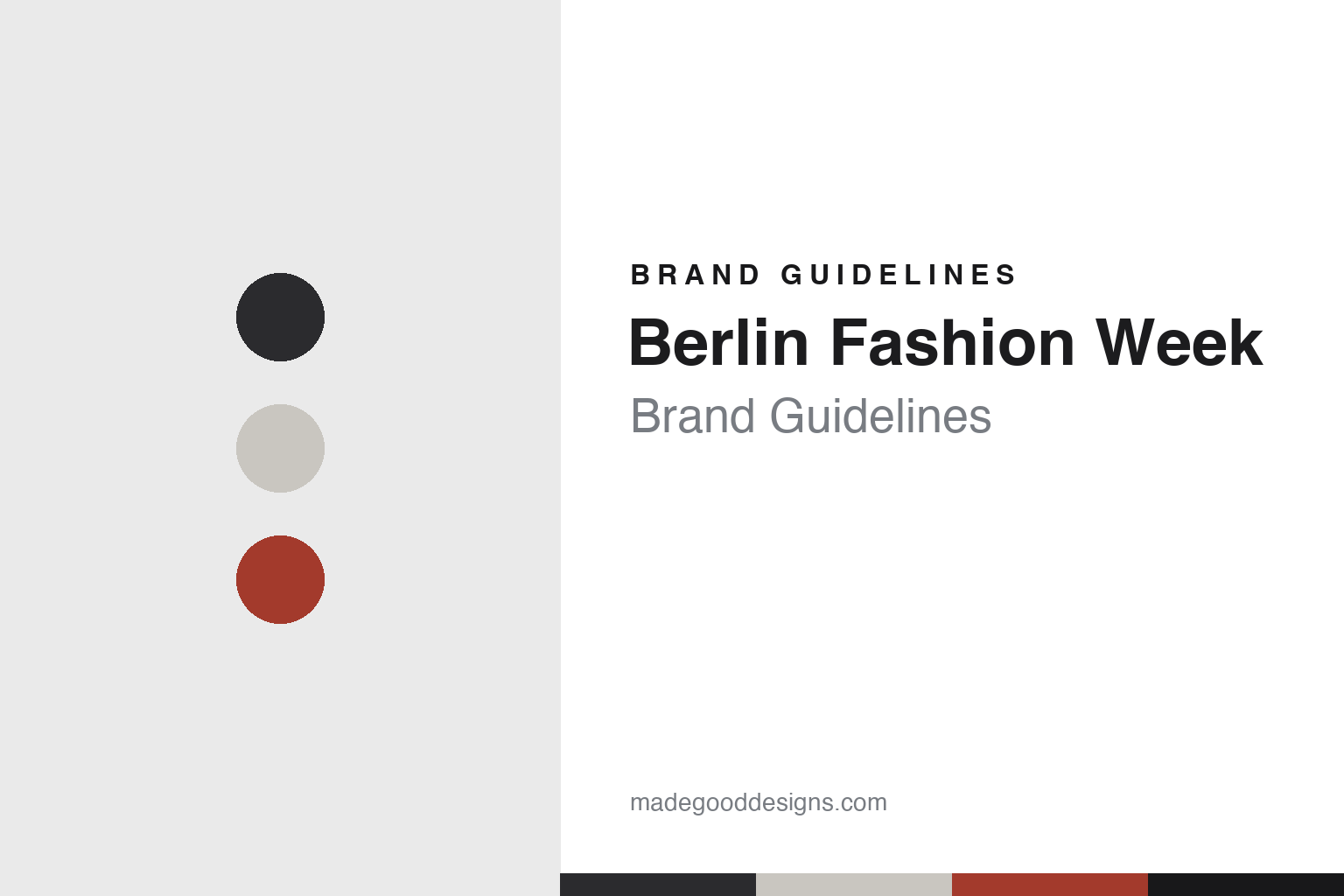
For a design guide, Berlin Fashion Week shows how an event can keep a city name steady while sponsors, organisers and venues change around it, from a tent at the Brandenburg Gate to a hall at the trade-fair grounds. Compare Copenhagen Fashion Week, another northern European week, and Hugo Boss, whose Hugo label opened the first edition. For this guide we use asphalt grey, concrete and a signal brick red with a sans, an unofficial interpretation; no product or logo is reproduced.
Explore & save
Keep Berlin Fashion Week’s identity on hand — save it to a board in the Made Good inspiration library.
Berlin Fashion Week identity set
Pin the Berlin Fashion Week asphalt, concrete and signal brick palette and the industrial grotesque register to your own board.
Source & notes
Frequently Asked Questions
What font can I use to match the Berlin Fashion Week look?
This guide describes Berlin Fashion Week’s type as “An industrial grotesque for a week staged in halls, galleries and a former airport”. Its type specimen is set in Space Grotesk from Google Fonts as a stand-in; Space Grotesk is not Berlin Fashion Week’s own lettering.
What colours are in the Berlin Fashion Week palette?
This guide’s Berlin Fashion Week palette is Asphalt #2B2B2E, Night black #18181A, Concrete #C9C6C0, Signal brick #A33A2C and Paper #F4F3F0. The tones are the guide’s own unofficial interpretation, not official Berlin Fashion Week hex codes.
When was Berlin Fashion Week founded?
Berlin Fashion Week was founded in July 2007 (first edition), in Berlin, Germany.