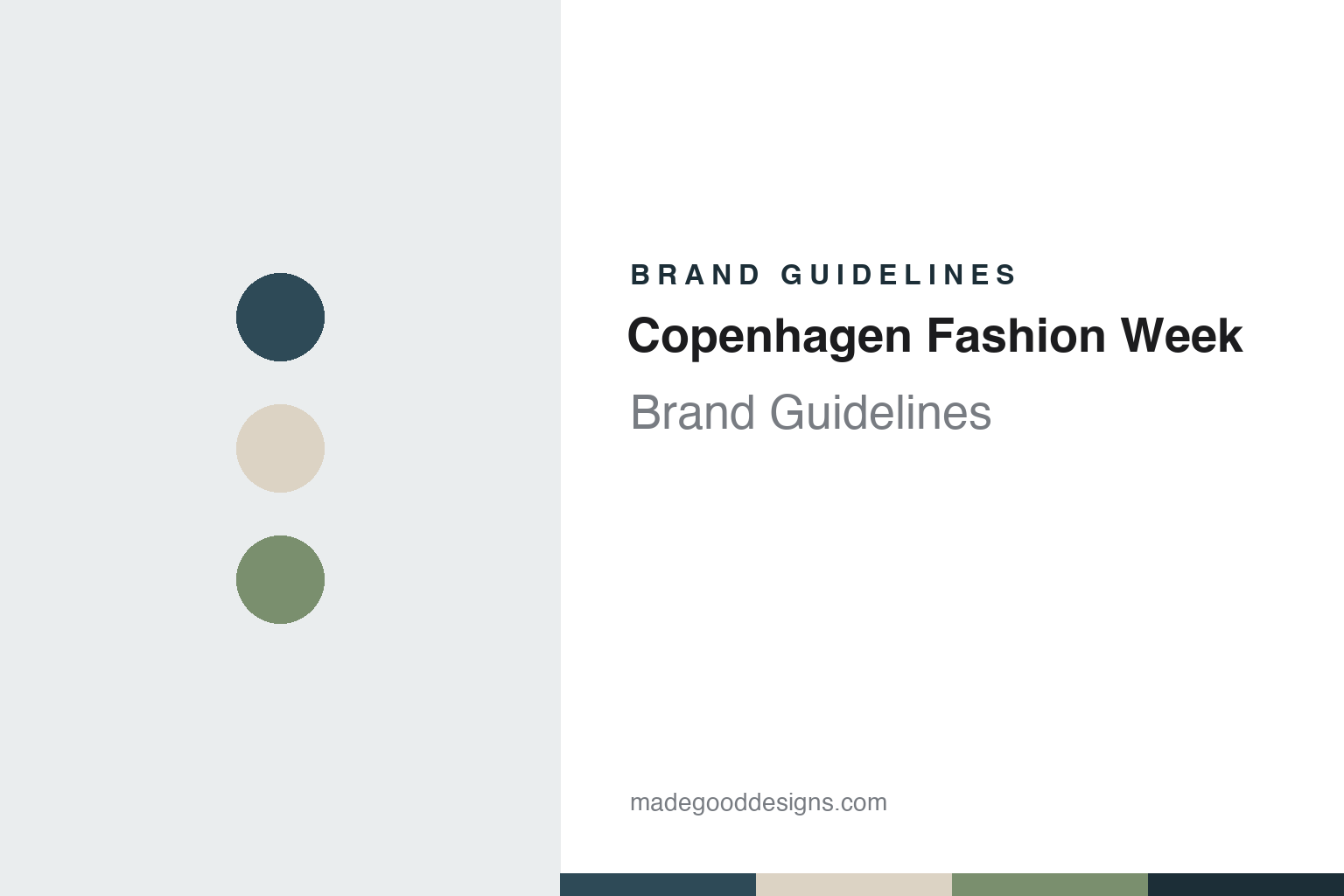
Copenhagen Fashion Week Brand Guidelines
The Danish fashion week that grew out of two trade fairs and later wrote rules for its own schedule.
Aa
Two constants: a harbour slate, pale sand and sea grass palette and a Nordic grotesque register. Abstract homage — not a Copenhagen Fashion Week mark; no logo or campaign image is reproduced.
Two fairs become a week
Trade fairs first, shows later.
Copenhagen Fashion Week grew out of the Danish clothing trade. English Wikipedia says the first Copenhagen Fashion Week was held in 2006, following the merger of two trade fairs, Dansk Modeuge and Dansk Herremodeuge, the Danish fashion week and the Danish menswear week, whose history went back to the 1950s.
The organisation behind the week was young as well. English Wikipedia describes the Danish Fashion Institute as a non-profit trade group for the Danish fashion industry founded in 2005, and says that establishing and developing Copenhagen Fashion Week, until then a trade-fair event, was its first big initiative. The Danish article now names the foundation Copenhagen Fashion Week as the organiser. The Danish timing sat close to its neighbour: Vogue noted in August 2022 that Stockholm’s fashion week was set up in 2005 and Copenhagen’s the following year.
The structure has stayed seasonal. FashionUnited reported in September 2018 that the event is held twice a year, in January and August. English Wikipedia says each season brings four days of shows, presentations and events alongside two trade shows, CIFF and Revolver; CIFF is held at the Bella Center, according to the Danish article.
Getting on the calendar is a selection process. English Wikipedia says applications for the official schedule are assessed by a committee drawn from the Scandinavian fashion industry, including press, production professionals and industry organisations, and that the Copenhagen Fashion Week secretariat itself does not take part in the assessment.
Colour
A rulebook for the schedule, 2020–2023.
A change of leadership came in 2018. FashionUnited reported on 8 September 2018 that Cecilie Thorsmark had been appointed chief executive from 1 November 2018. She had spent two years as communications director at Global Fashion Agenda, and before that she was head of press and communication at the Danish Fashion Institute and Copenhagen Fashion Week.
Her tenure brought a set of rules for the schedule. On 28 January 2020, FashionUnited reported that the organisers had unveiled a Sustainability Action Plan 2020–2022 at the opening of the autumn/winter 2020 season. Under the plan, brands on the official schedule would from January 2023 have to meet a set of minimum standards, scored across six areas of the value chain: strategic direction, design, smart material choices, working conditions, consumer engagement and shows. Examples included a pledge not to destroy unsold clothes, at least 50 percent certified, organic, upcycled or recycled textiles in collections, and zero-waste set designs. FashionUnited said the plan was developed in 2019 with the consultancy In Futurum, founded by Moussa Mchangama and Frederik Larsen, and that a pilot would collect baseline data in 2020.
The rules took effect as announced. British Vogue reported on 30 January 2023 that the autumn/winter 2023 season was the first with the requirements fully in place, by then numbering 18 minimum requirements. Brands had to show that at least half of a collection used certified, preferred, upcycled or recycled materials and to set out due diligence across their supply chain; their documents were verified by a sustainability committee led by the consultancy Rambøll. The magazine noted that the process relies on self-reporting by brands, and that one brand, which the organisers did not name, failed to qualify for the season.
The Guardian added detail on 11 February 2023. Chloe Mac Donnell wrote that the 18 requirements were based on the United Nations sustainable development goals, that 30 brands had been approached and 28 qualified, and that, to meet the zero-waste requirement, brands sent digital QR codes in place of embossed paper invitations, with single-use plastic banned and props reused. The paper also reported that the Oslo and Helsinki fashion weeks had adopted Copenhagen’s framework.
Typography
Cities, councils and seasons.
A fashion week usually takes its name from a city, and that name is the one part of its identity that rarely changes. The rest follows a calendar. In New York the shows run in February and September, and Wallpaper* described the September 2026 week as the start of a month of shows that moved on to London, Milan and Paris. Each round carries a season label, spring/summer or autumn/winter, set roughly six months ahead of the clothes reaching shops.
Behind most weeks sits an organising council or trade body that keeps the official schedule. In New York that is the Council of Fashion Designers of America, which took over the official schedule in 2014; other cities have their own councils and chambers, each with a formal name that is often longer and less familiar than the week it runs. Production companies, venues and sponsors work alongside them, and the division of roles differs from city to city.
Sponsors have often put their names in front of the city. From 2007 to 2015 the New York shows produced by IMG were billed as Mercedes-Benz Fashion Week New York, and FashionUnited reported in January 2015 that the car maker also backed weeks in Sydney, Istanbul and Berlin. When a title sponsor leaves, the week usually returns to its plain city name, so the same event can appear under several names in its own history.
Venues and visual material change even faster. A week may move from tents in a park to a performing-arts campus to a studio building within a few years, while individual houses stage shows in rooms of their own choosing. Invitations, schedules and season campaign images are made new for each round, and a gala such as the Met Gala sets a fresh theme and dress code every May. The guides in this collection trace those changing parts around a name that stays the same.
Aa
A clean Nordic grotesque for a week that grew from trade fairs. (Specimen set in Manrope, a sans STAND-IN; NOT the Copenhagen Fashion Week logo.)
CPHFW
A short name and a written standard.
In print the event often shortens itself to CPHFW, the abbreviation used by Vogue and The Guardian in their coverage. The schedule has widened beyond Denmark. In August 2022 Vogue wrote that, having made sustainability its focus, Copenhagen Fashion Week was hosting designers from Europe and the United States, and its spring 2023 schedule took in collections from London and Budapest as well as from the Nordic region. The same piece quoted Thorsmark saying that the old contrast between playful Danish design and minimal Swedish design had become harder to draw.
Other titles place the week in the wider calendar. British Vogue wrote in January 2023 that Copenhagen is often referred to as the “fifth fashion week” after Paris, Milan, New York and London, and that it belongs to the newly formed European Fashion Alliance, which also includes the British Fashion Council. The Guardian used the same “fifth fashion week” phrase that February.
The requirements themselves have a public structure that reads almost like a style guide for behaviour. British Vogue said that, beyond the 18 minimum requirements, brands answer 58 further questions and receive a score for each action point, which the organisers use for internal benchmarking. Frederik Larsen of In Futurum told the magazine that the documentation brands submit includes links to strategies, certification documents, codes of conduct and examples of public communication. On the set side, The Guardian described minimal stagings and reused props in the February 2023 season, so the look of a show is shaped partly by the rules on materials and waste.
The week also keeps its trade-fair roots visible. Show days run alongside CIFF and Revolver each season, according to English Wikipedia, so buyers and press move between runway venues and fair halls in the same few days. That pairing of a show calendar with exhibition halls is the format the event inherited from Dansk Modeuge and Dansk Herremodeuge in 2006.
For a design guide, Copenhagen Fashion Week shows how an event can let a written standard carry part of its identity: the name and the seasons stay fixed, while invitations, sets and materials follow published rules. Compare Berlin Fashion Week, another northern European week rebuilt in the same period, and London Fashion Week, run by the British Fashion Council. For this guide we use a harbour slate, pale sand and a sea-grass green with a sans, an unofficial interpretation; no product or logo is reproduced.
Explore & save
Keep Copenhagen Fashion Week’s identity on hand — save it to a board in the Made Good inspiration library.
Copenhagen Fashion Week identity set
Pin the Copenhagen Fashion Week harbour slate, pale sand and sea grass palette and the Nordic grotesque register to your own board.
Source & notes
Frequently Asked Questions
What font can I use to match the Copenhagen Fashion Week look?
This guide describes Copenhagen Fashion Week’s type as “A clean Nordic grotesque for a week that grew from trade fairs”. Its type specimen is set in Manrope from Google Fonts as a stand-in; Manrope is not Copenhagen Fashion Week’s own lettering.
What colours are in the Copenhagen Fashion Week palette?
This guide’s Copenhagen Fashion Week palette is Harbour slate #2E4A57, Deep canal #1C2E37, Pale sand #DCD3C4, Sea grass #7A8F6E and Paper #F5F3EF. The tones are the guide’s own unofficial interpretation, not official Copenhagen Fashion Week hex codes.
When was Copenhagen Fashion Week founded?
Copenhagen Fashion Week was founded in 2006 (first edition), in Copenhagen, Denmark.