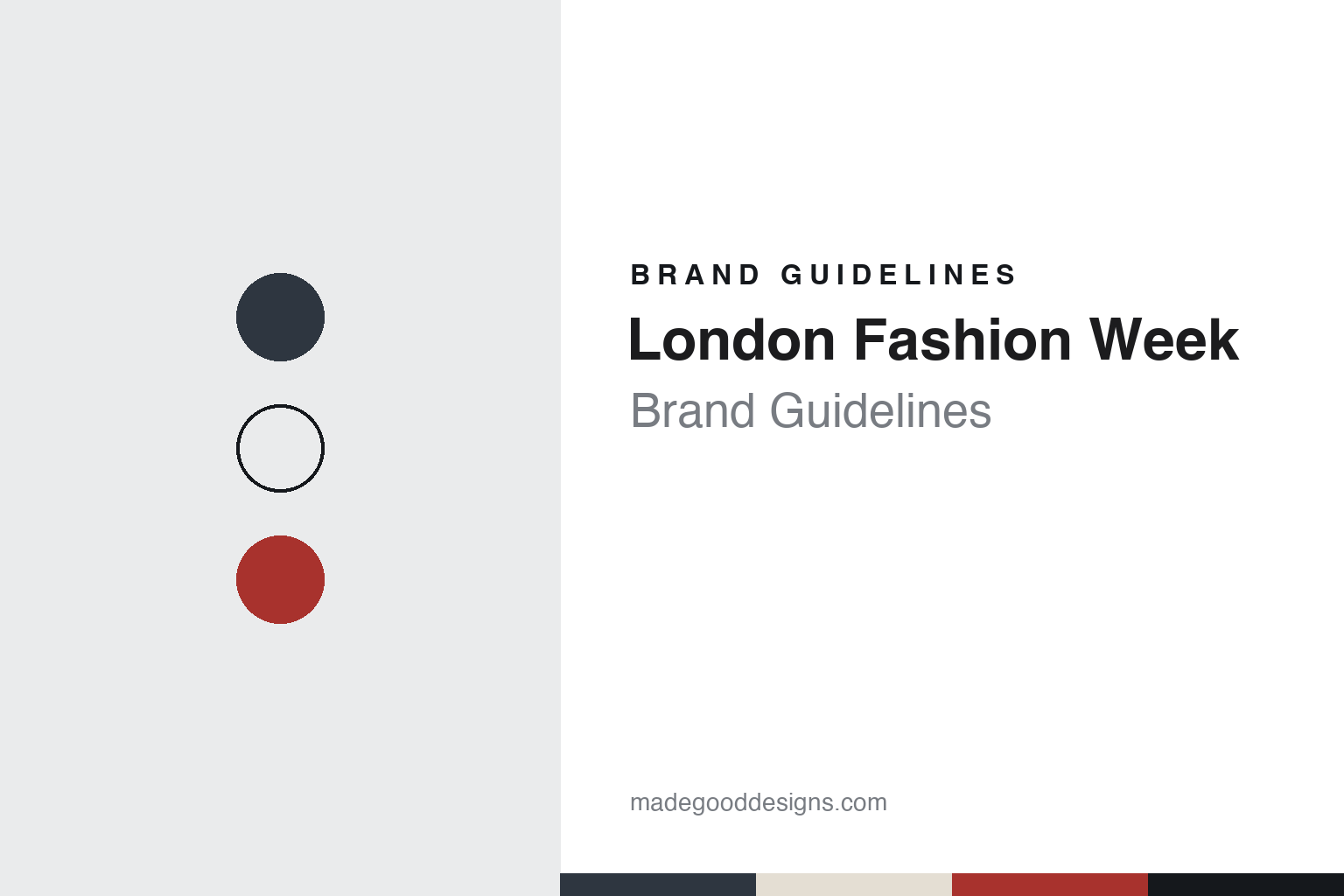
London Fashion Week Brand Guidelines
The London trade show that has changed its venue more often than its name.
Aa
Two constants: a slate, stone and red palette and a schedule sans register. Abstract homage — not a London Fashion Week or British Fashion Council mark; no logo, campaign image or venue photograph is reproduced.
A tent in Kensington
Fifteen shows in a car park, 1984.
London Fashion Week began in 1984. Euronews reported in February 2024, marking the event’s fortieth year, that the first edition took place in a tent in a Kensington car park, with the newly formed British Fashion Council hosting a new three-day event for British designers. English Wikipedia places that tent in the car park of the Commonwealth Institute in Kensington and counts 15 catwalk shows at that opening event. Wikipedia says the British Fashion Council was set up in 1983 as a non-profit limited company.
The idea came partly from the public relations world. Euronews named the PR agency founder Lynne Franks as one of the people behind the first edition, and said her team put the event together in about six months, from the idea to the venue and the money. Franks described the designers of the time to Euronews as young, “fresh out of art college,” with large ambitions and little financial backing.
The designer Betty Jackson showed in that first edition, Euronews reported; Wikipedia’s list of early names also includes the label Ghost. Jackson recalled for the 2024 report that the 1984 show was packed, in a period before the internet and mobile phones, when the only way to see a collection was to be in the room. Euronews set London’s start against the older weeks: New York, it said, had been running since 1943, Milan since 1958 and Paris since 1973, and London, in its words, was in a sense playing catch-up.
From the start the event was a trade show. English Wikipedia describes London Fashion Week as a clothing trade show held twice a year, with more than 250 designers showing to an audience of press and retailers. The womenswear seasons fall in February and September.
Colour
Barracks, museum, Somerset House, Strand.
After Kensington, English Wikipedia says, London Fashion Week went in September 1984 to the Duke of York’s Barracks on the King’s Road in Chelsea, where it stayed for three seasons, before moving to the larger Olympia exhibition hall in March 1986. In 1992, during the early-1990s recession, the shows moved into The Ritz hotel. By 1994 the official venue was the grounds of the Natural History Museum, where marquees held both the catwalks and the showrooms.
The early 2000s brought more changes. Wikipedia says the event returned to the Duke of York’s Headquarters on the King’s Road in September 2002, then moved to Battersea Park in February 2005 after planning problems. In 2009 it settled at Somerset House on the Strand, which remained the official venue until September 2015. That year the British Fashion Council placed designers’ showrooms at the Vinyl Factory in the Brewer Street Car Park in Soho for the shows of September 2015 and February 2016.
From February 2017 the venue was The Store Studios at 180 Strand, a former office building, where London Fashion Week stayed until February 2020. Since then, Wikipedia says, the British Fashion Council has run a hybrid digital and physical format with no single official venue; the first edition with a live audience after 2020 came in June 2021. The council’s own site describes londonfashionweek.co.uk as a year-round platform, the event’s “Official Digital Hub,” where retailers, media and the public can view collections, and it listed the September 2026 edition for 17 to 21 September.
The shows have also moved online. In 2009 Burberry returned to London from Milan and streamed its show, Wikipedia says, and in spring 2010 London Fashion Week offered designers on the Somerset House catwalk the option of broadcasting their shows live on the internet. Euronews dated the rise of social media around the shows to 2010 onwards.
Typography
Councils, calendars and venues.
A fashion week usually takes its name from a city, and that name is the one part of its identity that rarely changes. The rest follows a calendar. In New York the shows run in February and September, and Wallpaper* described the September 2026 week as the start of a month of shows that moved on to London, Milan and Paris. Each round carries a season label, spring/summer or autumn/winter, set roughly six months ahead of the clothes reaching shops.
Behind most weeks sits an organising council or trade body that keeps the official schedule. In New York that is the Council of Fashion Designers of America, which took over the official schedule in 2014; other cities have their own councils and chambers, each with a formal name that is often longer and less familiar than the week it runs. Production companies, venues and sponsors work alongside them, and the division of roles differs from city to city.
Sponsors have often put their names in front of the city. From 2007 to 2015 the New York shows produced by IMG were billed as Mercedes-Benz Fashion Week New York, and FashionUnited reported in January 2015 that the car maker also backed weeks in Sydney, Istanbul and Berlin. When a title sponsor leaves, the week usually returns to its plain city name, so the same event can appear under several names in its own history.
Venues and visual material change even faster. A week may move from tents in a park to a performing-arts campus to a studio building within a few years, while individual houses stage shows in rooms of their own choosing. Invitations, schedules and season campaign images are made new for each round, and a gala such as the Met Gala sets a fresh theme and dress code every May. The guides in this collection trace those changing parts around a name that stays the same.
Aa
A plain schedule sans for a name printed on show tickets and timetables. (Specimen set in Archivo, a sans STAND-IN; NOT the London Fashion Week logo.)
London Fashion Week
One name, several spin-offs.
The London Fashion Week name has been stretched across several related events. In June 2012 the British Fashion Council launched a separate menswear week, London Collections: Men, styled LC:M, with spring/summer and autumn/winter seasons. English Wikipedia says that by June 2015 it had 77 designers showing. For the autumn/winter 2017 collections, shown in January 2017, it was renamed London Fashion Week Men’s, bringing it under the main name. In June 2025 the council moved away from a standalone men’s week and instead set up menswear-focused London showrooms in Paris, Wikipedia says.
A public event follows the trade days. The London Fashion Week Festival, formerly called London Fashion Weekend, runs for four days after each season at the same venue and is open to the public, with catwalk shows, shopping from designer collections and talks, according to English Wikipedia, which places it at The Store Studios on the Strand.
The event has also set policies in its own name. English Wikipedia says the September 2018 edition was fur-free. The council’s work spans more than the shows: Wikipedia describes the British Fashion Council as the body that organises London Fashion Week and represents the British designer fashion industry.
The visual side of London Fashion Week changes with each season while the name stays. Venues have shifted from a tent in a car park to a museum lawn, a riverside palace and a former office block on the Strand, and since 2020 the schedule itself, published online by the council, has become the main thing that holds a season together. Euronews quoted Caroline Stevenson of London College of Fashion in 2024 on how digital media had widened the audience beyond editors and buyers.
For a design guide, London Fashion Week shows how an event can keep one name and one organiser while its venue, format and audience keep changing: the constant is the council and the calendar, not the building. Compare Paris Fashion Week, the last stop in the same season, and Central Saint Martins, the London art school. For this guide we use a slate grey, a pale Portland stone and a postbox red with a sans, an unofficial interpretation; no product or logo is reproduced.
Explore & save
Keep London Fashion Week’s identity on hand — save it to a board in the Made Good inspiration library.
London Fashion Week identity set
Pin the London Fashion Week slate, stone and red palette and the schedule sans register to your own board.
Source & notes
Frequently Asked Questions
What font can I use to match the London Fashion Week look?
This guide describes London Fashion Week’s type as “A plain schedule sans for a name printed on show tickets and timetables”. Its type specimen is set in Archivo from Google Fonts as a stand-in; Archivo is not London Fashion Week’s own lettering.
What colours are in the London Fashion Week palette?
This guide’s London Fashion Week palette is Thames slate #2E3640, Ink #15181C, Portland stone #E4DED3, Postbox red #A8322D and Paper #F7F5F1. The tones are the guide’s own unofficial interpretation, not official London Fashion Week hex codes.
When was London Fashion Week founded?
London Fashion Week was founded in 1984, in London, United Kingdom.