Longwood Gardens Brand Guidelines
Du Pont’s Brandywine garden and its 2024 glasshouse.
Aa
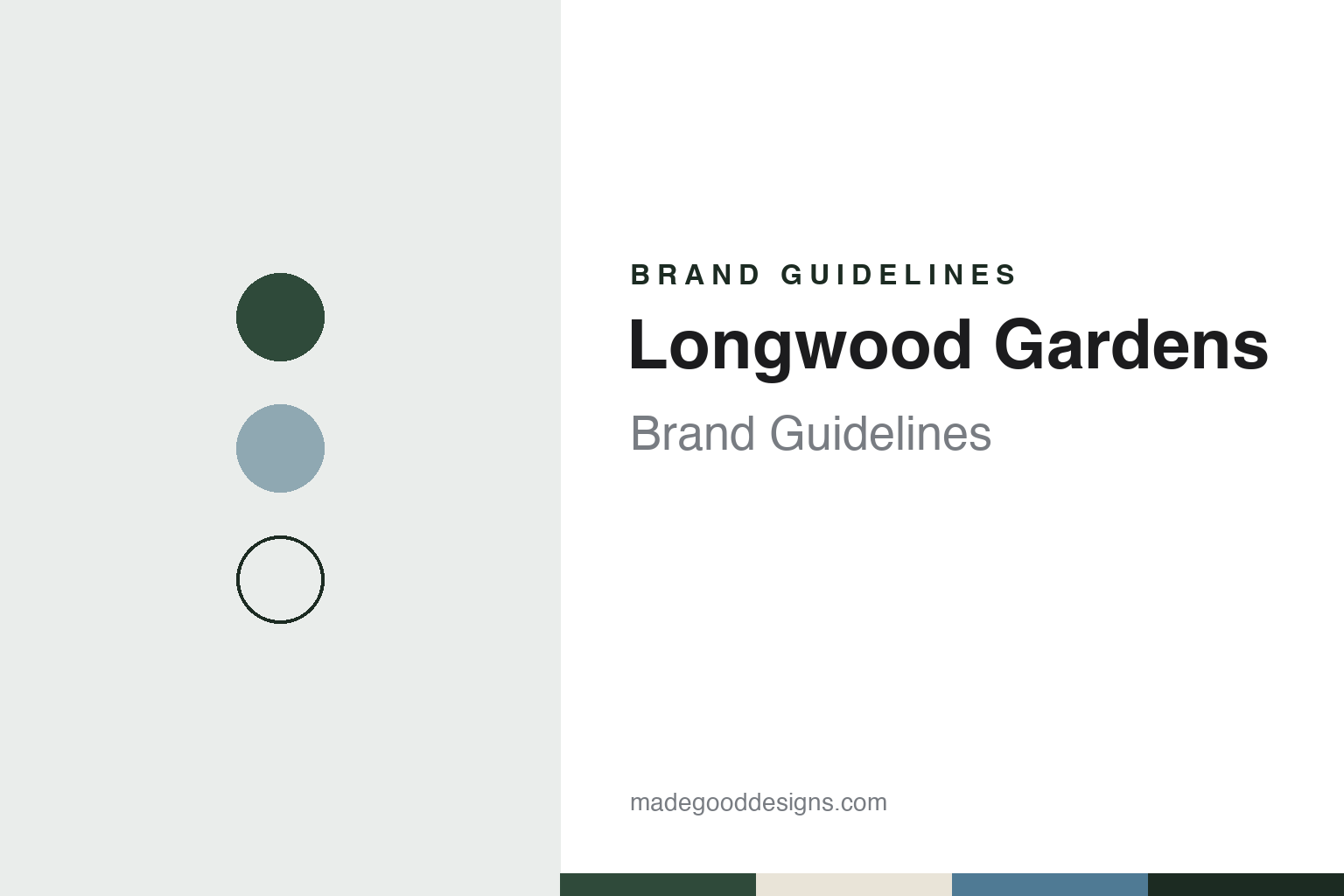
Two constants: a conservatory green, glass grey and fountain blue palette and a garden serif register. Abstract homage — not a Longwood Gardens mark; no logo, sign or photograph is reproduced.
Peirce’s Park
A Quaker farm, an arboretum and a 1906 purchase.
Longwood Gardens covers more than 1,100 acres of gardens, woodland and meadow in the Brandywine Creek valley at Kennett Square, Pennsylvania, according to English Wikipedia; Dezeen, writing in May 2025, gave the same figure and placed the town about an hour’s drive from Philadelphia.
The garden grew out of a farm. English Wikipedia says the Peirce family, Quaker farmers, bought 402 acres there in 1700 and built a brick farmhouse in 1730 that, enlarged, still stands as the Peirce-du Pont House. In 1798 two brothers of the family began planting an arboretum that eventually covered 15 acres, and in the later 19th century the grounds were known locally as Peirce’s Park, a place for community picnics.
On 20 July 1906 the industrialist Pierre S. du Pont bought the farm, English Wikipedia says, primarily to preserve its trees after a lumber-mill operator had planned to cut them for timber. He added the 600-foot Flower Garden Walk in 1907; an Open Air Theatre in 1914, modelled on the garden theatre of the Villa Gori near Siena; and the Italian Water Garden in 1925–27, after a visit to the Villa Gamberaia near Florence.
The main Conservatory opened in 1921, the same year du Pont opened the garden to the public. In 1937 he created the Longwood Foundation, which came under the control of trustees in 1946, according to the same source. The Main Fountain Garden, south of the Conservatory, was shown to the public in 1931; Architectural Record counted 1,719 jets in its display in December 2024. A ballroom of 1929 houses an Aeolian pipe organ of 10,010 pipes, and a 61-foot stone Chimes Tower was built the same year, English Wikipedia says.
Colour
Designers, collections and seasons.
The garden kept commissioning designers. English Wikipedia lists a Palm House of 1966, the Silver Garden of 1989 and a Mediterranean Garden of 1993 inside the Conservatory, and outdoors the Peirce’s Woods garden of 1995 and the 86-acre Meadow Garden, opened in 2014 around native plantings, with a restored early-18th-century farmhouse as its interpretive centre.
In 1988 the Brazilian landscape architect Roberto Burle Marx was asked to redesign the Conservatory’s former Desert House. His Cascade Garden, of plants, rock walls, pools and falling water, opened in 1992, English Wikipedia says; Architectural Record dates it to 1993, and Dezeen described it in 2025 as his only surviving project in North America.
Planning for the next decades began in 2010, when Longwood hired the Dutch landscape practice West 8. The opening project of that plan, the revitalisation of the Main Fountain Garden with the architects Beyer Blinder Belle, began in 2014, and the fountain garden reopened on 27 May 2017, according to English Wikipedia.
The living collection is broad. English Wikipedia gives more than 13,500 taxa, with core collections that include boxwood, chrysanthemums, waterlilies and orchids, as well as the trees of Peirce’s Park; a Victoria water-platter hybrid called ‘Longwood Hybrid’ was developed and is maintained there. The garden runs a tuition-free, two-year Professional Horticulture Program and a fellows programme, and it has drawn more than one million visitors a year since 2012, Wikipedia says.
The calendar is built around five named seasonal themes, from Winter Wonder in mid-January to A Longwood Christmas, the holiday light display that starts before Thanksgiving; in between come Spring Blooms, the Festival of Fountains from May to October, and Autumn’s Colors, which ends with a chrysanthemum festival, according to English Wikipedia.
Typography
Botanic gardens.
Botanic gardens tend to carry their place in their names. Many take a city, a state or a country, some carry a royal title, and some are better known locally by a founder’s name or a short form. Edinburgh’s garden received a royal warrant in 1699 and is called “the Botanics” in the city; St. Louis has long called the Missouri Botanical Garden “Shaw’s Garden”, after Henry Shaw, who created it. Initials such as RBGE stand in for a long formal name on websites and publications.
Glasshouses often act as the visual signature. Edinburgh’s Tropical Palm House dates from 1834 and its Temperate Palm House from 1858, and the pair reopened in October 2026 after five years of restoration; in St. Louis the Climatron, a geodesic dome opened in 1960, has given the garden a shape that its anniversaries are built around. Newer visitor buildings, such as Edinburgh’s John Hope Gateway, add a contemporary entrance alongside the historic houses.
The institutions behind the names differ. Some gardens are public bodies, as the Edinburgh garden is in Scotland; some are run by trusts and boards of trustees, as Shaw’s will arranged for St. Louis in 1889; others belong to cities, national institutes, horticultural societies or families. Many manage more than one site, from regional gardens to nature reserves, and heritage registers list several of their grounds and buildings.
Named seasonal events extend the identity beyond the gates. Illuminated winter trails such as Christmas at the Botanics in Edinburgh and Garden Glow in St. Louis carry the garden’s name into the evening, alongside festivals and concert series. This guide sets out what can be checked about each garden — when it was founded, who runs it, what it built and when — and marks clearly what rests on the garden’s own account.
Aa
A garden serif for a conservatory estate. (Specimen set in Cormorant Garamond, a serif STAND-IN; NOT the Longwood Gardens logo.)
Longwood Reimagined
A pleated glass roof over a shallow pool.
The main recent change is Longwood Reimagined. Work began in 2021, English Wikipedia says, and the project opened in late November 2024, Architectural Record reported that December. It was designed by the New York architects Weiss/Manfredi, lead designer and master planner, with the landscape architects Reed Hilderbrand, and covers 17 acres of the conservatory area.
Its centrepiece is the West Conservatory, a 32,000-square-foot glasshouse of 1,958 glass panels, according to Architectural Record, with what Dezeen described in May 2025 as a pleated roof of “asymmetrical, crystalline peaks” that appears to float over a shallow pool. Inside is a Mediterranean garden of canals, bridges, stone paths and brick-lined terraces, with 60 species of permanent plants and about 90 more brought in by season, Dezeen reported. Earth ducts buried under the slope temper the air for the main level, and geothermal wells serve the lower level and nearby buildings, both magazines said.
The same project moved Burle Marx’s Cascade Garden into its own 3,800-square-foot glasshouse, a near-exact replica of the original according to Architectural Record. It also added The Grove, an administration and education building with a 20,000-volume library; an outdoor bonsai courtyard with a workshop in a former potting shed; and a restaurant named 1906, after the year of du Pont’s purchase, carved beneath the 1921 Conservatory where a retaining wall once stood, looking out to the Main Fountain Garden. The Waterlily Court was restored and framed with a new arcade. The project credits published by Architectural Record name Pentagram for signage and wayfinding.
In 2024 Longwood also acquired Granogue, a 505-acre landscape in Wilmington, Delaware, English Wikipedia says.
For a design guide, Longwood Gardens shows how a garden’s identity can be carried by its buildings and water as much as by its plants: a 1921 conservatory, a 1931 fountain garden and a 2024 glasshouse, each named plainly for what it is. Compare New York Botanical Garden, another American garden with a major glasshouse, and Gardens by the Bay, a garden organised around large conservatories. For this guide we use a conservatory green, a glass grey and a fountain blue with a serif, an unofficial interpretation; no product or logo is reproduced.
Explore & save
Keep Longwood Gardens’s identity on hand — save it to a board in the Made Good inspiration library.
Longwood Gardens identity set
Pin the Longwood Gardens conservatory green, glass grey and fountain blue palette and the garden serif register to your own board.
Source & notes
Frequently Asked Questions
What font can I use to match the Longwood Gardens look?
This guide describes Longwood Gardens’ type as “A garden serif for a conservatory estate”. Its type specimen is set in Cormorant Garamond from Google Fonts as a stand-in; Cormorant Garamond is not Longwood Gardens’ own lettering.
What colours are in the Longwood Gardens palette?
This guide’s Longwood Gardens palette is Conservatory green #2F4A3A, Deep hedge #1C2B22, Fountain blue #4F7A94, Glass grey #8FA8B2 and Limestone #E9E4D8. The tones are the guide’s own unofficial interpretation, not official Longwood Gardens hex codes.
Who founded Longwood Gardens?
Longwood Gardens was founded by Pierre S. du Pont. Longwood Gardens is known for Conservatory, Main Fountain Garden, West Conservatory.