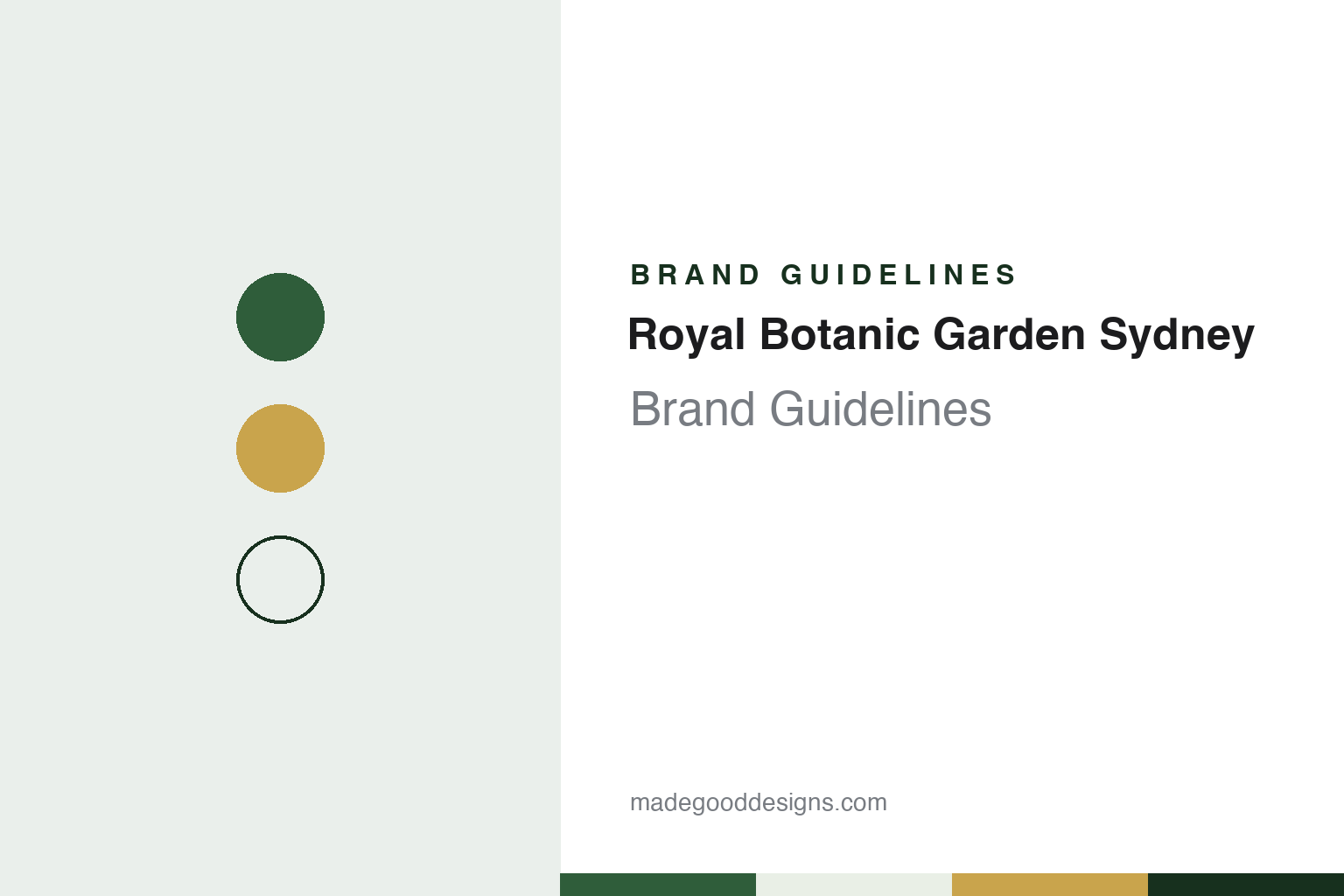
Royal Botanic Garden Sydney Brand Guidelines
The harbourside garden at Farm Cove, founded in 1816.
Aa
Two constants: a fig green, sandstone and harbour-mist palette and an open botanical sans register. Abstract homage — not a Royal Botanic Garden Sydney asset or mark; no logo, sign or photograph is reproduced.
Farm Cove
A colonial farm site that became a scientific garden.
The Royal Botanic Garden Sydney sits on Farm Cove, on the eastern edge of the city centre, between Macquarie Street and Sydney Harbour. English Wikipedia, whose history section draws on the New South Wales State Heritage Register listing, says the first European farm on the continent was laid out on this ground in 1788; that farm failed, but the land has been cultivated ever since. The botanic garden itself was founded on the site in 1816 by Governor Lachlan Macquarie, as part of the Governor’s Domain, and English Wikipedia calls it the oldest scientific institution in Australia.
The early garden was a working place. A colonial botanist was appointed in 1817, and from 1821 the superintendent began developing the grounds along scientific lines, bringing back plants from inland journeys; some of the hoop pines and swamp oaks planted in 1827 and 1828 still grow on the eastern side of the palm grove, English Wikipedia says. From 1825 an experimental garden west of Farm Cove Creek was used to acclimatise Australian plants for export and imported plants for the colony, and by 1833 four gardens were recognised: the botanic garden, a fruit garden, an experimental garden and a kitchen garden still feeding the Governor’s table.
The modern garden took shape under Charles Moore, director for 48 years, from 1848 to 1896. Under Moore a sea wall was built and the tidal flats of Farm Cove reclaimed between 1848 and 1879, using stone recycled from the demolished Old Government House; the herbarium collection was started in 1852; and the Palm Grove was established in 1862. A zoo operated in the garden from 1862 until 1883, when most of it moved to Moore Park. His successor, Joseph Maiden, served for 28 years and added much to Moore’s maturing landscape.
In 1912 a new superstructure for the Palm House, designed by the Government Architect, was completed. In 1959 the garden received the title “Royal,” which English Wikipedia links to the Queen’s landing at Farm Cove. The herbarium and the garden, administered apart for years, were combined again in 1968.
Colour
Glasshouses, a herbarium and the Calyx.
The garden’s buildings record changing ideas of how to show plants. Many older glasshouses were removed in the 1970s, and the Pyramid Glasshouse, built in 1970–71 to a design by the firm Ancher, Mortlock & Murray, took their place, with a spiral staircase that let visitors see every level of tropical growth. In 1982 a new herbarium building, named after a colonial botanist, opened beside the older herbarium; English Wikipedia says it held the collection in 55,000 specially designed red boxes, and a fourth level added in the mid-1990s made room for 20,000 more.
In 1980 the state parliament passed the Royal Botanic Gardens Trust Act, intended to stop further loss of land: the 72.6 hectares of garden and Domain recorded in 1916 had shrunk to about 63 hectares by 1980, English Wikipedia says. In 1987 and 1988 two satellite gardens were opened, at Mount Annan, south-west of Sydney, for native plants, and at Mount Tomah in the Blue Mountains, for cool-climate plants; both were formally opened in 1988 as part of Australia’s Bicentennial. They are now called the Australian Botanic Garden Mount Annan and the Blue Mountains Botanic Garden Mount Tomah.
A curved Arc glasshouse was added beside the Pyramid in the late 1980s; ArchitectureAU dates it to 1987, while English Wikipedia places it in 1988–89. The Pyramid was demolished in 2015 to make way for the Calyx, which opened in June 2016 for the garden’s 200th anniversary. ArchitectureAU reported on 17 June 2016 that the Calyx was designed by PTW Architects with the landscape practice McGregor Coxall: a circular building of radiating steel frames that grafts onto the base of the Arc, adding 530 square metres and bringing the indoor and outdoor display area to 1,495 square metres. The name refers to the outer casing of a flower bud, and an “Iris” podium sits at its centre. Its green wall holds 18,000 plants arranged as a changeable picture, and its first exhibition, Sweet Addiction, told the botanical story of chocolate until April 2017.
The Royal Botanic Garden and the adjoining Domain were added to the New South Wales State Heritage Register on 2 April 1999. The garden covers 30 hectares; its operator says it holds more than 27,000 plants in 15 themed gardens, among them the Palm Grove, the Succulent Garden, the Fernery, the Spring Walk and the Cadi Jam Ora garden, which tells the story of the Gadigal people, on whose Country the garden stands.
Typography
Gardens, trusts and names.
Botanic gardens tend to carry their place in their names. Many take a city, a state or a country, some carry a royal title, and some are better known locally by a founder’s name or a short form. Edinburgh’s garden received a royal warrant in 1699 and is called “the Botanics” in the city; St. Louis has long called the Missouri Botanical Garden “Shaw’s Garden”, after Henry Shaw, who created it. Initials such as RBGE stand in for a long formal name on websites and publications.
Glasshouses often act as the visual signature. Edinburgh’s Tropical Palm House dates from 1834 and its Temperate Palm House from 1858, and the pair reopened in October 2026 after five years of restoration; in St. Louis the Climatron, a geodesic dome opened in 1960, has given the garden a shape that its anniversaries are built around. Newer visitor buildings, such as Edinburgh’s John Hope Gateway, add a contemporary entrance alongside the historic houses.
The institutions behind the names differ. Some gardens are public bodies, as the Edinburgh garden is in Scotland; some are run by trusts and boards of trustees, as Shaw’s will arranged for St. Louis in 1889; others belong to cities, national institutes, horticultural societies or families. Many manage more than one site, from regional gardens to nature reserves, and heritage registers list several of their grounds and buildings.
Named seasonal events extend the identity beyond the gates. Illuminated winter trails such as Christmas at the Botanics in Edinburgh and Garden Glow in St. Louis carry the garden’s name into the evening, alongside festivals and concert series. This guide sets out what can be checked about each garden — when it was founded, who runs it, what it built and when — and marks clearly what rests on the garden’s own account.
Aa
An open botanical sans for signage and labels. (Specimen set in Figtree, a sans STAND-IN; NOT the Royal Botanic Garden Sydney or Botanic Gardens of Sydney logo.)
Royal Botanic Garden Sydney
One garden inside a wider name.
The garden is owned by the Government of New South Wales and administered by the Royal Botanic Gardens and Domain Trust, constituted under the Royal Botanic Gardens and Domain Trust Act 1980. That trust trades as Botanic Gardens of Sydney, which its website describes as the trust’s registered business name. The name covers four places, the Royal Botanic Garden Sydney, the Australian Botanic Garden Mount Annan, the Blue Mountains Botanic Garden Mount Tomah and The Domain, together with the Australian Institute of Botanical Science, which brings together the National Herbarium of New South Wales, the Australian PlantBank and the Daniel Solander Library. So “Royal Botanic Garden Sydney” is now the name of one site within a wider family, each site carrying its place name after the garden name.
The identity has been reworked more than once. In July 2018 Transform magazine reported that the Royal Botanic Garden Sydney had appointed the Australian agency Hulsbosch to update its brand, built around the line “The Vital Science”, with campaign images of the garden’s scientific projects. The rollout, the magazine said, covered double-sided flags, gate banners, entrance posters and A-frame signage, as well as merchandise and new digital assets. The current Botanic Gardens of Sydney brand page says the logo gives meaning to symbols such as cupped hands, used for drinking water at cultural gatherings and for receiving items from Elders, and the sun shining through. It also uses “digital kaleidoscope” patterns that Swell Design Group adapted from botanical paintings by the Florilegium Society at the garden, of plants such as Banksia integrifolia and Callistemon viminalis. The organisation acknowledges the Gadigal, Darug and Dharawal peoples, on whose Country its gardens lie.
Its seasonal programme runs alongside this, with what’s-on listings for each of the three gardens and The Domain, which the organisation presents as a venue for outdoor events. The Calyx, with its changing exhibitions, gives the Sydney garden a single indoor stage where each display can be rebuilt, as its horticulture director told ABC News in 2016, as quoted by ArchitectureAU.
For a design guide, Royal Botanic Garden Sydney shows how a historic garden can keep its own name while sitting under a newer umbrella brand, with a cycle of glasshouses from the 1912 Palm House to the 2016 Calyx. Compare its harbour neighbour Sydney Opera House and another royal botanic garden, Kew Gardens. For this guide we use a fig-leaf green, a deep canopy green, a sandstone gold and a pale harbour mist with a sans, an unofficial interpretation; no product or logo is reproduced.
Explore & save
Keep Royal Botanic Garden Sydney’s identity on hand — save it to a board in the Made Good inspiration library.
Royal Botanic Garden Sydney identity set
Pin the Royal Botanic Garden Sydney fig green, sandstone and harbour-mist palette and the open botanical sans register to your own board.
Source & notes
Frequently Asked Questions
What font can I use to match the Royal Botanic Garden Sydney look?
This guide describes Royal Botanic Garden Sydney’s type as “An open botanical sans for signage and labels”. Its type specimen is set in Figtree from Google Fonts as a stand-in; Figtree is not Royal Botanic Garden Sydney’s own lettering.
What colours are in the Royal Botanic Garden Sydney palette?
This guide’s Royal Botanic Garden Sydney palette is Fig leaf green #2F5D3A, Deep canopy #17301E, Sandstone gold #C9A44C, Harbour mist #E9EFE6 and Paper #F8F7F3. The tones are the guide’s own unofficial interpretation, not official Royal Botanic Garden Sydney hex codes.
When was Royal Botanic Garden Sydney founded?
Royal Botanic Garden Sydney was founded in 1816, in Farm Cove, Sydney.
Who owns Royal Botanic Garden Sydney?
Royal Botanic Garden Sydney is part of Botanic Gardens of Sydney.