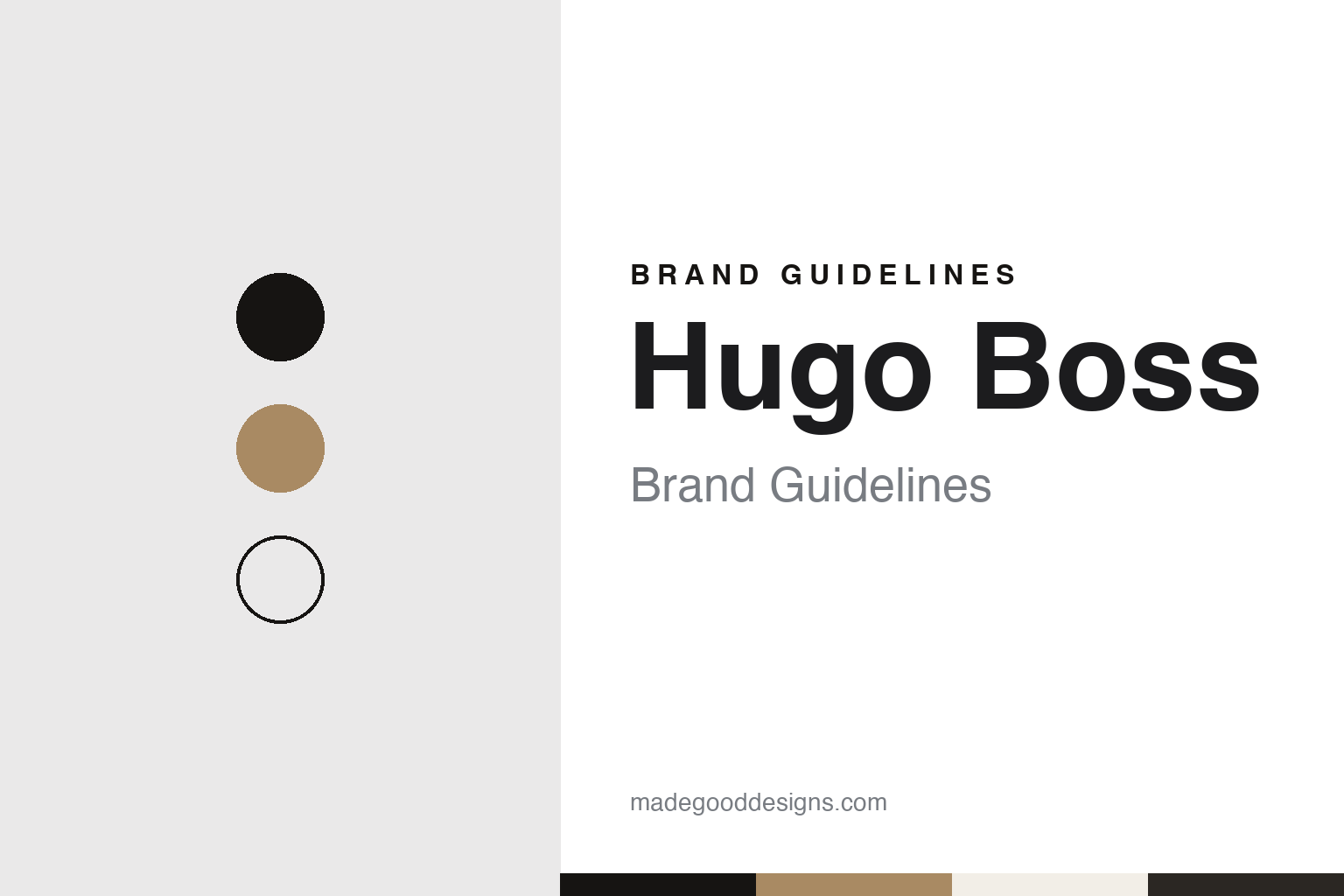
Hugo Boss Brand Guidelines
From a Metzingen clothing factory to BOSS and HUGO, with its wartime record on the page.
Aa
Two constants: a black, camel and white palette and a bold grotesque register. Abstract homage — not a Hugo Boss product or mark; no garment, logo or label is reproduced.
A Factory in Metzingen
A clothing factory, the Nazi Party and forced labour.
Hugo Boss began in Metzingen, a small town in Swabia, in 1924. The historian Roman Köster, whose study was published by C. H. Beck in 2011, writes that Hugo Ferdinand Boss, heir to his parents’ lingerie and linen shop in the town, opened a clothing factory that year with financial support from two other Metzingen manufacturers; Wikipedia names them as the brothers Albert and Theodor Bräuchle. Between 20 and 30 seamstresses made garments by hand, from shirts to the loden jackets of southern Germany. The company financed the research and printing of Köster’s study, and its abridged version states that no influence was brought to bear on content or form.
The depression hit the textile trade hard, and by 1931 the factory was facing bankruptcy; production continued only after negotiations with creditors. That same year Hugo F. Boss joined the Nazi Party, which then placed orders with him for uniforms. Köster concludes that Boss did not join solely for the orders but because he supported the National Socialists, and that those orders rescued the company and then drove its success. In the mid-1930s Boss advertised the firm as a “supplier of Party equipment since 1924.”
Major army commissions arrived in 1938. According to witnesses Köster cites, during the Second World War the company chiefly made uniforms for the German armed forces and the Waffen-SS, and it still had a Waffen-SS order pending at the start of 1945. It had also made uniforms for the SA, the SS and the Hitler Youth. Köster finds nothing to show that the firm designed uniforms or led the sector, describes it as fairly typical among uniform producers, and calls the “Hitler’s tailor” narrative baseless.
The factory used forced labour. Köster counts 140 forced labourers, most of them women, and 40 French prisoners of war between October 1940 and April 1941. The first arrived in April 1940, recruited from Bielsko in Poland with the active support of the Gestapo; German Wikipedia says most came from the Soviet Union and Poland. They worked 12-hour days, and from 1943 they had to live in a camp for eastern European workers built by large Metzingen companies, where living conditions were, Köster writes, in some respects “truly catastrophic.” Some committed National Socialists in management treated the women extremely harshly and threatened them with concentration camps. Boss was likely not personally involved, Köster says, but took no action to stop it. Köster also judges that provisions and pay at the factory were better than most forced labourers received at the time, a judgement made in a study the company paid for.
After the war a denazification tribunal first classed Boss as “incriminated” and imposed a heavy fine; on appeal he was classed as a “follower.”
Colour
The Holy brothers’ fashion house.
The company carried on making uniforms after 1945, Köster writes, now for the French occupation forces and the Red Cross, and it expanded under Hugo Boss’s son-in-law Eugen Holy. Wikipedia adds uniforms for the post office, railways and police, and dates the first Boss men’s suits on the market to 1953; Köster says only that the firm was selling suits during the 1950s.
Eugen Holy’s sons Uwe and Jochen Holy then took over: Wikipedia gives 1967, Köster 1969. Köster says the firm was on the brink of bankruptcy at the time. The brothers turned it into a fashion business. They opened a first factory outlet in a nearby warehouse in 1972, the origin of Outletcity Metzingen, and hired the Austrian designer Werner Baldessarini in 1975; he rose to head designer. The Boss mark was registered in 1977. German Wikipedia says the company dressed the casts of L.A. Law and Miami Vice in the 1980s, and from 1982 it supplied the McLaren Formula One team, a partnership that ended in 2014. In December 2023 the road to the Metzingen headquarters was renamed Holy-Allee in the brothers’ honour, the company says.
The shares were listed in 1985, and in 1991 the Italian Marzotto group became majority shareholder. The Holy brothers left in 1993, the year the Hugo line appeared alongside Boss and Baldessarini. Women’s clothing followed under Hugo in 1998 and Boss Woman in 2000. Marzotto spun its fashion business off as Valentino Fashion Group in 2005; the investor Permira bought that group in 2007, held Hugo Boss separately from 2009 and had sold out by early 2015. The Baldessarini brand went to Werner Baldessarini himself in 2006. From 2017, German Wikipedia says, the company ran two brands only, BOSS and HUGO.
In the late 1990s the company commissioned a study by Elisabeth Timm but did not publish it; she later put it online herself. In June 2000 Hugo Boss joined the German industry foundation initiative to compensate forced labourers, and in 2011, with Köster’s book, it expressed “profound regret to those who suffered harm or hardship at the factory run by Hugo Ferdinand Boss under National Socialist rule,” Ynetnews reported that October.
Typography
Cloth, chalk and shop windows.
Tailoring houses have an unusual advantage in presenting themselves: the work itself is graphic. A bespoke order follows a set sequence. The customer and tailor choose fabrics, linings and details, the tailor takes measurements and drafts a pattern from scratch, and the cloth is chalked out and cut with shears before being basted for a fitting. Chalk marks on cloth, paper patterns on hooks and a cutter working at the board are the working tools of that sequence, and they also make natural pictures for a house’s windows, pages and packaging.
The street matters too. Savile Row in Mayfair, London, is known principally for bespoke men’s tailoring, and tailors have traded there since at least 1803. Its windows can be a statement in themselves: when Nutters of Savile Row opened in 1969, it used bold displays created by the then unknown Simon Doonan. In Italy the home town often takes the street’s place, and a house can put a place name at the front of its story, as Zegna does with its mill in the Biellese Alps.
Cloth carries the identity as well. Fabrics and linings are chosen at the start of an order, which puts the fabric book in the customer’s hands early. Mills keep their own record of that work: the Zegna archive at Trivero holds sample books alongside technical drawings.
The words matter as much as the images. A bespoke garment starts from a new pattern, made to measure adjusts an existing one, and ready-to-wear comes in standard sizes. In June 2008 Britain’s Advertising Standards Authority ruled that an advertisement calling a suit cut and sewn by machine “bespoke” did not breach its code, and the term has stayed contested since.
Aa
A bold grotesque, after the “notably bolder graphic typeface” of 2022. (Specimen set in Archivo, a sans STAND-IN; NOT the Hugo Boss logo.)
BOSS and HUGO
A bolder mark and a new majority owner.
The current identity dates from January 2022. Under chief executive Daniel Grieder, in post since June 2021, and his Claim 5 strategy, the company introduced a new BOSS logo “after almost 50 years” and a new HUGO look, the first since a logo adjustment in the early 1990s. Its press release of 26 January 2022 says both logos feature “a notably bolder graphic typeface.” The company describes the new aesthetic as centred on a palette of camel, white and black, and its own history page calls black, white and camel “the signature BOSS colors.”
BOSS now runs on four lines, the 2025 annual report says: BOSS Black for modern tailoring and smart casualwear, BOSS Camel for high-end tailoring in menswear, BOSS Orange for casualwear and BOSS Green for athleisure. HUGO covers contemporary and streetwear-led clothing.
Most of what carries the name is not made in Metzingen. In fiscal 2025 Hugo Boss produced 17 percent of its sourcing volume at its own five sites, all in Europe, the annual report says; the rest came from contract suppliers and merchandise, mainly in Asia and Europe. Izmir in Turkey is the largest site, at 15 percent of global volume. Metzingen mainly makes products for BOSS Camel, including tailored BOSS Made to Measure suits, along with prototypes and samples. Radom in Poland and Morrovalle in Italy focus on shoes, and Coldrerio in Switzerland on Made to Measure shirts. The headquarters remains in Metzingen, where most collections are developed.
Ownership changed again in 2026. Frasers Group, the British retailer that took a stake of about 5 percent in 2020, launched a cash offer in June, which the management and supervisory boards rejected as financially inadequate. Its direct holding still rose to 47.89 percent by August, FashionUnited reported, and Frasers chief executive Michael Murray became supervisory board chairman in September. On 23 October Frasers announced it had passed 50 percent, with Hugo Boss’s results to be consolidated into its accounts. FashionUnited gave 50.08 percent. The Marzotto family remains a shareholder, with about 14 percent according to German Wikipedia.
For a design guide, Hugo Boss shows how a house can rebuild its mark around a few plain tones while its history stays on the record. Compare Zegna, a menswear group that has stayed under family control, and Jil Sander, another German fashion name. For this guide we use a black, a worn camel and an off-white with a sans, an unofficial interpretation; no product or logo is reproduced.
Explore & save
Keep Hugo Boss’s identity on hand — save it to a board in the Made Good inspiration library.
Hugo Boss identity set
Pin the Hugo Boss black, camel and white palette and the bold grotesque register to your own board.