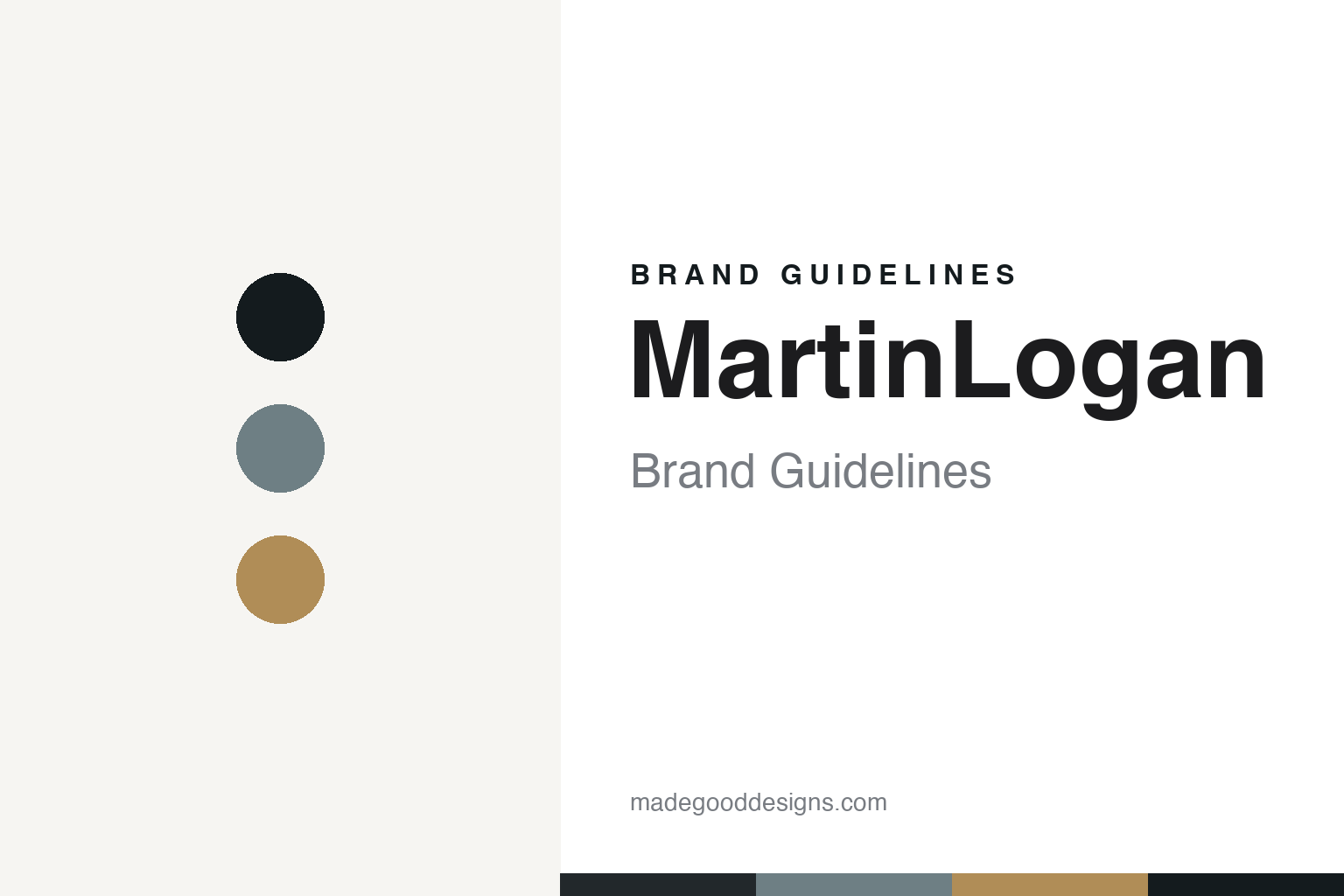
MartinLogan Brand Guidelines
The Kansas speaker maker that made the electrostat see-through.
Aa
Two constants: a MartinLogan graphite, smoked-glass and brass palette and a Geometric sans register. Abstract homage — not a MartinLogan product or mark; no speaker, logo or nameplate is reproduced.
Martin and Logan
Two middle names from Lawrence, Kansas.
MartinLogan is named after its founders’ middle names. Gayle Martin Sanders and Ron Logan Sutherland met in the late 1970s at a high-end audio shop that Sanders managed in Lawrence, Kansas, the company’s own history says; Sanders had trained in architecture and advertising, Sutherland in electrical engineering. MartinLogan, Sanders explains on the company’s website, “just sounded better than SandersSutherland.”
Sources differ on the founding year. English Wikipedia gives 1979, without a citation; the company’s own 2019 press-release boilerplate, and SoundStage! the same year, give 1983. The company’s history fills the gap: a first prototype in 1980, a flat aluminium panel that arced when played loud; a concept shown with only a mock-up and photographs at the 1982 Consumer Electronics Show in Chicago, where the company says it won a CES Design and Engineering Award; and, at the 1983 show, the Monolith, a full-range hybrid electrostatic speaker. It was then, the company says, that the pair “put their middle names to the venture.”
The technology was the electrostatic loudspeaker, in which a thin charged diaphragm — here clear Mylar between two perforated-steel stators — is moved by an electric field rather than by a cone and magnet. MartinLogan’s answer to the narrow treble of a wide flat panel was to curve it: the curvilinear line source, or CLS, which the company says came out of a midnight session in which Sutherland sketched a sound wave and Sanders pictured a horizontally curved panel. It calls the CLS central to every MartinLogan electrostat since.
The early years were small. The company says it built the first ten pairs of Monoliths with one full-time and one part-time employee, and lost three pairs in freight. Sales picked up in 1985, when Sutherland left to return to electronics — he later made phono stages under the Sutherland Engineering name, reviewed by Stereophile — and in 1986 the company moved to Delaware Street in Lawrence. It says Inc. magazine listed it among the 500 fastest-growing private companies in the United States in 1989 and 1990.
Colour
See-through panels, then subwoofers.
The look followed the technology. Because the panel is transparent, a MartinLogan electrostat lets you see the room through the speaker; the company describes dealers at the 1983 show as “bowled over” by “the visually stunning, see-through Monoliths.” That curved, glass-like panel standing above a dark bass cabinet is the brand’s most recognisable image.
The range widened through the 1990s. The company says its Logos was the world’s first electrostatic centre-channel speaker, a claim we report rather than confirm, and names the SL3, Aerius, Quest and reQuest among its best-loved models of the period. Its flagship Statement e2, a two-part system weighing 2,000 pounds, arrived in 1998 by the company’s account; English Wikipedia says work on it began in 1997. Smaller hybrids — the Prodigy, Odyssey, Ascent and Aeon — carried that work into domestic sizes.
In 2001 came the company’s first non-electrostatic product, the Descent subwoofer, followed by the Depth, Grotto, Dynamo and Abyss. The Summit, introduced in 2005, paired a newer electrostatic panel with powered woofers. Later lines included the Vista (2006), the powered Purity (2007), the Ethos (2010) and, also in 2010, the Motion series, conventional box speakers with a folded thin-film tweeter the company calls Folded Motion. The Neolith, shown at CES in 2015 at $80,000 a pair according to Stereophile’s coverage, stands more than six feet tall; the Masterpiece series followed in 2016, led by the Renaissance ESL 15A.
The company’s tagline throughout is “Truth in Sound.”
Typography
Design and documentation.
Colorado’s Front Range, around the city of Boulder, is home to several of America’s high-end audio makers. Avalon Acoustics builds loudspeakers in Boulder; Ayre, founded in Boulder in 1993 according to English Wikipedia, now gives its address at Niwot, just north-east of the city; Boulder Amplifiers moved to Louisville, east of Boulder, in 2016; and YG Acoustics gives its headquarters and machining plant as Denver.
The others are spread more widely: MartinLogan in Lawrence, Kansas, where it was founded — in 1979 according to English Wikipedia, in 1983 according to the company — and where it still has its design centre; Rockport Technologies in South Thomaston, Maine, where SoundStage! found it in 2012; and Constellation Audio in California, which Hi-Fi News called a “Californian amplifier specialist” in 2025.
The shows have changed too. For years the Consumer Electronics Show in Las Vegas gave high-end audio rooms of its own, latterly at the Venetian hotel, and Boulder showed its 3050 amplifiers there in January 2011; at CES 2019, Stereophile wrote that the curtain had closed on the show as the place for high-end launches. Denver had its own event, the Rocky Mountain Audio Fest, first held in 2004; its organisers cancelled the 2021 show and all future ones. AXPONA, held at Schaumburg near Chicago, now describes itself as North America’s largest high-end audio show.
Prices at this level can be startling: Boulder’s 3050 mono amplifiers cost about $195,000 a pair in 2011, Enjoy the Music reported. Several of these makers remain small and privately held.
This guide sets out what can be checked about each brand — who founded it, who owns it, and what it says about where its products are made — and marks clearly what rests only on the company’s own word.
Aa
A geometric sans for a see-through speaker. (Specimen set in Jost, a sans STAND-IN; NOT the MartinLogan logo.)
MartinLogan
A Kansas name, a Canadian group.
Independence ended in late 2005. The Minneapolis private-equity firm ShoreView Industries had taken a controlling stake in the Canadian speaker maker Paradigm Electronics that year, with Paradigm co-founder Scott Bagby keeping a minority share, and the two formed SVI Holdings, which bought MartinLogan “a short time later,” according to the group’s 2019 press release. Stereophile reported the deal in December 2005, describing Sanders as the former majority owner, who would stay on as a consultant; Sanders later told Copper magazine that he left in 2005, retired, and returned to audio in 2019 with a new company, Eikon Audio.
Manufacturing moved north. SoundStage! Xperience reported in 2013 that while the design staff remained in Lawrence, “much of the manufacturing has been moved to Paradigm’s facility in Mississauga, Ontario.” The company’s own factory-tour page says every speaker “begins life” at its design centre in Lawrence and that its Canadian facility handcrafts each electrostatic panel and hand-assembles its electrostatic products; it adds that staff spend about 90 working days a year overseas checking quality at “international manufacturing facilities,” without naming them.
In May 2019 Scott Bagby and John Bagby bought all of Paradigm, Anthem and MartinLogan, effective 10 May, and ShoreView exited, the press release said; Scott Bagby became chairman and chief executive and John Bagby managing director. The group, PML Sound International, added GoldenEar from 1 January 2025, StereoNET reported in December 2024. MartinLogan’s website still describes its world headquarters as three buildings in Lawrence, while The Ear, reporting a new UK distributor in 2019, gave the group’s headquarters as Mississauga.
For a design guide, MartinLogan shows how a single visual idea — a curved, see-through panel — can carry a brand through four decades and two changes of owner. Compare Klipsch, another American speaker maker identified with one technology, the horn, and Wilson Audio. For this guide we use graphite, smoked glass and a warm brass with a sans, an unofficial interpretation; no product or logo is reproduced.
Explore & save
Keep MartinLogan’s identity on hand — save it to a board in the Made Good inspiration library.
MartinLogan identity set
Pin the MartinLogan graphite, smoked-glass and brass palette and the Geometric sans register to your own board.