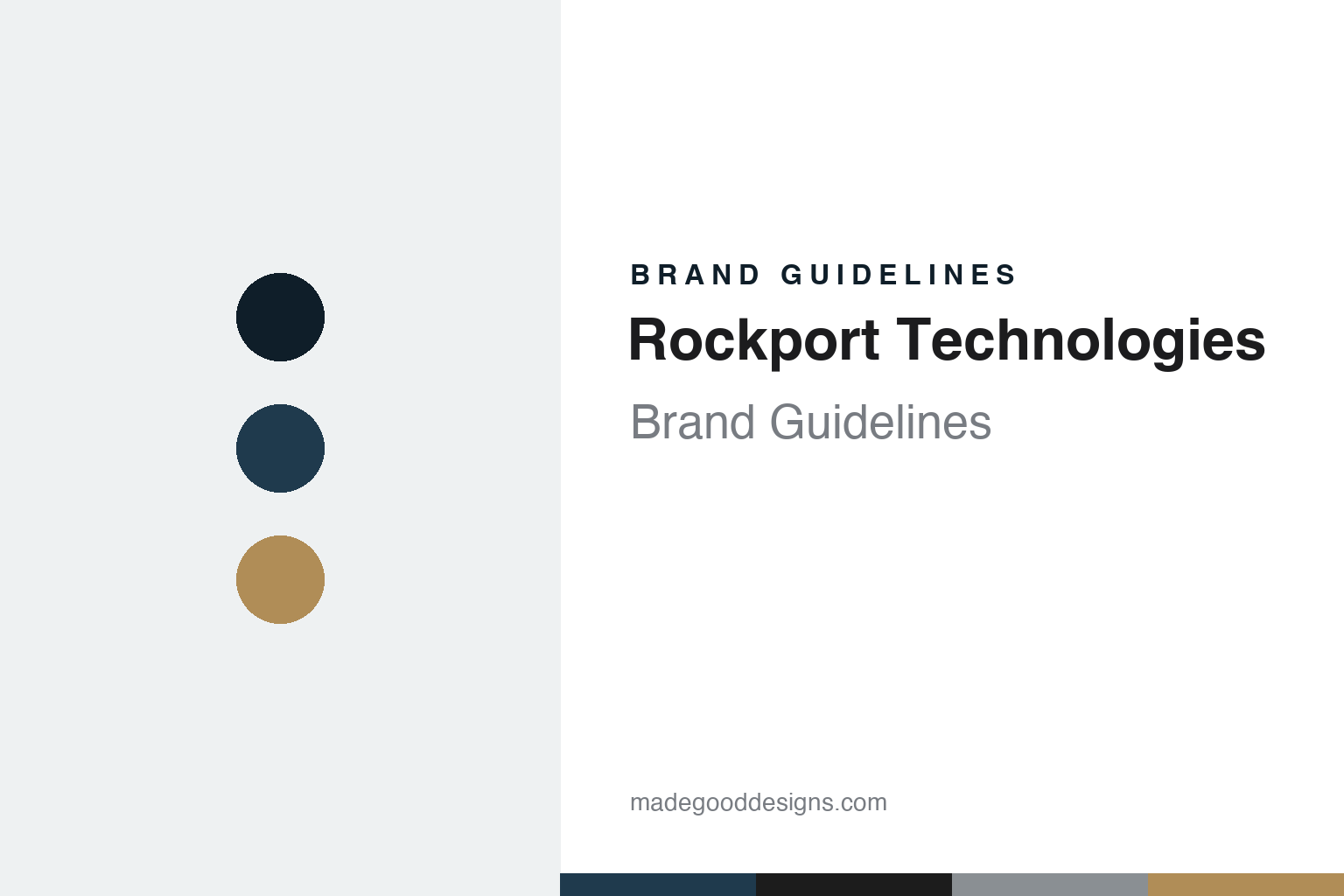
Rockport Technologies Brand Guidelines
The Maine loudspeaker maker that builds cabinets like boat hulls.
Aa
Two constants: a harbour navy, carbon black and brass palette and an engineered sans register. Abstract homage — not a Rockport Technologies product or mark; no loudspeaker, logo or nameplate is reproduced.
Payor Acoustics
An engineer, a coastal town and a turntable.
Rockport Technologies began in Maine in 1984 as Payor Acoustics Inc., the company says, and its first product was “a compact, satellite/subwoofer loudspeaker system.” Its founder is Andrew “Andy” Payor, an electrical engineer by training, according to a 2012 factory visit by SoundStage! Global. The Absolute Sound, profiling him in December 2022, says he “has been creating loudspeakers since 1985,” so the two dates sit a year apart.
The name came from the place. Rockport is the coastal town where the company was founded, The Absolute Sound explains; the business has since moved a short way down the coast to South Thomaston. The company’s website describes a facility “nestled in a quiet cove on the coast of Maine,” and SoundStage! Global reported in 2012 that Payor had designed the factory himself, close to his home, and that boat design and building were among his other interests.
Before it was known for loudspeakers, the workshop was known for turntables. The Absolute Sound says Payor redesigned the Well Tempered Turntable, invented by Bill Firebaugh, and that in the late 1980s his shop built them “at the rate of 25 turntables a week for five years.” His own Sirius turntable was introduced in 1990, the magazine says — dealer histories put the change to the Rockport name in the same year — with an air-bearing platter and tonearm, vacuum record hold-down and a self-levelling pneumatic support. Stereophile’s Michael Fremer reviewed the System III Sirius in August 2000, priced at $73,750 with its arm. Rockport still services the Sirius, The Absolute Sound says.
Colour
Cabinets built like boat hulls.
Rockport’s loudspeakers are recognisable by their swept-back baffles and rounded, seamless enclosures, and that shape comes from how they are built. According to The Absolute Sound, the upper models are not made from flat panels glued together but from an inner and an outer skin — carbon fibre and fibreglass — moulded separately and bonded, with a cavity of about two inches filled with hundreds of pounds of dense epoxy. The magazine says the method was “inspired by high-end boat-hull construction” and that Payor developed it in 1991 for the Procyon. Each shell is laid up in a mould machined from solid aluminium and cured under heat and pressure in an autoclave.
The idea has been pushed further since. The Lyra, introduced in 2016, uses inner and outer shells of cast aluminium with epoxy between them, and the Orion, introduced in 2022, pairs a cast-aluminium inner shell with a carbon-fibre outer one, The Absolute Sound reports. In 2015 SoundStage! Ultra’s Jeff Fritz, who had lived with the original Arrakis, described its successor, the Arrakis 2, as “basically molded and poured” rather than glued or bolted, and called it “easily the most beautiful speaker” in his survey of the most expensive models, at $225,000 a pair.
Payor also designs the drive units. The Absolute Sound credits him with being the first to develop, in 2004, the carbon-fibre sandwich cones that are now common, and says every driver in the range is his design, built on large cast-aluminium baskets. The company’s website lists five current models — Taurus, Atria II, Lynx, Orion and Lyra. The Lynx was launched at the High End show in Munich in 2024 at $78,000 a pair, ecoustics reported, with Payor calling it “the first time we’ve been able to trickle down technology from our flagship LYRA.” The Absolute Sound later gave it a Golden Ear award, the company says.
Typography
Design and documentation.
Colorado’s Front Range, around the city of Boulder, is home to several of America’s high-end audio makers. Avalon Acoustics builds loudspeakers in Boulder; Ayre, founded in Boulder in 1993 according to English Wikipedia, now gives its address at Niwot, just north-east of the city; Boulder Amplifiers moved to Louisville, east of Boulder, in 2016; and YG Acoustics gives its headquarters and machining plant as Denver.
The others are spread more widely: MartinLogan in Lawrence, Kansas, where it was founded — in 1979 according to English Wikipedia, in 1983 according to the company — and where it still has its design centre; Rockport Technologies in South Thomaston, Maine, where SoundStage! found it in 2012; and Constellation Audio in California, which Hi-Fi News called a “Californian amplifier specialist” in 2025.
The shows have changed too. For years the Consumer Electronics Show in Las Vegas gave high-end audio rooms of its own, latterly at the Venetian hotel, and Boulder showed its 3050 amplifiers there in January 2011; at CES 2019, Stereophile wrote that the curtain had closed on the show as the place for high-end launches. Denver had its own event, the Rocky Mountain Audio Fest, first held in 2004; its organisers cancelled the 2021 show and all future ones. AXPONA, held at Schaumburg near Chicago, now describes itself as North America’s largest high-end audio show.
Prices at this level can be startling: Boulder’s 3050 mono amplifiers cost about $195,000 a pair in 2011, Enjoy the Music reported. Several of these makers remain small and privately held.
This guide sets out what can be checked about each brand — who founded it, who owns it, and what it says about where its products are made — and marks clearly what rests only on the company’s own word.
Aa
An engineered sans for a maker whose shape follows its construction. (Specimen set in Archivo, a sans STAND-IN; NOT the Rockport Technologies logo.)
Rockport Technologies
A craft shop by choice.
The company has stayed small on purpose. The Absolute Sound wrote in 2022 that Rockport was “roughly the same size it was three decades ago,” a craft shop rather than an industrial operation, and that Payor personally tunes each crossover to the drivers going into a particular speaker, trimming coil windings and adding capacitance until it measures correctly; each pair is then auditioned by Payor and at least two others before it ships. SoundStage! Global found in 2012 that cabinet-making and finishing were done by “highly skilled local craftsmen,” some of whom also worked in the high-end marine industry, while final assembly, crossover building and driver installation took place in South Thomaston. The company’s own site says design, assembly, testing and quality assurance happen at its facility, with “highly skilled local vendors” supplying specialised manufacturing.
Ownership changed in 2019. Payor sold the company that year to Josh Clark, “with Payor remaining at the engineering helm,” The Absolute Sound reported; Clark, who previously worked at the Maine cable maker Transparent Audio according to press accounts, runs the business side. “I purchased the company in April of 2019,” Clark told Audiophilia in 2021, “and since then I have been working side-by-side with Andy as my mentor.” In its December 2022 issue The Absolute Sound named Payor to its High-End Audio Hall of Fame, calling Rockport “high end within the high end.”
For a design guide, Rockport Technologies shows how a construction method can become a visual identity: the curved, joint-free cabinet is both the engineering and the look. Compare Wilson Audio, another American maker of large, sculpted loudspeakers, and VPI, an American turntable maker. For this guide we use harbour navy, carbon black and granite grey with a brass accent and a sans, an unofficial interpretation; no product or logo is reproduced.
Explore & save
Keep Rockport Technologies’s identity on hand — save it to a board in the Made Good inspiration library.
Rockport Technologies identity set
Pin the Rockport Technologies harbour navy, carbon black and brass palette and the engineered sans register to your own board.