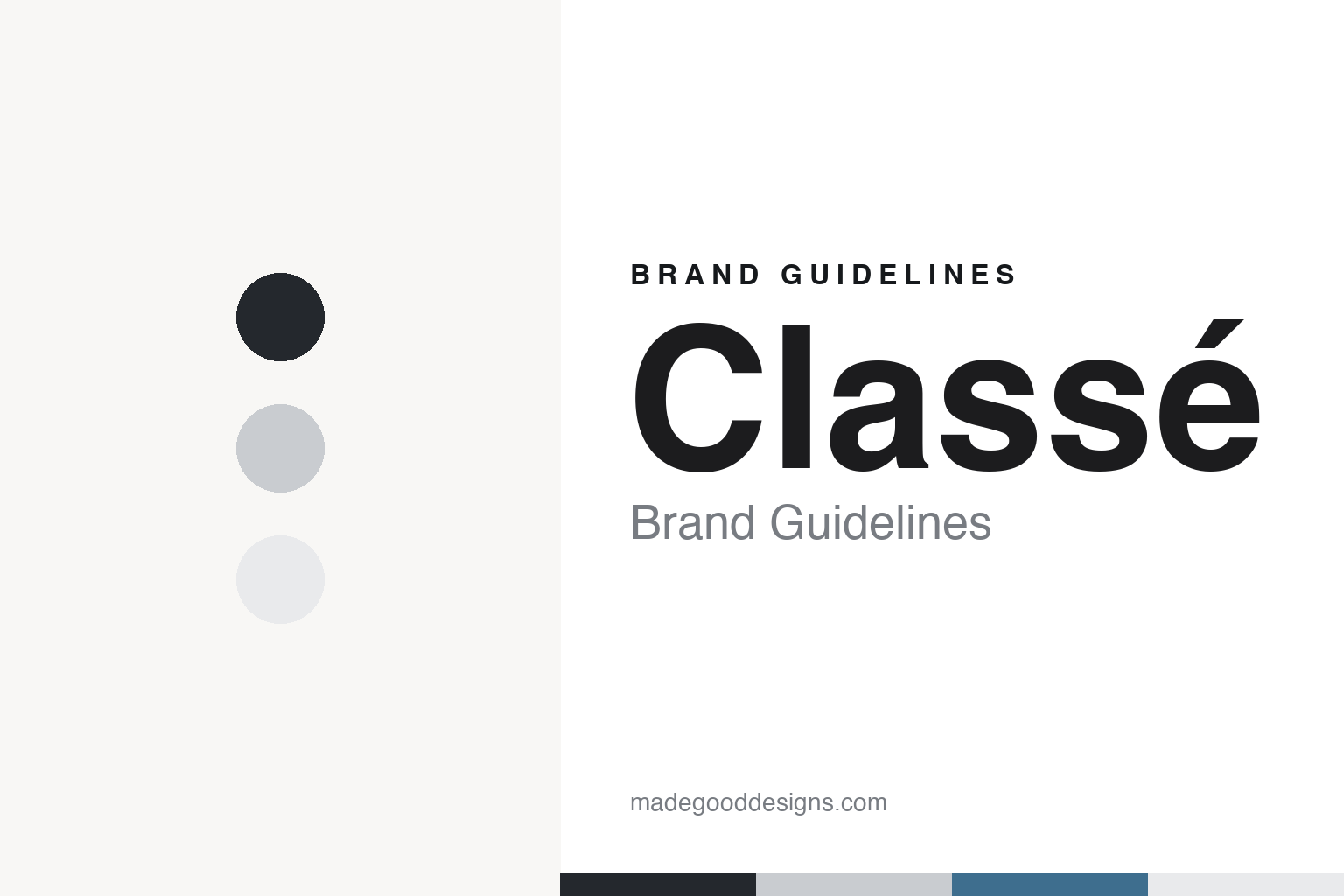
Classé Brand Guidelines
The Montréal amplifier maker named for class A.
Aa
Two constants: a Classé graphite, silver and blue palette and a Geometric sans register. Abstract homage — not a Classé product or mark; no amplifier, logo or nameplate is reproduced.
The DR-2
A failed valve amplifier and a class-A answer.
Classé was founded in Montréal and introduced its first amplifier in 1980. Its founders were the businessman Mike Viglas and the engineer David Reich, according to both the company and the Canadian magazine SoundStage! — a correction to the shorthand that credits Reich alone. The company’s own account, signed by its brand director Dave Nauber, says Viglas, a Greek immigrant who had built businesses in Montréal, decided in 1979 that “there has to be something better” after the valve amplifier in his high-end system failed during a party, and that he then heard the solid-state amplifiers Reich was building and set out with him to make something both good-sounding and reliable. We give the story as the company tells it.
Their first product was the DR-2, a 25-watt-per-channel stereo amplifier running in class A, the mode in which the output devices conduct all the time. The company says that design “inspired the name of the new company.” SoundStage! wrote in 2021 that the DR-2 became known for driving loudspeakers to unexpectedly high volumes despite its modest rating, and that its sound remained the reference for every Classé product since.
Classé grew into a maker of power amplifiers, preamplifiers and, later, surround-sound processors for home cinema. David Reich later left to join the American digital-electronics maker Theta Digital, while Viglas stayed on as chairman, SoundStage! reported.
Colour
Delta, Sigma and a long pause.
In 2001 Classé became part of the British B&W Group, owner of Bowers & Wilkins, according to English Wikipedia and Sound United’s 2018 announcement; SoundStage! gives 2002. SoundStage! reported that Dave Nauber, who had worked at Madrigal Audio Labs, the maker of Mark Levinson equipment, was recruited to build a design team, and that within two years Classé had launched the Delta line, followed by a second generation in 2011 and the less expensive Sigma series in late 2014.
Then came the pause. In May 2016 B&W was bought by EVA Automation, a Silicon Valley company founded by Gideon Yu, English Wikipedia says. By July 2017 there were signs that Classé was closing, and on 6 October 2017 B&W shut its headquarters and dismissed the remaining staff, the trade site Strata-gee reported, with support moved to B&W’s offices in Massachusetts. SoundStage! reported that a third-generation Delta had already been shown quietly at the CEDIA trade show and was held back, while Sigma production continued.
The brand was rescued. On 8 January 2018 Sound United, the American owner of Denon and Marantz and a portfolio company of the Boston private-equity firm Charlesbank Capital Partners, acquired Classé Audio from B&W Group, according to the announcement at the time; Nauber stayed on to lead the brand, StereoNET reported. SoundStage! wrote that within a year Classé had rehired almost all its former staff and reopened its Montréal headquarters. The new Delta PRE, Delta STEREO and Delta MONO were previewed at CES in January 2019 and, StereoNET reported that April, were to launch at the High End show in Munich that May; they reached dealers in 2020, at prices SoundStage! gave as $9,999, $12,999 and $10,999 each.
Typography
Canada and the high-end trade.
Canada’s loudspeaker industry owes an unusual debt to a government laboratory. The engineer Floyd Toole joined the National Research Council (NRC) in Ottawa in 1965 and, SoundStage! Hi-Fi wrote in 2024, carried out “seminal research in acoustics and psychoacoustics” there in the 1970s, before leaving in 1991 to join Harman International.
The same magazine called that work “pivotal to the remarkable growth of the Canadian loudspeaker industry in the 1980s.” Paul Barton, who founded PSB in 1972, began research at the NRC under Toole in 1974, and Axiom’s founder, Ian Colquhoun, said learning Toole’s methods “changed everything.” Axiom says that Canadian makers including itself, Paradigm and PSB jointly funded a further NRC research project, called Athena, from 1988.
The industry clusters in two provinces. In Ontario, Paradigm says it builds its speakers at its headquarters just outside Toronto, Axiom and Bryston share a plant at Dwight, in Muskoka, and Tri-Art Audio works in Kingston. In Quebec, Totem Acoustic is based in Montreal, Classé gives Montréal as its home, according to their own websites; Verity Audio, which announced in 2024 that it was ceasing operations, was based in Quebec City.
Ownership has moved, too. In 2019 Paradigm’s co-founder Scott Bagby and John Bagby bought Paradigm, Anthem and MartinLogan back from the private-equity firm Shoreview Industries. In 2021 Bryston was sold to its vice-president, James Tanner, in partnership with Colquhoun, and moved most of its manufacturing from Peterborough to Axiom’s plant, Global News reported. Classé’s website now carries a Harman International copyright.
This guide sets out what can be checked about each brand — who founded it, who owns it, and what it says about where its products are made — and marks clearly what rests only on the company’s own word.
Aa
A clean geometric sans for an amplifier maker of curved aluminium and meters. (Specimen set in Jost, a sans STAND-IN; NOT the Classé logo.)
Classé
Designed in Montréal, built in Japan.
The current Delta amplifiers are designed in Montréal and built at Sound United’s Shirakawa Audio Works in Japan, StereoNET reported in 2019. Classé’s website says every detail of the series is “perfected by hand in our unique production facility in Japan,” credits its Montréal design team, and lists a fourth model, the Delta PRE Mk II, which adds network streaming. SoundStage! described the Delta Mono as using lateral MOSFET output devices, giving 35 watts in class A before moving into class AB, with its front and sides formed from a single curved piece of aluminium — the shape that makes a Delta recognisable — and a backlit meter in a window on the front panel. The magazine reported that the new models were designed by Sergiu Ignat, who joined Classé in 2012, and that the Delta Mono’s power supply holds nearly twice the capacitor energy of its predecessor, the 600-watt CA-M600, trading voltage for current so that it can more easily drive low-impedance speakers.
Ownership has moved twice more. The medical-technology company Masimo bought Sound United in 2022 for $1.025 billion. On 6 May 2025 Masimo announced the sale of Sound United to Harman International, the Samsung Electronics subsidiary, for $350 million in cash, and Strata-gee reported on 23 September 2025 that the deal had been completed, listing Classé among the brands and saying Sound United would run as a standalone business unit within Harman’s Lifestyle division. As of October 2026 Classé’s website carries a Harman International copyright notice and gives Montréal, Canada as its location.
For a design guide, Classé shows how a name built on one technical idea — class A — can outlast the closure of its own headquarters and three changes of owner. Compare Simaudio, another Quebec amplifier maker, and Bryston, the Ontario amplifier maker. For this guide we use graphite, anodised silver and a muted meter blue with a sans, an unofficial interpretation; no product or logo is reproduced.
Explore & save
Keep Classé’s identity on hand — save it to a board in the Made Good inspiration library.
Classé identity set
Pin the Classé graphite, silver and blue palette and the Geometric sans register to your own board.