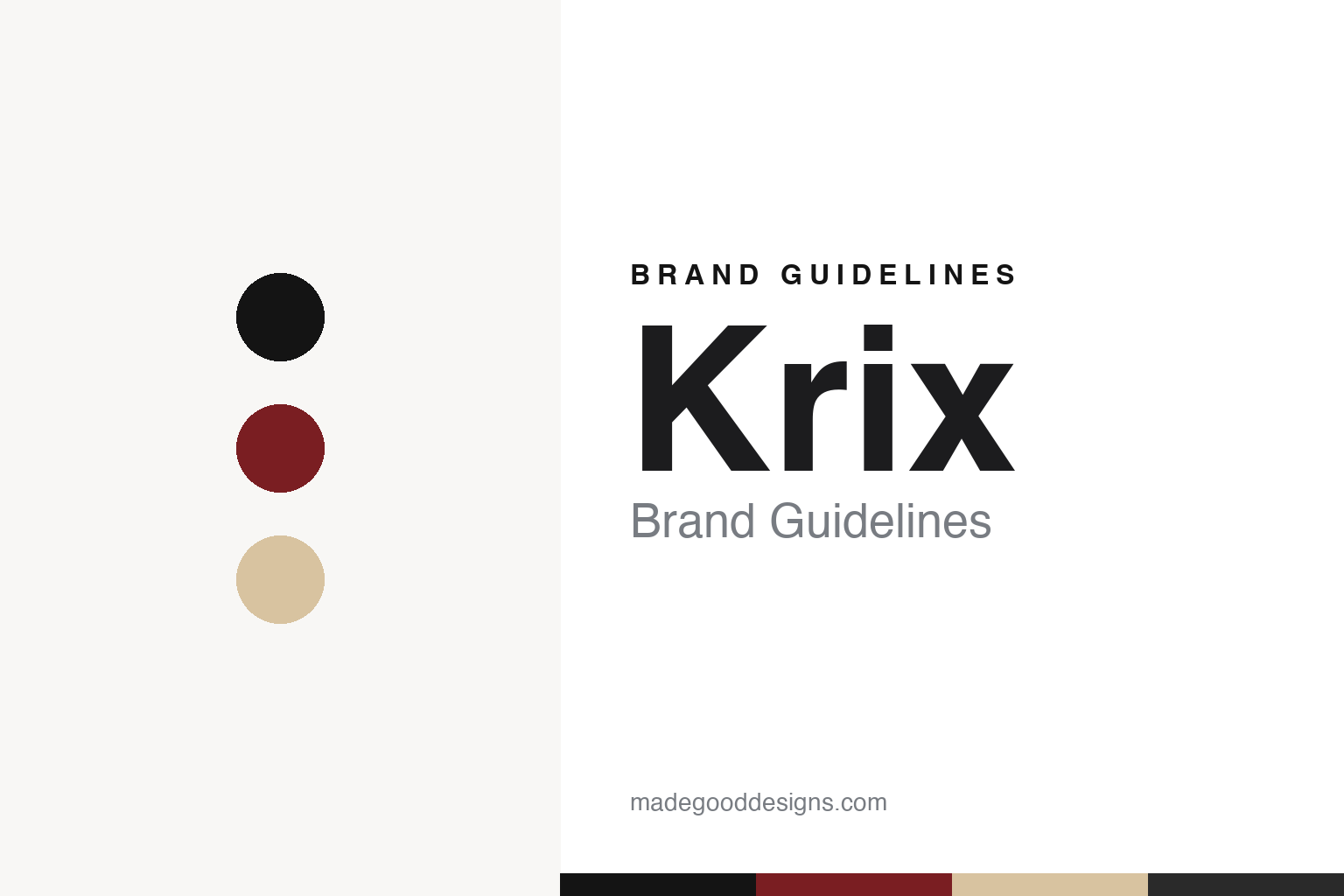
Krix Brand Guidelines
The Adelaide loudspeaker maker that went into cinemas.
Aa
Two constants: a Krix black, cinema red and sandstone palette and an engineered sans register. Abstract homage — not a Krix product or mark; no speaker, logo or nameplate is reproduced.
A garage in Adelaide
An engineer, a shop and a factory in the southern suburbs.
Krix is a loudspeaker maker from Adelaide, South Australia, founded in 1974 by Scott Krix. The Lead South Australia reported in 2018 that Scott Krix, an electronic engineer, started the business as a consumer hi-fi speaker maker out of his garage and soon opened a small shop in Adelaide. A 2024 company history published by its UK distributor, Invision, says he founded “Krix Speaker Systems” after an engineering degree in Adelaide, building speakers for friends and family; SBS News, profiling the company in 2017, said it began as a hobby.
The shop came in 1976. The company’s timeline names it The Acoustic Foundry, and the Invision history says it was where a “Design Your Own Systems” idea took shape: customers could audition separate speaker elements and put together a system to suit their taste. In 1978 the most popular of those combinations became the company’s first complete range, the Home Grown series, according to the same history and the Finnish magazine Inner Magazines. In 1979, the timeline says, Krix opened its first factory and office at Hackham, in Adelaide’s southern suburbs, on a one-acre site with a building of 120 square metres.
That site grew in steps the company still lists: a 500-square-metre shed in 1985, another in 1990 and a two-level building of 1,000 square metres in 1996. Its head office today is on Chapman Road in Hackham, and its website warns visitors that, “being a manufacturing facility,” it may have limited demonstration capabilities.
Colour
The Capri, horns and THX.
Krix’s turn toward cinema came in 1980. The Lead South Australia reported that the big break came when the Capri Cinema “down the road in Goodwood” became the first theatre to have a Krix system installed, and that within five years Krix was providing sound in cinemas around Australia. The company says that installation was the world’s first “infinite baffle wall,” a way of mounting screen speakers in a solid wall; we give that as its claim. SBS News said the breakthrough came from fixing acoustic problems in a local Adelaide cinema, and named the chains Hoyts, Greater Union and Village Roadshow among its clients.
The cinema work shaped the products. Krix speakers use horns — flared structures that control where sound goes — and the company’s timeline records an Australian patent awarded in 2003 to David Murphy, whom Inner Magazines described as its senior cinema speaker design engineer, for a constant-directivity horn design, followed by further patents in 2007 and 2010. In 1993, the timeline says, its KSX-1 cinema speaker gained THX accreditation from Lucasfilm.
Exports started in the 1990s, though the accounts differ. The timeline lists New Zealand, Singapore and Thailand in 1993; the Invision history says the consumer business went abroad in 1994 after a meeting at the Consumer Electronics Show in Las Vegas, with Hong Kong first, then Malaysia, and the United States by 1996. In 2018 The Lead South Australia reported strong growth in the Middle East through a partnership with Dubai-based VOX Cinemas — more than 300 cinemas in three years — and new installations in China and India, with exports making up about half of revenue.
The figures for its reach are the company’s own and have grown over time: “over 3500 cinemas in more than 30 countries” in 2018; more than 4,000 cinemas in 40 countries in its 50th-anniversary timeline; “over 4500 installations across 40 countries” in the Invision history of 2024; and more than 4,000 cinemas in 45 countries on its website in 2026.
Typography
Hi-fi from the far side of the world.
Hi-fi making in Australia and New Zealand has largely been the work of small firms a long way from their biggest markets. Plinius says it was founded in 1980 to serve “local customers in New Zealand,” and that its amplifiers are assembled at a Christchurch facility shared with other manufacturing work. Krix says it was established in Australia in 1974.
Ownership has often followed the fortunes of a parent. Halcro, its website says, was created by the physicist Bruce Candy inside his metal-detector company, Minelab; when Codan bought Minelab in 2008, Halcro was shelved, until Longwood Audio, set up by the owners of an Australian hi-fi importer, bought its assets — in 2014 or 2023, as different pages of the same site say.
South Korea’s best-known hi-fi names are digital specialists. Astell&Kern began as the premium player brand of iriver, which SK Telecom bought in 2014 and which renamed itself Dreamus in 2019; English Wikipedia says bemyfriends became Dreamus’s largest shareholder in 2025. Aurender makes music servers, and HiFi Rose belongs to Citech, a listed company that made its name with kiosks; Citech says 87% of HiFi Rose’s 2024 sales were exports.
The makers in this guide are Krix and Halcro in Australia, along with Redgum, which stopped manufacturing at the start of 2025; Plinius, in Christchurch, and Perreaux in New Zealand; Aurender, whose head office is at Anyang, just south of Seoul; and HiFi Rose, run from Citech’s offices in Seoul, according to their websites and filings.
This guide sets out what can be checked about each brand — who founded it, who owns it, and what it says about where its products are made — and marks clearly what rests only on the company’s own word.
Aa
An engineered sans for a maker of horn speakers. (Specimen set in Archivo, a sans STAND-IN; NOT the Krix logo.)
Krix
Still family-owned, still made at Hackham.
Krix is still family-owned. Its 2024 timeline names Scott, Gary and Ashley Krix as its owners, and trade coverage names Gary Krix as chief executive. Accounts of how many brothers work there differ — SBS said in 2017 that Scott ran the company with four brothers, while The Lead South Australia counted five Krix brothers among about 25 staff in 2018 — so we leave the number open.
The company says its speakers are designed and made in-house at Hackham, with an “in-house manufacturing facility and R&D team,” and that every speaker leaving the factory is tested in an acoustic measurement chamber; SBS described each speaker as handmade. The global financial crisis tested that model. Ashley Krix told The Lead South Australia that, with the Australian dollar above parity, the company had to find more efficient ways of manufacturing, including new software for its CNC machines.
Home cinema now sits alongside the commercial business. The Invision history dates Krix’s first dedicated home-cinema range to 2010; its current ranges, Series X, SX and MX, are described as covering rooms from three to 23 metres deep. In 2018, according to Invision, Krix became the exclusive distributor of the French processor maker Trinnov’s commercial-cinema products for Australia, New Zealand, the Middle East and China. For its 50th year in 2024 it announced a programme that included Integrated Systems Europe in Barcelona and the StereoNET Hi-Fi & AV Show in Melbourne.
For a design guide, Krix shows how a brand built for cinemas — where the speakers are hidden behind the screen — can carry its engineering into the living room. Compare Halcro, another Adelaide audio name, and Redgum, another Australian maker. For this guide we use horn black, cinema red and warm sandstone with a sans, an unofficial interpretation; no product or logo is reproduced.
Explore & save
Keep Krix’s identity on hand — save it to a board in the Made Good inspiration library.
Krix identity set
Pin the Krix horn black, cinema red and sandstone palette and the engineered sans register to your own board.