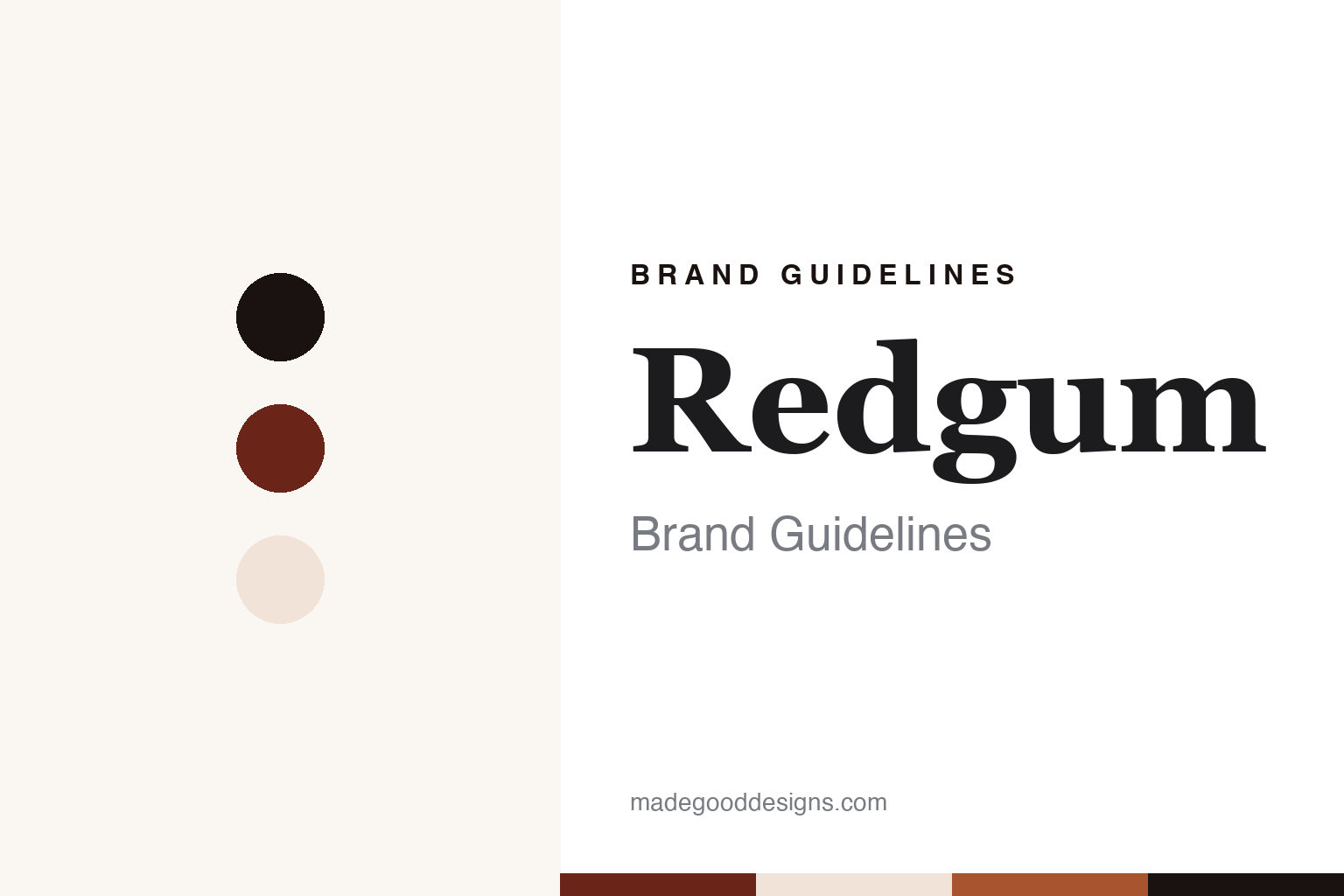
Redgum Brand Guidelines
The Victorian amplifier maker with a key for a power switch.
Aa
Two constants: a red-gum timber and black palette and a timber serif register. Abstract homage — not a Redgum product or mark; no amplifier, logo or nameplate is reproduced.
Contemporary Sound
Twenty-five years behind the counter.
Redgum Audio was the work of two people: the designer Ian Robinson and his partner Lindy Gerber, whom SoundStage! Australia named in 2020 as having established the company with him and in 2024 as its manager. The company’s own pages name Robinson as the designer of every Redgum amplifier, and the best account of how the brand began is a profile of him in Australian Hi-Fi from July 1999, which Redgum reprinted on its website.
According to that profile, Robinson was born and raised in Melbourne and studied electronic engineering at a technical college without finishing the course, because, in his words, “business got easier and study got harder.” He worked for Victoria’s State Electricity Commission until 1974, and registered his first business, Chelsound Electronics, in 1967, at the age of 20. He later bought a cabinet factory, Recab Storage Cabinets in Parkdale, and used it to make his own Link bookshelf loudspeakers.
His longest venture was retail. In 1972 a customer who owed him about $1,500 handed over the keys to his shop, and that became Contemporary Sound Centre, in the bayside suburb of Beaumaris; a second store opened in Hawthorn in 1976. Robinson told the magazine that its brands included Rogers, NAD, Mission and the New Zealand amplifier maker Perreaux, and that the shop did warranty service on Perreaux and McLaren amplifiers — work he credited with teaching him MOSFET amplifier design. He counted more than 18,000 service jobs from about 1972.
Colour
A black box, a red-gum front and a key.
By the early 1990s, Robinson said, customers were trying to replace their old amplifiers and finding nothing he liked, so he set out to build his own. He had working prototypes by 1993, housed in a plain black box that he nicknamed “Mundrum,” which he was told was a Tamil word for black magic; he dropped it because Australians heard “humdrum.” He then gave the box a front panel of red gum, and the name followed. SoundStage! Australia gives the first product as the RGi120 integrated amplifier in 1993 and says the company was incorporated in 1995.
Two details made the amplifiers recognisable. The first was the wood: the company says each front panel is “one solid piece of unfilled natural timber,” chosen for its grain, and explains the name by saying that “if any one wood conjures up the essence of Australia, it is red gum.” The second was the power switch, a lock and key. Redgum’s website quotes Ken Kessler in Hi-Fi News & Record Review in November 1995: “Redgum: cool name and a cool feature. The company’s amps can be locked with a key which serves as the on switch.” The company says each amplifier has its own key and that it keeps a register matching keys to warranty records, so a stolen amplifier is useless; it also offered conventional switches to buyers who asked.
Other habits were just as deliberate. Many models had two volume knobs, one per channel, which the company defended as fewer contacts in the signal path; it added a dual-mono remote control in 2007. Robinson closed Contemporary Sound Centre in January 1998, after showing the amplifier in England in 1997 and at the Consumer Electronics Show in the United States, where, he said, Redgum signed a distributor. The range grew to monoblocks, loudspeakers built for Redgum by John Reilly of Axis, and a CD player whose converter was designed by Jon De Sensi of Music Labs and which used a computer CD-ROM drive the owner could replace.
Typography
Design and documentation.
Hi-fi making in Australia and New Zealand has largely been the work of small firms a long way from their biggest markets. Plinius says it was founded in 1980 to serve “local customers in New Zealand,” and that its amplifiers are assembled at a Christchurch facility shared with other manufacturing work. Krix says it was established in Australia in 1974.
Ownership has often followed the fortunes of a parent. Halcro, its website says, was created by the physicist Bruce Candy inside his metal-detector company, Minelab; when Codan bought Minelab in 2008, Halcro was shelved, until Longwood Audio, set up by the owners of an Australian hi-fi importer, bought its assets — in 2014 or 2023, as different pages of the same site say.
South Korea’s best-known hi-fi names are digital specialists. Astell&Kern began as the premium player brand of iriver, which SK Telecom bought in 2014 and which renamed itself Dreamus in 2019; English Wikipedia says bemyfriends became Dreamus’s largest shareholder in 2025. Aurender makes music servers, and HiFi Rose belongs to Citech, a listed company that made its name with kiosks; Citech says 87% of HiFi Rose’s 2024 sales were exports.
The makers in this guide are Krix and Halcro in Australia, along with Redgum, which stopped manufacturing at the start of 2025; Plinius, in Christchurch, and Perreaux in New Zealand; Aurender, whose head office is at Anyang, just south of Seoul; and HiFi Rose, run from Citech’s offices in Seoul, according to their websites and filings.
This guide sets out what can be checked about each brand — who founded it, who owns it, and what it says about where its products are made — and marks clearly what rests only on the company’s own word.
Aa
A warm timber serif for a brand named after a wood. (Specimen set in Fraunces, a serif STAND-IN; NOT the Redgum logo.)
Redgum
Made in Victoria until the last day of 2024.
Redgum built its case on where its products were made. Its website says all its products are “designed and made in Australia” and that “REDGUM really is made in the suburbs of Melbourne,” and in 1999 Robinson told Australian Hi-Fi that Gerber assembled the circuit boards herself; those are the company’s own claims. Its later address was at Emerald, in the hills east of Melbourne, where SoundStage! Australia reviewed the 200-watt Articulata integrated amplifier in 2020 at AU$7,200. Later ranges were sold as Amplifolia, the wood-fronted models, and the Black Series.
The business has now stopped making amplifiers. In August 2024 SoundStage! Australia reported that Redgum would cease manufacturing on 1 January 2025, quoting Robinson: “I’ve had over 60 years of direct involvement in the audio industry,” and “with minor health issues impinging, it now seems a good time to rest on one’s laurels.” The report said existing owners would still be supported and remaining stock sold while parts lasted. The website was still online in October 2026; we found no report of a sale or revival of the brand. The name has its traps: in 1999 Robinson joked that Americans thought Redgum was chewing gum and the British thought it was glue, and Australians may know it as the name of an unrelated folk band.
For a design guide, Redgum shows how one material and one unusual control can carry a whole identity. Compare Perreaux, the New Zealand amplifier maker whose products Robinson once sold and serviced, and Krix, another Australian maker. For this guide we use red-gum browns and black with a serif, an unofficial interpretation; no product or logo is reproduced.
Explore & save
Keep Redgum’s identity on hand — save it to a board in the Made Good inspiration library.
Redgum identity set
Pin the Redgum red-gum and black palette and the timber serif register to your own board.