Furutech Brand Guidelines
A Tokyo maker of the plugs and cables between the wall and the speaker.
Aa
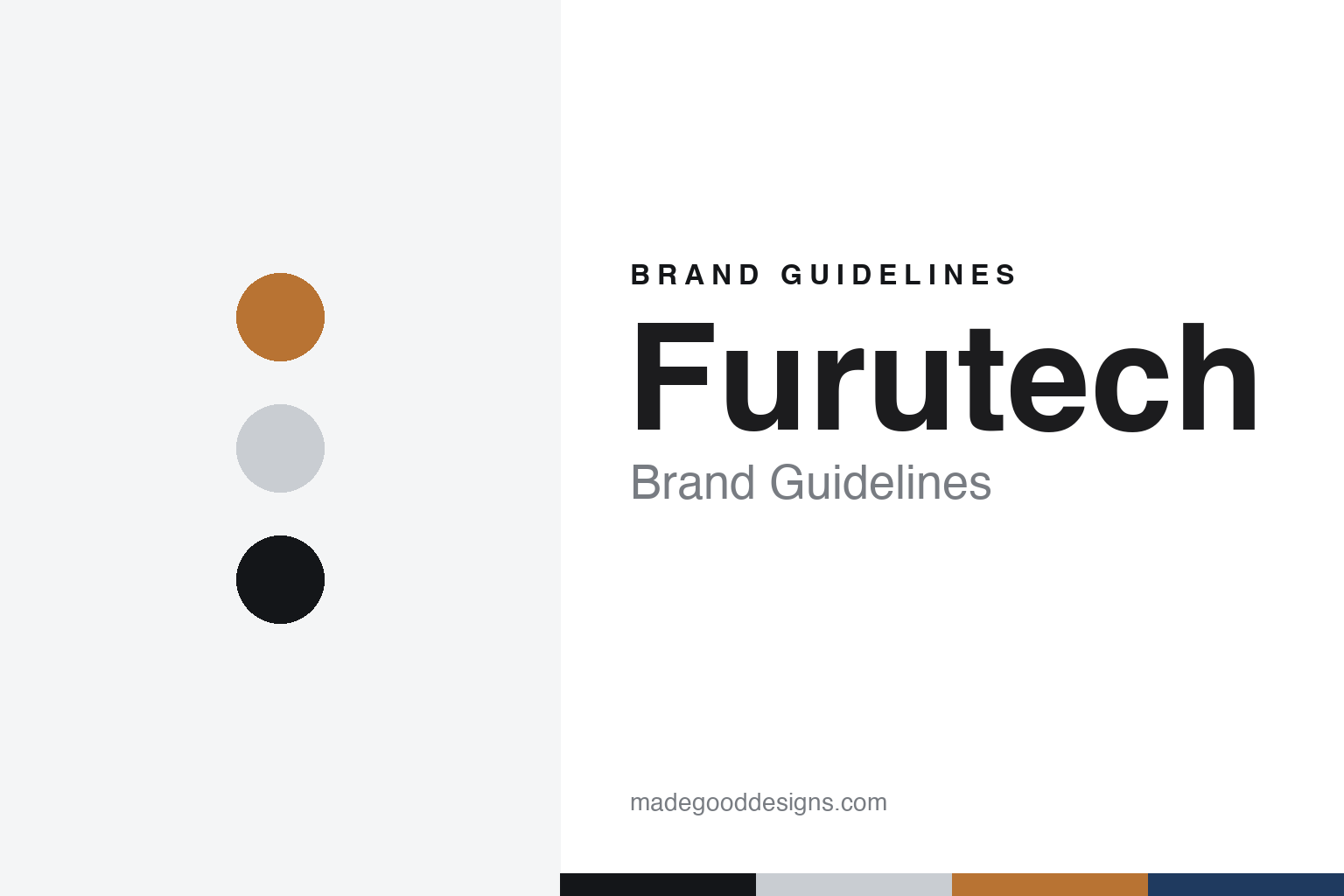
Two constants: a carbon black, rhodium silver and copper palette and a technical condensed sans register. Abstract homage — not a Furutech product or mark; no connector, logo or nameplate is reproduced.
Shinagawa, 1988
A cable and connector specialist in southern Tokyo.
Furutech is a Tokyo company. Its website gives its legal name as Furutech Co., Ltd. (フルテック株式会社), says it was established in April 1988, and gives its address as the Furutech Building in Togoshi, Shinagawa, in the south of the city. Archived versions of the site show that it was earlier based a short distance away, in Nishi-Gotanda, also in Shinagawa. The sources we checked do not name a founder, so we do not give one.
Its leadership can be traced through those archived pages. The company profile on its website in 2008 and 2010 named Toshi Morino as president. By 2013 the English profile named Frank Hayama as president, and the Japanese page listed him as representative director and president under his Japanese name, 葉山吉祥. The current website gives Hayama as the company’s contact but does not state his title, so we do not either.
The same archived profiles listed two companies outside Japan: Furutech (H.K.) Co., Ltd., in Kowloon, Hong Kong, and Furutech Ind Co., Ltd., in what is now New Taipei City, Taiwan. The 2013 Japanese page described the business as making and selling cables, power equipment and audio parts for home audio, AV and car audio, and the 2008 English profile said the company kept “a very strong presence” in car audio as well as home audio.
A note on names: an unrelated Japanese company, a distributor of automatic doors based in Sapporo and listed on the Tokyo Stock Exchange, uses exactly the same Japanese name, フルテック株式会社, and is the company described in the Japanese Wikipedia article of that name. Nor is Furutech part of Furukawa Electric, the Japanese cable group.
Colour
Plugs, outlets, cables — and the Alpha process.
Most audio brands treat connectors as a part bought in. For Furutech they are the main product. Its range runs from IEC, Schuko, UK and Australian power plugs to wall receptacles, power distributors and in-line filters, and on to RCA and XLR plugs, spade and banana connectors, binding posts and finished or bulk cable. The company describes this as a “Pure Transmission Design Concept” that runs from the AC inlet to the speaker terminals.
Its technical claims centre on materials and treatment. Furutech says it uses ultra-high-purity OCC single-crystal copper, silver-plated copper, copper-silver hybrids and PC-Triple C, as well as DUCC copper licensed from Mitsubishi Materials, and that all its metal parts go through a multi-stage “Alpha” process of cryogenic treatment and demagnetisation; in 2008 it described a “2-Stage Alpha Cryogenic and Ring Demagnetization Process.” It lines parts with an EMI-absorbing compound it calls GC-303. Its newer NCF (“Nano Crystal² Formula”) material, it says, generates negative ions to remove static and converts heat into far-infrared energy; these are the company’s claims, not tested findings. Furutech says NCF is a registered trademark in the US, Germany, China and Japan.
Furutech also makes parts for other brands. Its OEM page says its connectors have been “the first choice for many of the world’s leading high-end audio component and cable manufacturers for the past 25 years.” Where its own products are made is less clear. The website says Furutech “designs and manufactures” them, and in a 2021 warning about counterfeits it stated that “NO Furutech product or Furutech product part is made in China.” It does not say which country its factories are in, and none of the sources we checked does either, so we make no claim either way.
The company lists many awards on its own site. It reports that the NCF Booster won a VGP Gold Award and an Audio Accessory magazine Grand Prix in Japan in 2017, and that The Absolute Sound named its GTX-D NCF wall receptacle a Product of the Year in 2019; we give these as the company reports them.
Typography
Design and documentation.
Japan’s audio industry is best known for its large electronics groups, but much of its valve-amplifier and cable trade belongs to small specialist companies. The seven in this guide are all based in or around Tokyo, according to the addresses on their own websites.
Three are valve-amplifier makers. Shindo Laboratory lists its address in Hongo, in Tokyo’s Bunkyo ward. Audio Note, the Japanese company behind the Kondo name, says it was founded in 1976 and has worked with silver since then; it is based in Kawasaki, Kanagawa. Triode, set up in 1994 as Triode Supply Japan, is based in Koshigaya, Saitama; it says it designs its products itself and has them built by partner factories in China, and that its TRV-CD6SE CD player of 2020 was its first product made in Japan.
Two more make a wider mix of equipment. Fidelix, in Kiyose, western Tokyo, gives its founding year as 1976. Kripton, whose range runs from loudspeakers to cables and power accessories, lists its address in Yotsuya, Shinjuku.
The last two are cable and connector specialists. Furutech says it was established in April 1988 and designs and manufactures cables, connectors and power products from Togoshi, Shinagawa. Oyaide Electric began as an Akihabara wire seller in 1952, still runs a shop beneath the JR Sobu line, and has its head office in Yushima, Bunkyo.
This guide sets out what can be checked about each brand — who founded it, who owns it, and what it says about where its products are made — and marks clearly what rests only on the company’s own word.
Aa
A technical condensed sans — for a maker of plugs and part numbers. (Specimen set in Barlow Semi Condensed, a sans STAND-IN; NOT the Furutech logo.)
Furutech
Carbon fibre, rhodium and a counterfeit problem.
Furutech does not publish brand guidelines, but its products have a consistent look. Its NCF Clear Line, launched in 2020, was announced with a carbon-fibre shell and rhodium-plated conductor parts, and that pairing of dark composite bodies and bright plated metal runs across its plugs and receptacles. The names are technical rather than poetic: model codes such as FI-68, GTX-D NCF and NCF Booster, and cable families with names such as LineFlux, PowerFlux and DigiFlux.
The brand’s reach has made it a target. In February 2021 Furutech warned that any Furutech or NCF product sold through AliExpress or Taobao and shipped from China or Hong Kong was counterfeit, and said it was working to have such listings removed. For a company whose products are often fitted out of sight, inside other makers’ equipment or behind a rack, the mark on the plug is much of what the buyer sees.
Furutech has a second, cheaper brand. A 2013 post on its site introduces ADL (Alpha Design Labs), “created by Furutech” to bring its technology to lower prices; the line has included cables, and Japanese Wikipedia says Furutech sold headphones under the ADL name. Furutech has also presented new products to the international trade at the High End show in Munich, in years including 2014, 2016, 2018, 2019 and 2023, according to its news pages.
For a design guide, Furutech shows how a component maker can build a recognisable identity from the parts other brands hide — plugs, outlets and cable jackets — and from consistent materials. Compare Oyaide, another Tokyo maker of cables and connectors, and Audio-Technica. For this guide we use carbon black, rhodium silver and copper with a condensed sans, an unofficial interpretation; no product or logo is reproduced.
Explore & save
Keep Furutech’s identity on hand — save it to a board in the Made Good inspiration library.
Furutech identity set
Pin the Furutech carbon black, rhodium silver and copper palette and the technical condensed sans register to your own board.