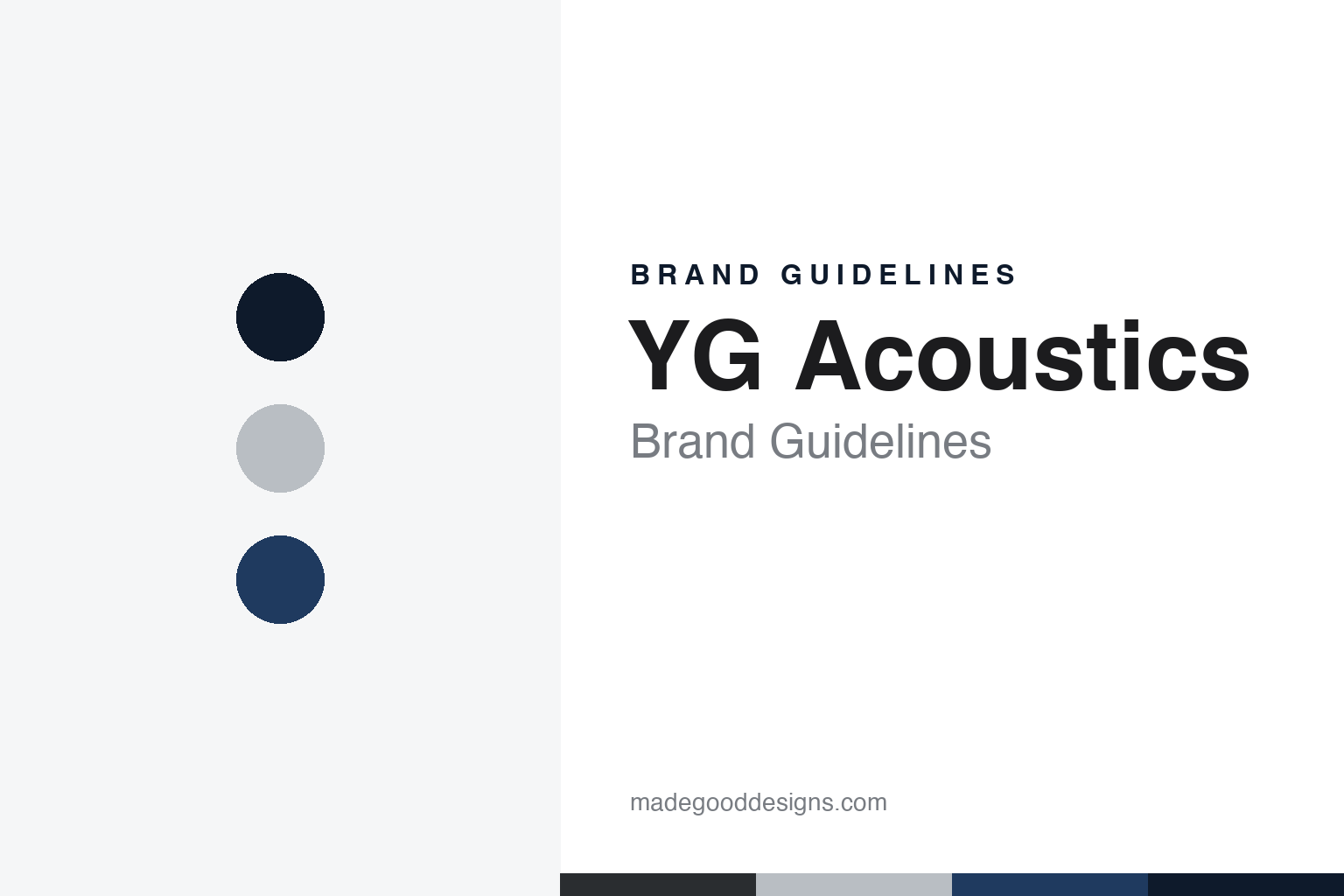
YG Acoustics Brand Guidelines
The loudspeaker maker that turned machined aluminium into an identity.
Aa
Two constants: a YG Acoustics graphite, aluminium and blue palette and an Engineered sans register. Abstract homage — not a YG Acoustics product or mark; no speaker, logo or nameplate is reproduced.
Yoav Geva
From Israel to Arvada.
YG Acoustics takes its name from its founder’s initials, Yoav Geva. Although it is now known as a Colorado maker, it did not start there. SoundStage!, visiting in 2009, reported that the company “was founded in Israel” and that, with outside investment, Geva and his family moved to Arvada, Colorado, a Denver suburb, in 2004, believing the United States was the best place from which to grow a maker of “extreme-fidelity” speakers. The founding year, 2002, is given by the company and by StereoNET, which says Geva was 24 at the time.
Geva came to speakers through software. A keyboard player from a musical family — his father a bass guitarist, his brother an opera singer, he told Dagogo in 2011 — he had written digital-signal-processing code and built speakers as a hobby. His first invention, he said, was a crossover-design algorithm, which became what the company calls its DualCoherent crossover; SoundStage! described his program as optimising frequency and phase at the same time. Still living in Israel in the early 2000s, he entered it in a contest held by Israel’s Ministry of Industry, won, and received a government grant to start the company. Manufacturing expertise, he said, “came second.”
By 2009, SoundStage! reported, YG had seven employees, a 10,000-square-foot factory and a capacity of about 100 pairs a year. It machined its own cabinet parts, built its crossovers, and assembled and measured every speaker, without glue: a pair of Anat Reference Studio speakers, the magazine said, needed more than 4,000 screws and washers. The flagship then was the Anat Reference II, at $107,000 a pair; the smaller Kipod Studio cost $38,000.
Colour
Billet aluminium.
YG’s visual identity is its material. Its cabinets are machined from aluminium rather than built from wood: HomeTheaterHifi’s Carlo Lo Raso recalled in 2023 first hearing owners describe a speaker “completely made of aluminum,” enclosure and all, and remembered an all-black anodised pair of Sonjas at a Denver show. The look is industrial and exact — flat machined faces, dark or natural metal — and SoundStage! noted that almost all the screws sit inside the cabinet to keep the outside sleek.
Geva named and dated his technologies. StereoNET listed them in 2020 as Cabinet (2004), FocusedElimination (2007), ToroAir (2010), BilletCore (2011), ViseCoil (2015) and BilletDome (2016) — the article said there were seven but named six — and credited him with every model to that date: the Anat and Kipod, then the Sonja, Hailey and Carmel. BilletCore refers to driver cones that YG machines from aluminium, according to HomeTheaterHifi’s factory visit.
The range today, according to the company’s website, runs from the Titan at the top through a Reference line — Carmel 3, Vesper 3, Vantage 3, Hailey 3, Sonja 3.2 and 3.3, and the XV 3 — to active Live versions and the Peaks series, a more affordable range of six models whose wood-veneered cabinets HomeTheaterHifi described in 2023 as a different aesthetic for the brand.
Where things are made is more nuanced than “all in-house.” In 2017 the company said it was one of very few makers producing “its own drivers, cabinets and most other high-precision parts” in-house. On HomeTheaterHifi’s 2023 visit, it explained that it develops custom drivers with a “world-renowned” driver manufacturer, machining and anodising the aluminium cones in Colorado and shipping them to that partner to be built into drivers. At HIGH END Vienna in June 2026, YG showed the Carmel 3 in a partnership with the Danish driver maker Scan-Speak and Niron Magnetics, using rare-earth-free iron-nitride magnets — which the three companies called the world’s first loudspeakers powered by such magnets.
Typography
Design and documentation.
Colorado’s Front Range, around the city of Boulder, is home to several of America’s high-end audio makers. Avalon Acoustics builds loudspeakers in Boulder; Ayre, founded in Boulder in 1993 according to English Wikipedia, now gives its address at Niwot, just north-east of the city; Boulder Amplifiers moved to Louisville, east of Boulder, in 2016; and YG Acoustics gives its headquarters and machining plant as Denver.
The others are spread more widely: MartinLogan in Lawrence, Kansas, where it was founded — in 1979 according to English Wikipedia, in 1983 according to the company — and where it still has its design centre; Rockport Technologies in South Thomaston, Maine, where SoundStage! found it in 2012; and Constellation Audio in California, which Hi-Fi News called a “Californian amplifier specialist” in 2025.
The shows have changed too. For years the Consumer Electronics Show in Las Vegas gave high-end audio rooms of its own, latterly at the Venetian hotel, and Boulder showed its 3050 amplifiers there in January 2011; at CES 2019, Stereophile wrote that the curtain had closed on the show as the place for high-end launches. Denver had its own event, the Rocky Mountain Audio Fest, first held in 2004; its organisers cancelled the 2021 show and all future ones. AXPONA, held at Schaumburg near Chicago, now describes itself as North America’s largest high-end audio show.
Prices at this level can be startling: Boulder’s 3050 mono amplifiers cost about $195,000 a pair in 2011, Enjoy the Music reported. Several of these makers remain small and privately held.
This guide sets out what can be checked about each brand — who founded it, who owns it, and what it says about where its products are made — and marks clearly what rests only on the company’s own word.
Aa
An engineered sans, set in the typeface YG’s own website loads. (Specimen set in Barlow, a sans STAND-IN; NOT the YG Acoustics logo.)
YG Acoustics
Colorado owners, a Cambridge laboratory.
In 2017 YG announced its “acquisition by LK Capital and Yoav Geva.” LK Capital, founded by Steve Foreman, described itself as an investment office focused on private equity in Colorado; Geva remained “a core owner and partner,” and David Komatz became chief executive, the announcement said. Geva stayed on as chief engineer until July 2020, when the company announced on Facebook that he had left, StereoNET reported.
That same year YG formed an exclusive partnership with Cambridge Acoustic Sciences, a research team in Cambridge, England. In July 2022 the company said the two management teams had merged under the YG name, with Dr Matthew Webster, who holds a PhD in astrophysics from Cambridge, as chief executive and Komatz staying on as a senior adviser and significant shareholder. It also said it had invested more than $2 million in its Colorado plant, more than doubling production capacity with six new machines.
Today YG calls itself “an international company.” Its website describes its “historic headquarters and main CNC manufacturing site” as Denver — reporters who have visited place it in Arvada, just outside the city — with waterjet cutting and three- and five-axis machining, and a research hub in Cambridge since 2020 with its own GPU computing cluster. Since the XV 3 Signature of early 2024, it says, it has added manufacturing in Cambridge and now offers its full range “from both Denver and Cambridge.”
For a design guide, YG Acoustics shows how a material can become an identity: machined aluminium, named and dated technologies, and a name drawn from its founder’s initials. Compare Magico, which also builds its speakers in aluminium, and Wilson Audio. For this guide we use anodised graphite, raw aluminium and a deep blue with a sans, an unofficial interpretation; no product or logo is reproduced.
Explore & save
Keep YG Acoustics’s identity on hand — save it to a board in the Made Good inspiration library.
YG Acoustics identity set
Pin the YG Acoustics graphite, aluminium and blue palette and the Engineered sans register to your own board.