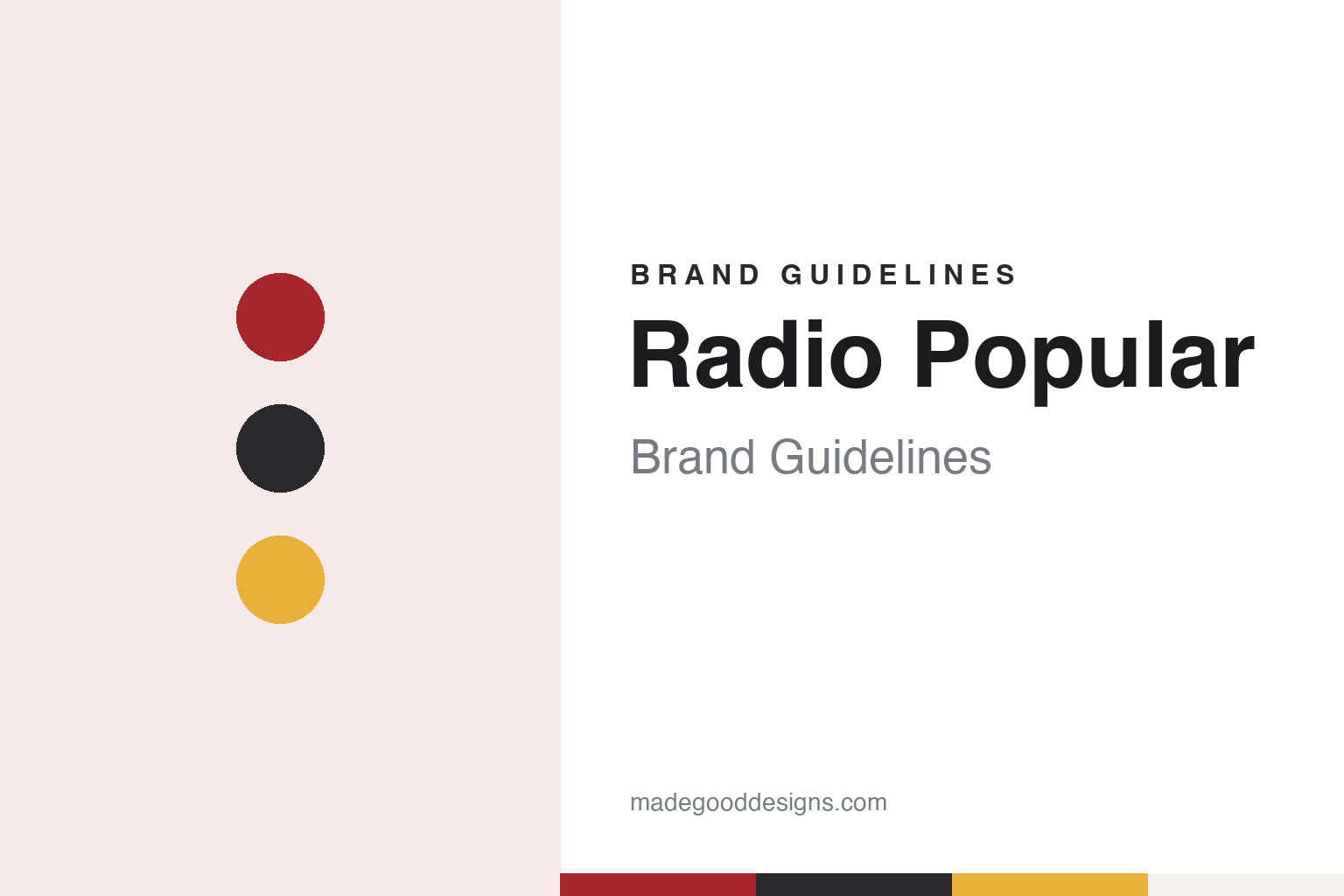
Radio Popular Brand Guidelines
The Porto appliance chain run by the Silva brothers.
Aa
Two constants: a red, graphite and yellow palette and a retail grotesque register. Abstract homage — not a Radio Popular product or mark; no appliance, logo or shop sign is reproduced.
Rua do Loureiro
A shop near São Bento station.
Radio Popular began in 1977 with a shop on Rua do Loureiro in Porto, a short street that, the Jornal de Negócios noted in December 2020, runs down to the square in front of São Bento railway station. The company writes its name without an accent, as Radio Popular, and trades as Radio Popular – Electrodomésticos, S.A.; the Portuguese press usually spells it Rádio Popular. The same December 2020 report described it as “the company of the brothers Ilídio and Edgar Silva,” and in February 2021 the newspaper, reporting with the Lusa news agency, identified Ilídio Silva as its director-general.
The chain grew out of the north. In 1998, the trade title Grande Consumo reported in January 2020, it opened in Maia, on the edge of Porto, a large store given over entirely to household appliances; the company’s registered seat is in Maia today. Its own “Quem Somos” page says the business has been online since 2004; Grande Consumo added in 2020 that the online shop sells to customers around the world, and the site’s footer credits its design to Radio Popular itself.
The range is broad rather than specialist. The Jornal de Negócios listed computing, telecommunications, sound and image, photography, gaming and small and large appliances, and the company says it keeps more than 50,000 products on display. Its slogans, which it quotes on the same page, have moved from “Tudo mais barato” (everything cheaper) to “Preços de Amigo” (friends’ prices); a tagline cited on Portuguese Wikipedia is “A tecnologia é para todos,” technology is for everyone.
Colour
From store 50 to the islands.
The press has followed the chain store by store. In January 2020 Grande Consumo reported the opening of the 50th store, in Leiria’s LisShopping centre, with about 1,000 square metres. In December 2020 the Jornal de Negócios reported the 52nd, in Paços de Ferreira, a store of about 2,000 square metres in a standalone building opposite the Ferrara Plaza centre that had stood unused since it was built. In April 2022 the same paper reported the 56th, the second in Leiria, again over 2,000 square metres and called “XXL” by the company, which said it had more than 1,000 employees.
Logistics moved south. In February 2021 the Jornal de Negócios, citing Lusa, reported that Radio Popular had leased the whole of a warehouse development by the Belgian logistics group VGP at Nogueira da Regedoura, in Santa Maria da Feira, near the A1, A29 and A41 motorways, with about 30,000 square metres and 46 loading doors; in April 2022 the company announced that a logistics centre of more than 30,000 square metres had opened.
The same February 2021 report recorded the company’s financial history plainly. It said Radio Popular had started a Plano Especial de Revitalização (PER), a Portuguese recovery procedure for companies in difficulty, in 2013, and that according to the securities regulator, the CMVM, it has until 2028 to complete it.
The store network now spans the country; the company’s “Quem Somos” page traces it from the first shop on Rua do Loureiro to its most recent opening, in Miraflores, west of Lisbon. In November 2026 the company’s store locator listed 69 stores, from Viana do Castelo, Chaves and Monção in the north to Faro, Lagos and Portimão in the Algarve, with retail-park sites at Aveiro, Alverca and Barreiro, and island stores on São Miguel and Terceira in the Azores and at Funchal and Cancela in Madeira.
The locator’s own names show the mix of formats. Several stores carry retail-park names, among them Albufeira, Aveiro, Alverca, Barreiro’s Planet Retail Park, Carvalhos’ Atlantic Retail Park and Guimarães’ Retail Park Silvares; Braga has a “Retail Center”; others sit in shopping centres such as Mar Shopping and Viseu’s Palácio do Gelo, and Porto’s store occupies the Retail Fábrica do Cobre. In April 2022 the company tied the second Leiria opening to its 45th anniversary, which it marked with a month of promotions, the Jornal de Negócios reported, and in 2020 it told Grande Consumo that the LisShopping store had created about thirty direct and indirect jobs.
Typography
Shop signs and own brands.
Portugal’s fashion, footwear, accessories and electronics chains range from family firms that grew out of a single shop to brands held within larger retail groups. Several of the fashion and accessories chains now trade well beyond Portugal, in markets from Spain and France to the Middle East, sometimes through franchise partners abroad.
Formats vary with the trade and the company. Fashion and accessories chains work from shopping-centre units, high-street shops and outlet stores, and electronics retailers from their own large-format stores. Parfois, for example, opened its second shop in a Sonae shopping centre in Vila Nova de Gaia, Forbes Portugal reported, while Lanidor has run its own outlet concept, LA Factory, beside its main womenswear line.
Ownership is part of each brand’s story. Some chains remain in the hands of their founders or founding families, others have changed owners through acquisitions, investments or insolvency proceedings, and some groups hold several brands at once, each with its own shop sign. Each guide in this series states owners, stakes and dates only as dated sources give them, and names collections and own brands as the companies themselves name them.
For designers, these chains show how a retail identity travels from the shop sign to the carrier bag, the label and the website. Logos, colour schemes, shop interiors and corporate pages on founders and owners are described here as the companies publish them or as the press has reported them; the palettes in each guide are our own unofficial interpretation, and no logo or product is reproduced.
Aa
A heavy grotesque for shop signs and price cards. (Specimen set in Archivo, a sans STAND-IN; NOT the Radio Popular logo.)
Radio Popular
A family name on a national network.
Radio Popular’s “Quem Somos” page says it gives direct work to about a thousand people. Its web shop groups thousands of items by manufacturer, and a highlighted section is given to two names, Electronia and Princesse, which appear across large appliances and televisions.
For designers, the material to study is the retail layer: large store fronts in retail parks, long product grids on the website, and slogans written as everyday speech, such as “Preços de Amigo.” The palette and type in this guide are our own interpretation of a busy appliance showroom and its price cards, not a company specification.
The name needs care online. “Rádio Popular” is also the name of an AM radio station in Duque de Caxias, in Brazil, unrelated to the Porto retailer, whose own address is radiopopular.pt.
For a design guide, Radio Popular shows how a regional electronics chain can build a national network through big-box stores, short slogans and a single name over every door. Compare Worten, the Sonae electronics chain, and Fnac. For this guide we use a shopfront red, graphite and a price-tag yellow with a sans, an unofficial interpretation; no product or logo is reproduced.
Explore & save
Keep Radio Popular’s identity on hand — save it to a board in the Made Good inspiration library.
Radio Popular identity set
Pin the Radio Popular red, graphite and yellow palette and the retail grotesque register to your own board.
Source & notes
Frequently Asked Questions
What font can I use to match the Radio Popular look?
This guide describes Radio Popular’s type as “A heavy grotesque for shop signs and price cards”. Its type specimen is set in Archivo from Google Fonts as a stand-in; Archivo is not Radio Popular’s own lettering.
What colours are in the Radio Popular palette?
This guide’s Radio Popular palette is Shopfront red #A6262B, Graphite #2A2A2E, Price-tag yellow #E8B23A, Showroom white #F3F1EE and Cable grey #8C8C90. The tones are the guide’s own unofficial interpretation, not official Radio Popular hex codes.
When was Radio Popular founded?
Radio Popular was founded in 1977, in Porto, Portugal.