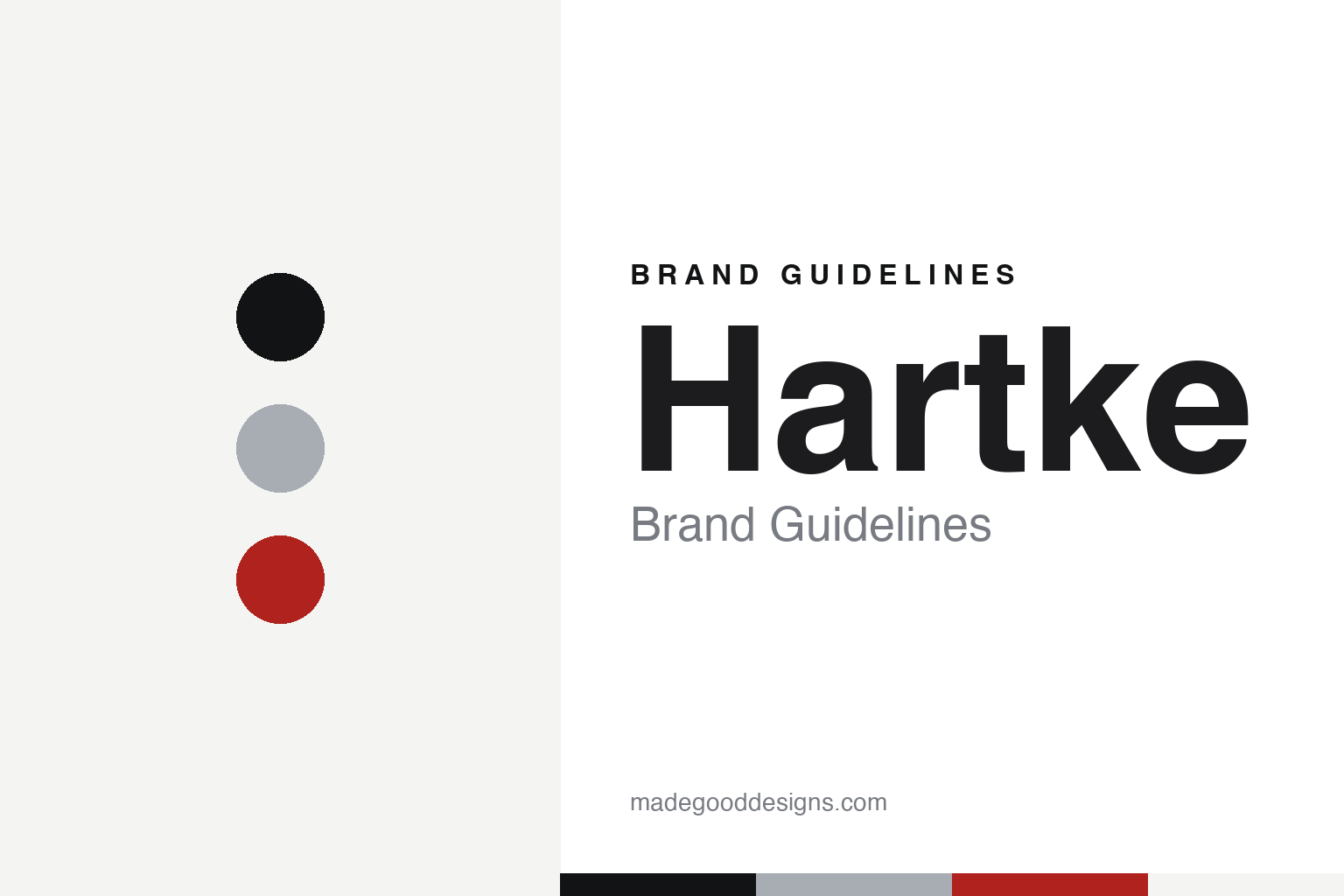
Hartke Brand Guidelines
The aluminium-cone bass brand built for Jaco.
Aa
Two constants: a Hartke black, aluminium and red palette and a Condensed sans register. Abstract homage — not a Hartke product or mark; no cabinet, logo or nameplate is reproduced.
Aluminium cones
Two engineers and a metal speaker cone.
Hartke is an American bass-amplifier and loudspeaker brand known for one material: aluminium. The company’s own history says that in the late 1970s Larry Hartke and Ron Lorman, whom it calls “electronics gurus,” began building prototype drivers with aluminium cones rather than paper ones. In 1980, it says, they released their first products under the Hartke name: an aluminium-cone, free-edge tweeter and a two-way bookshelf speaker with an eight-inch aluminium woofer — home-audio products, not bass gear.
The turn to bass came through one player. Hartke says that in 1984 Larry Hartke built an 8×10-inch cabinet with aluminium speakers for Jaco Pastorius, and that by 1985 word of “the new, faster, clearer bass sound of Jaco’s 810” had spread far enough for the company to begin mass-producing its first aluminium-cone bass cabinet, a 4×10 module. By 1989, it says, it had a full XL line — the 115XL, 210XL, 410XL, 4.5XL and 810XL — used by players it names as Pastorius, Marcus Miller, Darryl Jones, Jack Bruce, Will Lee and Garry Tallent.
The company’s own dates do not quite agree. Its About page says Hartke “first revolutionized the world of bass amplification in 1985” with its aluminium driver, while its XL cabinet page says that “in 1984, Hartke revolutionized bass amplification with the first all-aluminum cone driver,” and its story dates the first aluminium products to 1980. We give all three as the company’s claims; we found no independent account of the founding, and English Wikipedia has no article on the company.
Colour
From XL to HyDrive.
Hartke’s timeline lists the products that followed: Transporter cabinets in 1990, the HA3500 amplifier in 1991, the Kickback combo in 1996 — designed to sit flat or tilt back toward the player — B Series combos in 1998, the Pro Series and VX cabinets in 2002 and the Bass Attack pedal in 2004. Archived copies of hartke.com from 2005 show a range that had also spread into guitar cabinets and amplifiers, keyboard amplifiers, tuners and strings. By 2008 the pages, titled “Samson – Hartke Systems,” also listed the first HyDrive cabinets and combos, the LH amplifiers, a Kilo 1000 head and acoustic amplifiers.
The next change of material came, the company says, from a concert. In 2005 Jack Bruce rejoined Eric Clapton and Ginger Baker for Cream’s reunion shows at Madison Square Garden, playing through Hartke’s paper-cone cabinets alongside an aluminium 410XL. Noticing that some players liked to combine the two, Hartke says, its engineers set out to join them in one speaker. The result was HyDrive, introduced in 2007, which the company describes as using “patented Aluminum/paper speaker cones”: an anodised aluminium inner cone for the mids and a paper outer cone — Kevlar-loaded in the current HL range — for the lows. Hartke names Victor Wooten, Billy Sheehan and Nate Watts among HyDrive users.
The current range is built around that idea. It includes the XL V2 all-aluminium cabinets, HyDrive HD and the lightweight HyDrive HL cabinets introduced in 2022 — the HL112, the company says, handles 300 watts and weighs 24.8 pounds — Kickback and HD combos, and the LX, TX and HA amplifiers. The Kickback KB12, for instance, pairs a 500-watt Class D amplifier with a 12-inch neodymium HyDrive speaker. The website’s artist features include James Genus, bassist for NBC’s Saturday Night Live, and a session-playing lesson filmed with Victor Wooten.
Typography
Bass amplification and documentation.
The seven makers here were founded across five decades. Gallien-Krueger is the oldest: Robert Gallien began building amplifiers in his garage in San Jose, California, in 1968, English Wikipedia says. It is now based in Stockton, California, and Wikipedia lists it as privately held.
Eden was founded in 1976 by David Nordschow in Montrose, Minnesota. English Wikipedia says it passed to U.S. Music Corporation in 2002 and to Marshall in 2011, and that in March 2021 the British retailer Gear4music bought the brand and its assets; it gives Eden’s headquarters as York.
Trace Elliot grew out of a music shop in Romford, Essex, at the end of the 1970s; English Wikipedia names Peavey Electronics Europe as its parent, and its products are listed on Peavey’s website. Ashdown was founded in 1997 by Mark Gooday, Trace Elliot’s former managing director, and is based at Heybridge in Essex; since July 2024 the UK companies register has recorded the French music group Algam as its controlling shareholder.
Hartke traces its aluminium-cone speakers to Larry Hartke and Ron Lorman, the company says, and its website carries the names of Samson Technologies and Samson Distribution. Aguilar speaks of its “deep New York City roots.” Darkglass was founded in Helsinki in 2009 by Douglas Castro and Hugo Villarroel, English Wikipedia says. Both now sit with Korg USA: it announced the acquisition of Aguilar in January 2021, and bought a controlling stake in Darkglass in May 2022, Guitar World reported.
This guide sets out what can be checked about each brand — who founded it, who owns it, and what it says about where its products are made — and marks clearly what rests only on the company’s own word.
Aa
A condensed sans — tight and technical, like a spec plate. (Specimen set in Saira Semi Condensed, a sans STAND-IN; NOT the Hartke logo.)
Hartke
A brand inside Samson.
Hartke belongs to Samson, the Long Island audio company that says it began with wireless microphones in 1980. Samson’s website lists three brands — Samson, Hartke and Michael Kelly Guitars — and greets bass players with “Looking for Hartke? Visit hartke.com.” The Hartke site carries the copyright line of Samson Distribution LLC, and a 2016 Kickback owner’s manual names Samson Technologies Corp. of Hicksville, New York. The link is old: an archived copy of samsontech.com from June 1998 lists Hartke Systems beside Samson Wireless and Samson Audio — and beside Behringer and Zoom, brands Samson then distributed — from a Syosset mailing address; a capture from 2000 lists Hartke Systems again, beside Zoom, Brownsville Guitars and Armoured Cable. We found no dated source saying when, or whether, Samson acquired Hartke rather than first distributing it, so we leave the date open.
Nor does Hartke say where its products are made. Its product pages and the manual we checked give no country of origin, and we found no independent source on its manufacturing, so we make no claim either way. What the company does document is construction: the HL112, for example, is described as a front-ported cabinet of 16mm kiln-dried plywood with a powder-coated steel grille.
For a design guide, Hartke shows how a single material choice — a metal cone in place of paper — can become a brand’s whole identity. Compare Samson Technologies, the company behind it, and Ampeg, another American bass-amplifier name. For this guide we use cabinet black, cone aluminium and a signal red with a condensed sans, an unofficial interpretation; no product or logo is reproduced.
Explore & save
Keep Hartke’s identity on hand — save it to a board in the Made Good inspiration library.
Hartke identity set
Pin the Hartke black, aluminium and red palette and the Condensed sans register to your own board.