Cort Brand Guidelines
The Seoul guitar maker that built for other brands first.
Aa
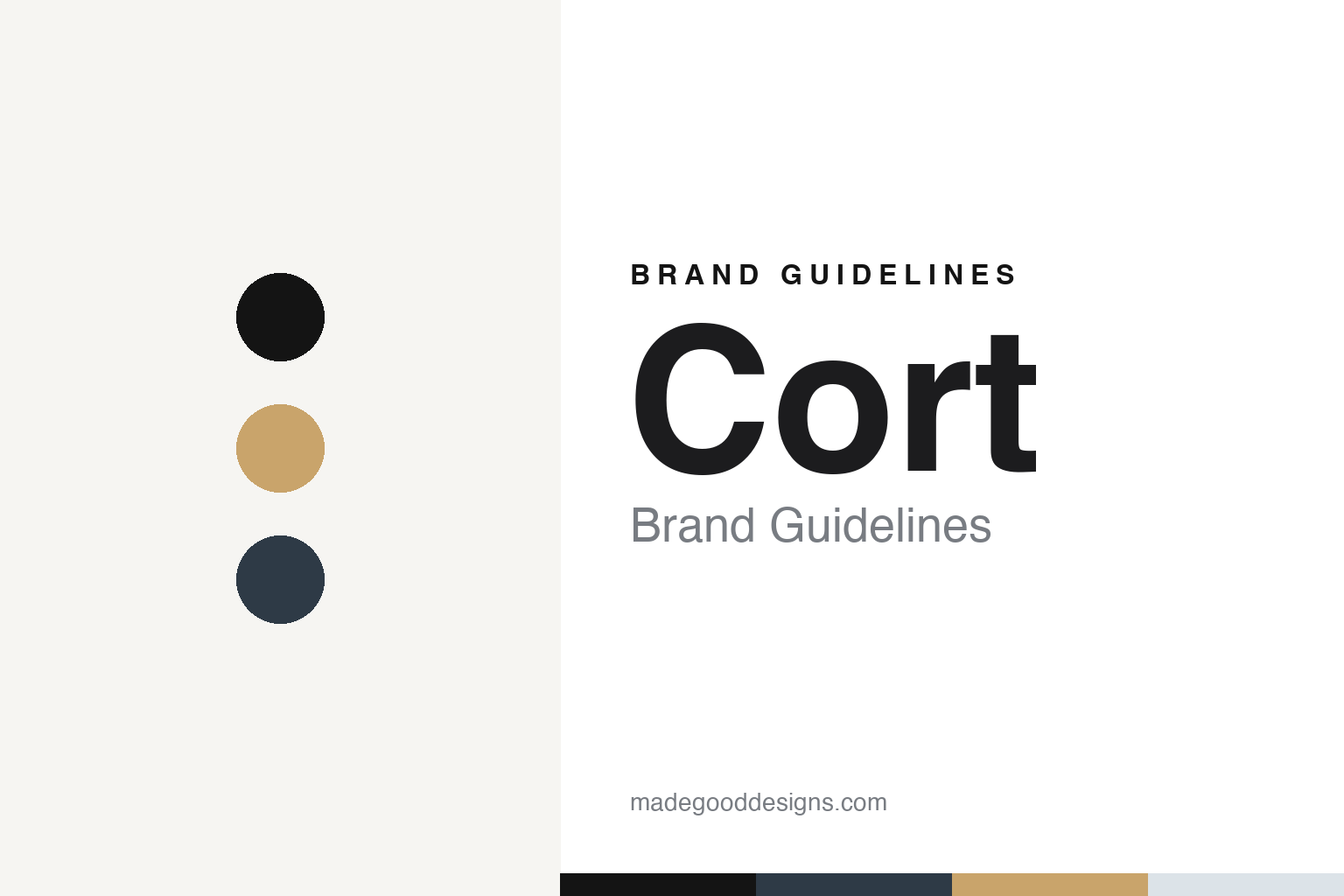
Two constants: a black, slate and natural maple palette and an industrial sans register. Abstract homage — not a Cort product or mark; no instrument, logo or headstock is reproduced.
Soo Doh Piano
A piano importer that became a guitar exporter.
Cort’s history begins with pianos, not guitars. In 1960 Park Jung-gyu — father of the company’s present head, Park Young-ho — started a piano-import business in Seoul, according to English Wikipedia and the company’s own history. The website of the parent company, Cortek, names that business Soo Doh Piano and says it opened a plant at Bupyeong in the same year. The company says the business grew from importing into making and selling pianos and then, in 1973, into guitars, through a new firm called Yoo-Ah Trading; Korean Wikipedia’s own summary gives 1972 for that step, so we note the difference.
For its first years in guitars the business was, in the company’s words, “strictly an OEM supplier” — building instruments that other brands sold under their own names. In 1982 it renamed itself Cort Musical Instruments and introduced the first guitars carrying the Cort name. The Cortek timeline also lists an American company, Westheimer, as a joint investor that came in during 1984; it does not describe Westheimer as a founder, and we found no independent account of the terms of that investment.
Also in 1984, the company says, it began making headless guitars under an exclusive licence from the designer Ned Steinberger, both for its own brand and for Kramer and Hohner; the Cortek timeline dates the licence to 1985. English Wikipedia credits the licensed headless guitars with bringing the Cort name into the mainstream electric-guitar market and drawing other brands looking for contract makers in Korea. The present company name, Cortek (also written Cor-Tek), dates from 1988, the corporate website says.
Colour
Factories in Indonesia and China.
Cort’s growth followed the guitar industry across Asia. It opened an acoustic-guitar plant at Daejeon, in central Korea, in 1991, the corporate timeline says. In 1995 it set up an electric-guitar factory in Indonesia “as price competitiveness in Korea slides for lower-cost instruments,” in the company’s words, and in 1999 an acoustic factory in Dalian, China, chosen, it says, for a climate and humidity suited to acoustic building.
Today the Cortek website lists two factories. PT Cort Indonesia, in East Java, covers about 100,000 square metres and makes acoustic and electric guitars and amplifiers — about 900,000 guitars and 300,000 amplifiers a year, the company says. Cortek Dalian, about 50,000 square metres, makes acoustic guitars, microphones and audio parts, about 400,000 guitars a year. The head office is in Seoul’s Gangseo district. Cort’s brand site says “we own our own factories” and produce “more than one million guitars per year.”
Much of that output carries other names. The Cortek site says its factories build guitars and amplifiers for “many first-class guitar brands,” and that one in three guitar players in the world plays a guitar it made — a claim we could not check. Independent sources are more specific but older: in January 2010 MusicRadar described Cort as having been the Korean manufacturer for companies such as Gibson, Fender and Ibanez. Korean Wikipedia, citing Music Trades, says Cortek ranked 29th among the world’s musical-instrument suppliers in 2020, and that more than 96 per cent of its sales are exports.
Cort’s own range is broad rather than built on one model; English Wikipedia notes it has no single signature shape of the kind Fender has in the Stratocaster. For heavier music its current electric line includes the KX series, which the company pitches at “thoroughly modern” players, with multi-scale fretboards and seven- and eight-string versions, and the META series made with the British builder Manson Guitar Works. The MBC-1, designed by Muse’s Matthew Bellamy with the luthier Hugh Manson, was announced in December 2014 and shown at NAMM in January 2015, Premier Guitar reported. The company also lists Gene Simmons, the Scorpions’ Matthias Jabs, Greg Curbow and Jeff Berlin among its collaborators.
Typography
Rock and metal guitar makers.
The seven makers in this guide build electric guitars for rock and metal players, but they are organised in very different ways.
Two belong to Fender. Jackson, founded by Grover Jackson in Glendora, California, in 1980, and Charvel, begun by Wayne Charvel as a repair shop in Azusa in 1974 and sold to Grover Jackson in 1978, have both been owned by Fender since 2002, English Wikipedia says, and it gives Scottsdale, Arizona, as the base of both.
Two are linked through one man. ESP grew from Electric Sound Products, a parts shop that Hisatake Shibuya opened in Tokyo in 1975. In 1987, English Wikipedia says — ESP’s own corporate history gives 1990 — Shibuya bought Schecter, which David Schecter had started as a repair and parts shop in Van Nuys, California, in 1976, and which now gives its custom shop’s home as Sun Valley, Los Angeles; the two have remained separate companies.
Kiesel, in Escondido, California, traces its heritage to the pickup company Lowell Kiesel founded in Southern California in 1946, which became Carvin, and took its present name when it split from Carvin in 2015. Mayones was founded in Gdańsk, Poland, in 1982 by Zenon Dziewulski, Polish Wikipedia says, and is run by the Dziewulski family.
Cort, based in Seoul, is the odd one out: a large share of its output, by its own account, carries other brands’ names, and it makes its guitars in factories it runs in Indonesia and China.
This guide sets out what can be checked about each brand — who founded it, who owns it, and what it says about where its products are made — and marks clearly what rests only on the company’s own word.
Aa
An industrial sans for a factory-built name. (Specimen set in Archivo, a sans STAND-IN; NOT the Cort logo.)
Cort
A 13-year dispute, and a settlement.
Cort’s Korean factories are also the subject of one of the country’s best-known labour disputes. In 2007, citing financial difficulties, the company laid off workers and shut its factory in Daejeon, moving the guitars made there to Indonesia, the Seoul newspaper The Hankyoreh reported in 2019. The dismissed workers went to court. In 2009 the Seoul High Court ruled the layoff invalid; in 2012 the Supreme Court reversed that ruling, accepting that a layoff could respond to a crisis expected in the future, the paper reported. In 2018, it added, investigators examining the Supreme Court under former Chief Justice Yang Sung-tae listed the 2012 ruling among decisions they suspected of being “courthouse deals” with the administration of the then president, Park Geun-hye — a suspicion reported, not a court finding.
The campaign reached the guitar trade abroad. At the NAMM Show in January 2010, MusicRadar reported, Rage Against the Machine’s Tom Morello and System of a Down’s Serj Tankian joined representatives of the Cort workers in a protest. The dispute ended on 22 April 2019, after 4,464 days: Cort agreed to express regret for the layoff, to reinstate three workers on an honorary basis and to pay a settlement to 25 union members, with all lawsuits withdrawn, in an agreement signed by Park Young-ho as president, The Hankyoreh reported. The company’s published timeline does not mention the dispute.
The company is privately held, English Wikipedia says. In 2022 Cortek bought the American effects brands DigiTech and DOD from Harman, according to English and Korean Wikipedia, and it sells a second guitar brand of its own, Parkwood, which it presents as premium solid-wood acoustics.
For a design guide, Cort shows how a contract maker’s own name can grow out of other brands’ orders. Compare Samick, another Korean guitar maker, and Ibanez, a brand MusicRadar named among Cort’s customers. For this guide we use black, slate and a natural maple tone with a sans, an unofficial interpretation; no product or logo is reproduced.
Explore & save
Keep Cort’s identity on hand — save it to a board in the Made Good inspiration library.
Cort identity set
Pin the Cort black, slate and natural maple palette and the industrial sans register to your own board.