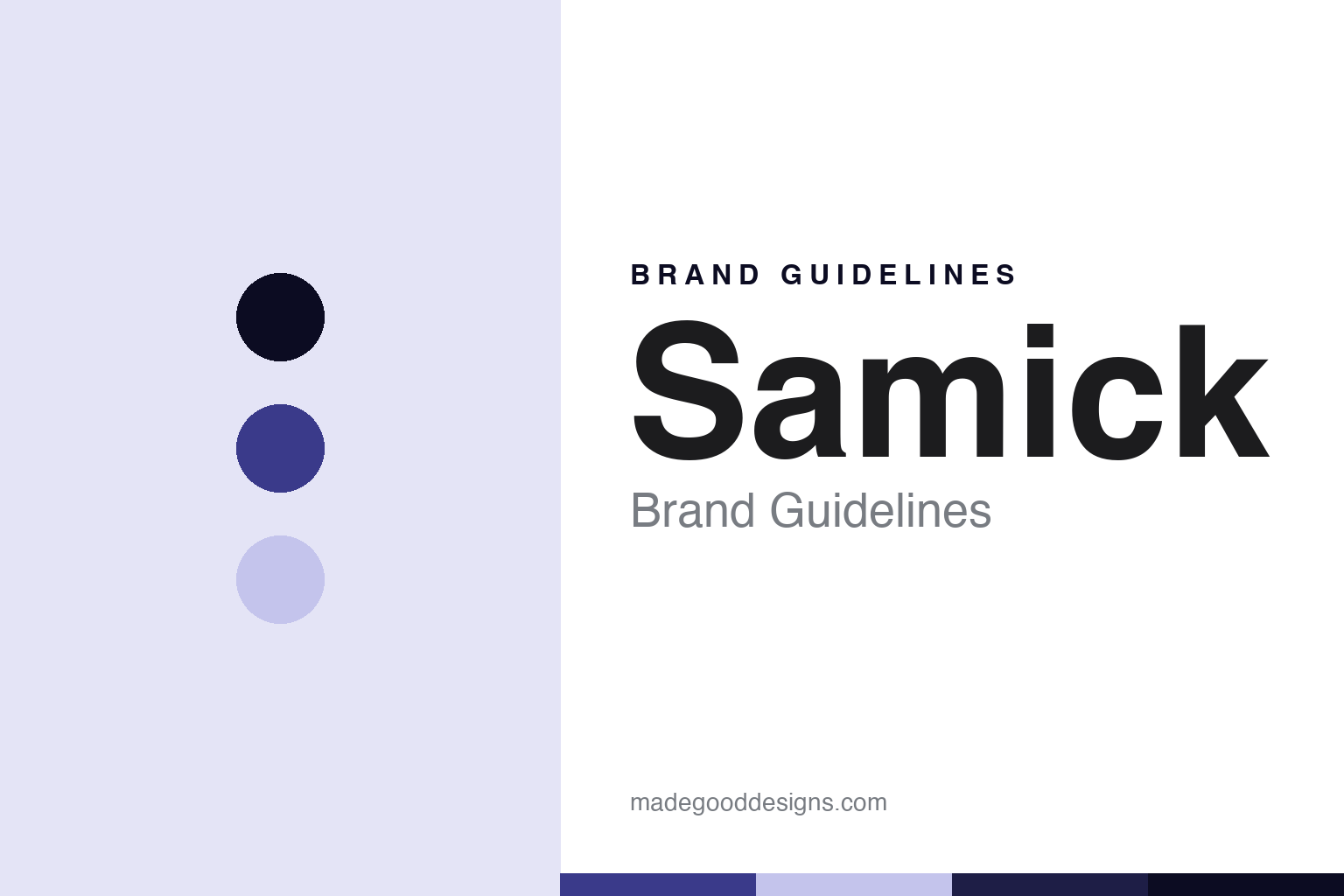
Samick Brand Guidelines
The group that held a third of Steinway.
Aa
Two constants: a spectrum-indigo palette and a corporate-sans register. Abstract homage — not a Samick product or mark; no piano, guitar or logo is reproduced.
Korea’s piano decades
Samick grew up in the years when Korea briefly made pianos for the world.
Samick’s own timeline begins in 1958 with the founding of Samick Piano. It made its first uprights in 1960, guitars from 1965 and grands from 1970, and incorporated in 1973 with a factory at Bupyeong, near Incheon. English-language reference works name the founder as Lee Hyo-ik and say the business began by importing Baldwin pianos; the company’s own timeline records the more formal link — a joint venture with Baldwin of the United States in 1982 — and a technical tie-up with the German engineer Klaus Fenner the following year.
Those were Korea’s piano decades. A 1983 US International Trade Commission report estimated that Korea made about 80,000 pianos in 1982, a third of them for export, and that “the two largest Korean piano manufacturers reportedly rank among the world’s largest producers.” By 1998, a later Commission report noted, the trade magazine Music Trades ranked Samick seventh and its rival Young Chang eighth among the world’s music-industry companies by sales — Samick at $285 million. In 1984 the Commission opened an anti-dumping investigation into grand and upright pianos from Korea; the Commerce Department found no sales at less than fair value, and no duty was ever imposed. It is the only American anti-dumping case on pianos that turns up in the Commission’s own record and in the Federal Register since 1994; the earlier American action against Japanese pianos, in 1969, was a safeguard tariff, not a dumping case.
Samick also moved production abroad early. It set up a joint venture in Indonesia in 1989 and completed its plant there in 1992; in 1993 it launched an “Arte” fashion piano that it describes as a world first. The Indonesian factory, at Cileungsi in Bogor regency, West Java, is still listed among its affiliates — and it matters to several other brands in this series.
Colour
Receivership in 1998. A new owner in 2002. Then a buying spree in Europe — and a run at Steinway.
Both Korean makers went through crises in the late 1990s. Young Chang entered bankruptcy in October 1996 and emerged in 1998; Samick entered a workout agreement with its creditors in 1998, and its own timeline records court receivership from 1998, and in 2002, “M&A 및 법정관리 종료 C.BECHSTEIN사 인수” — a merger and acquisition, the end of receivership, and the acquisition of C. Bechstein. Company histories say the new controlling group was a consortium led by the construction company Speco, whose former president, Kim Jong-sup, became Samick’s chairman.
The Bechstein deal ran both ways: a Berlin newspaper reported in 2002 that Samick was taking about 60 percent of Bechstein while Bechstein’s sellers took about 15 percent of Samick. Bechstein now calls that period “the Samick intermezzo.” Samick went on buying names. It had acquired the old American name Kohler & Campbell in 1988; it bought the Wm. Knabe name from PianoDisc in 2001; and in 2008, its timeline says, it acquired the German maker Seiler, out of an insolvency that summer. The Eduard Seiler and Johannes Seiler lines are built, a buyer’s guide says, entirely at Samick’s Indonesian factory.
Then it went for the biggest name of all. Filings with the US Securities and Exchange Commission show Samick and its affiliated holders — including Kim Jong-sup personally — building a stake in Steinway from November 2009. An amended filing records the group holding 4,013,254 Steinway shares, 32.0 percent. On 9 September 2013 Samick told Steinway it “would no longer pursue a business combination transaction.” The hedge-fund investor John Paulson acquired Steinway that year, and still owned all of it when Steinway filed its later-withdrawn listing in 2022, as our Boston guide records. A Korean maker that had come out of court receivership eleven years earlier had held nearly a third of the most famous piano company in the world.
Typography
The brands it owns, the brands it built for, and the brands it only sells.
Samick is easiest to understand in three lists. The names it owns include Samick itself, Seiler, Wm. Knabe, Kohler & Campbell, Pramberger, its own Greg Bennett guitars, and an electronic-drum brand, Beatmaster, which its site describes as Samick’s own. The names it has built for others, according to guitar histories, include Squier in 1989–91, Kramer for Gibson between 1998 and 2009, and Epiphone and Charvel in the 1990s. And the names it merely sells in Korea — Gibson, Epiphone, Alesis, KRK, Lâg and others appear in its brand menu — are distribution agreements, not ownership. A buyer reading Samick’s site could easily mistake the third list for the first.
Its factories spread across four countries. The company’s affiliates page lists P.T. Samick Indonesia at Cileungsi; Seiler at Kitzingen in Germany; a Seiler-Samick musical-instrument company in Shanghai; and Samick Music Corp in Gallatin, Tennessee. In 2011 it moved its Korean factory from Bupyeong to Eumseong, in North Chungcheong province, where its head office now stands.
The rivalry with Young Chang ended in an unexpected way. In 2006, Korean business reporting says, Samick was outbid for Young Chang by Hyundai Development Company. In April 2026 that company, by then renamed IPARK Young Chang, applied to the Seoul Rehabilitation Court for rehabilitation proceedings. Of the two Korean makers that once ranked among the world’s largest, Samick is the one still trading outside court protection — and it owns a German name and a Baltimore name besides its own.
Aa
A clear corporate sans — engineered, open, multilingual. (Specimen set in IBM Plex Sans, a sans STAND-IN; NOT the Samick logo or products.)
A spectrum of sound
Samick explains its own logo, element by element.
Samick’s site describes its corporate mark as “소리의 스펙트럼” — a spectrum of sound. Its overall pyramid shape, the company says, stands for trust; light dividing like a spectrum for harmony; the rising lines of a musical staff for creativity. Its tagline is “PLAY SAMICK WITH LOVE,” and a second line states its origin without hedging: “Samick Piano is Korean Piano.”
That last sentence is worth holding beside everything above. Samick’s own name is Korean and says so; the names it bought are German and American and keep their own stories. Few companies in this series are as clear about which of their names carries which origin — and few own as many origins.
For this guide we use a spectrum indigo and a pale violet with a clear corporate sans. These are an unofficial interpretation, not Samick’s own colour values, and nothing of its mark is reproduced.
Explore & save
Keep Samick’s identity on hand — save it to a board in the Made Good inspiration library.
Samick identity set
Pin the spectrum-indigo palette and the corporate-sans register to your own board.