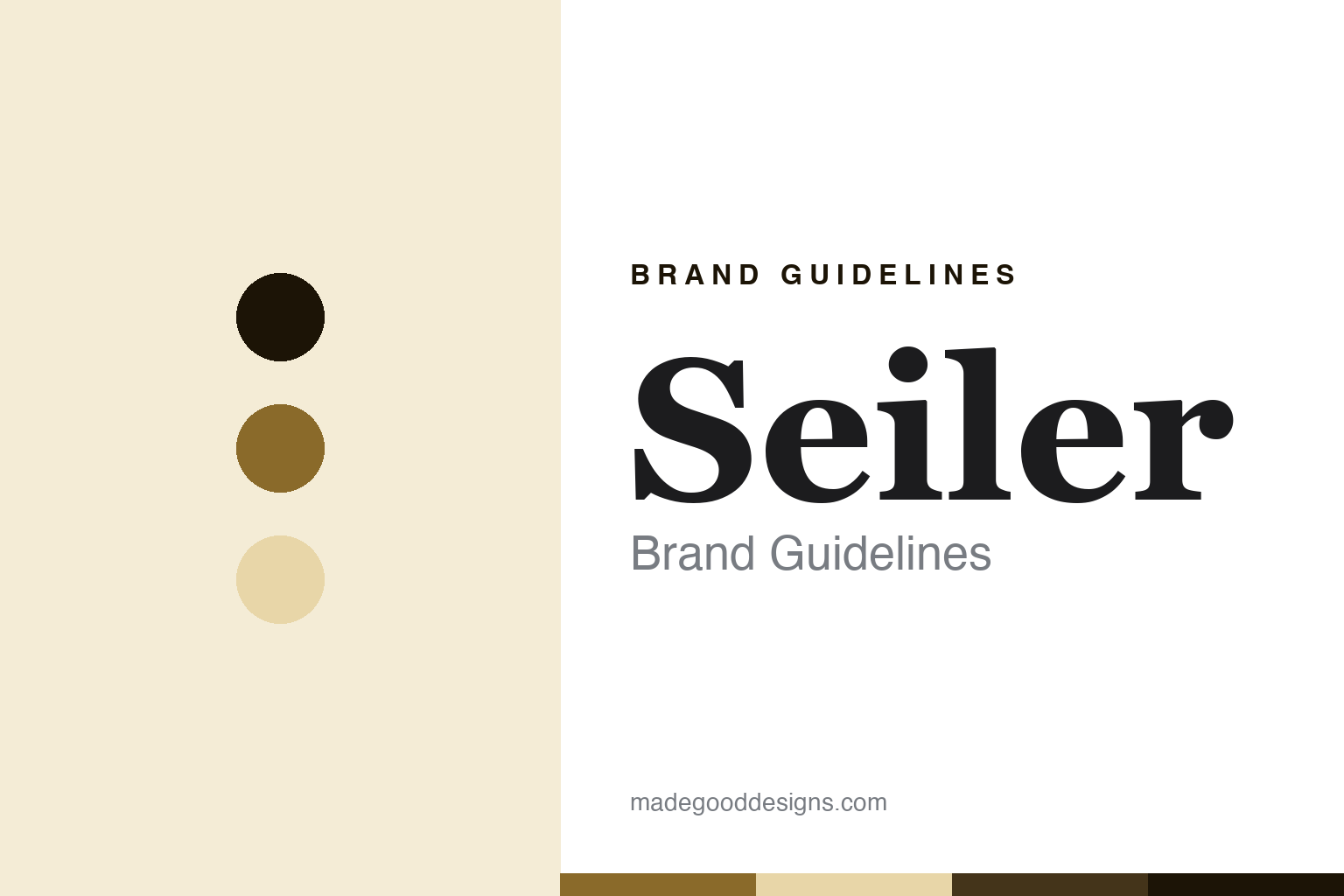
Seiler Brand Guidelines
The founders’ first names, built elsewhere.
Aa
Two constants: a Kitzingen-gold palette and a salon-serif register. Abstract homage — not a Seiler product or mark; no piano or wordmark is reproduced.
Three countries before Kitzingen
Seiler has been rebuilt more times than any other house in this round — and every rebuild moved it.
Seiler’s own history begins in 1849, when Eduard Seiler founded the firm in Liegnitz, in Silesia — today Legnica, in Poland. Eduard died in 1875, and his brother Johannes Seiler took over technical direction in 1879. By 1923, the company says, it employed about 430 people and called itself the “größte Pianofortefabrik Ostdeutschlands” — the largest piano factory in eastern Germany.
The Second World War ended all of that; Liegnitz did not remain German. The family restarted the firm in Copenhagen under Steffen Seiler — PianoBuyer dates that restart to 1954, nearly a decade after the war — and then moved to Kitzingen, in Bavaria, in the early 1960s — 1961, by Seiler’s own account, though one trade source gives 1962. Steffen Seiler is credited by the company with its SMR (“Super-Magnet-Repetition”) action and the DuoVox system. After his death in 1998 his widow, Ursula, ran the business.
So by the time the modern ownership story begins, the brand had already survived a lost homeland and a stay abroad. What it carried through all of it was the name, and a family whose first names would later become product lines.
Colour
In 2008 the family firm became insolvent. A Korean piano maker bought the business into a company that had been registered a year earlier under another name.
Seiler filed for insolvency in July 2008. By late 2008 it had been taken over by Samick, the South Korean piano group; the German music-industry association reported the deal under the headline “Samick kauft Seiler.” The exact day differs between sources, so we give the season rather than the date.
The register shows how it was done. The current operating company, Seiler Pianofortefabrik GmbH of Kitzingen, registered at the Würzburg court as HRB 9968, was first entered in October 2007 under an unrelated-sounding name — a Vermögensverwaltungs-GmbH, an asset-holding company — and renamed by November 2008. That is the ordinary mechanics of buying a business out of insolvency: a prepared company receives the assets and takes the famous name. Nothing about that is improper; it is simply the paperwork by which a nameplate changes hands, and it is rarely visible from the showroom floor. The register lists Sung Young Kwon as managing director from 2008 to 2013; the current managing director, Jung Keun Park, took office in February 2026.
The timing was not Seiler’s alone. In Braunschweig, Schimmel says in its own history that the 2008 crisis cost it its American market — more than 30 per cent of its sales — and it went through a planned insolvency of its own in 2009 and 2010 before coming out in time for its 125th anniversary. Schimmel came through that crisis under its family and was sold to a Chinese group six years later; Seiler was sold straight out of it.
Samick was not new to German pianos. A Berlin newspaper reported in 2002 that it was taking about 60 percent of Bechstein, in a deal that gave Bechstein’s sellers about 15 percent of Samick in return — the German house and the Korean one briefly owning pieces of each other. Bechstein’s own history now calls that period “the Samick intermezzo.” With Seiler, Samick did not stop at an intermezzo.
Typography
The Seiler line is built in Kitzingen. The lines named after Eduard and Johannes Seiler, a buyer’s guide says, are built in Indonesia.
Seiler now sells under three names. The Seiler line itself is hand-built in Kitzingen, according to the buyer’s guide PianoBuyer. The Eduard Seiler line, the same guide says, is “manufactured entirely at Samick’s Indonesian factory,” and the Johannes Seiler line is likewise built entirely in Indonesia, to its own scale design. Other trade sources place that factory in Bogor, West Java.
Here is the interesting part: what Seiler’s own pages say. The Johannes Seiler page tells buyers the instruments receive their “Ausarbeitung und Endkontrolle in Kitzingen” — finishing and final inspection in Kitzingen — and does not mention Indonesia or Samick. Yet the company’s history page does say it plainly: “Samick in Indonesia, Seiler in Germany.” So the information is on the site; it simply is not on the page where a buyer is choosing a piano. In one crawl of the current site we also found no page for the Eduard Seiler line at all, though the site links out to Samick’s own Seiler pages.
The naming is the identity question this round keeps returning to. Eduard founded the house; Johannes rebuilt its technical side. Their first names now stand in front of pianos made in another country by the company that bought their family’s firm out of insolvency — the same move as Grotrian’s “Wilhelm Grotrian” line, made in China by Grotrian’s parent. A founder’s first name has become the label for “our name, someone else’s factory.”
None of this is concealed, and this round shows how common it has become in the trade. Germany’s courts read “Made in Germany” as requiring the essential steps of manufacture to happen in Germany, and the German piano association offers a separate, voluntary seal for brands made “zu 100 % in Deutschland.” A finishing-and-inspection stage in Kitzingen is a real step; it is not the same thing.
Aa
An elegant salon serif — fine contrast, soft curves, a nineteenth-century drawing room. (Specimen set in Cormorant Garamond, a serif STAND-IN; NOT the Seiler wordmark or products.)
A date in the trademark
Seiler registered its founding year as part of its name.
Among the marks recorded for the Kitzingen company are “SEILER 1849”, “SEILER VIRTUOS” and “DUO VOX.” Putting the founding year into the mark is the house’s clearest identity choice: whatever has changed since — Liegnitz, Copenhagen, Kitzingen, Korea — the date has not. It is the same instinct as Bechstein’s “1853.”
The technical vocabulary is the other half of the brand. The Membrator soundboard, which PianoBuyer describes as a patented feature, and the SMR action are what Seiler talks about when it talks about sound; its grands run from 168 to 278 centimetres. The language of engineering and the language of heritage sit side by side — a date-stamped name on one hand, a patented soundboard on the other — which is apt for a firm that has needed both to survive.
For this guide we use a Kitzingen gold and a pale gilt with an elegant salon serif. These are an unofficial interpretation, not Seiler’s own colour values — the gold rule on its current site is page styling we could not confirm as a brand colour — and nothing of its mark is reproduced.
Explore & save
Keep Seiler’s identity on hand — save it to a board in the Made Good inspiration library.
Seiler identity set
Pin the Kitzingen-gold palette and the salon-serif register to your own board.