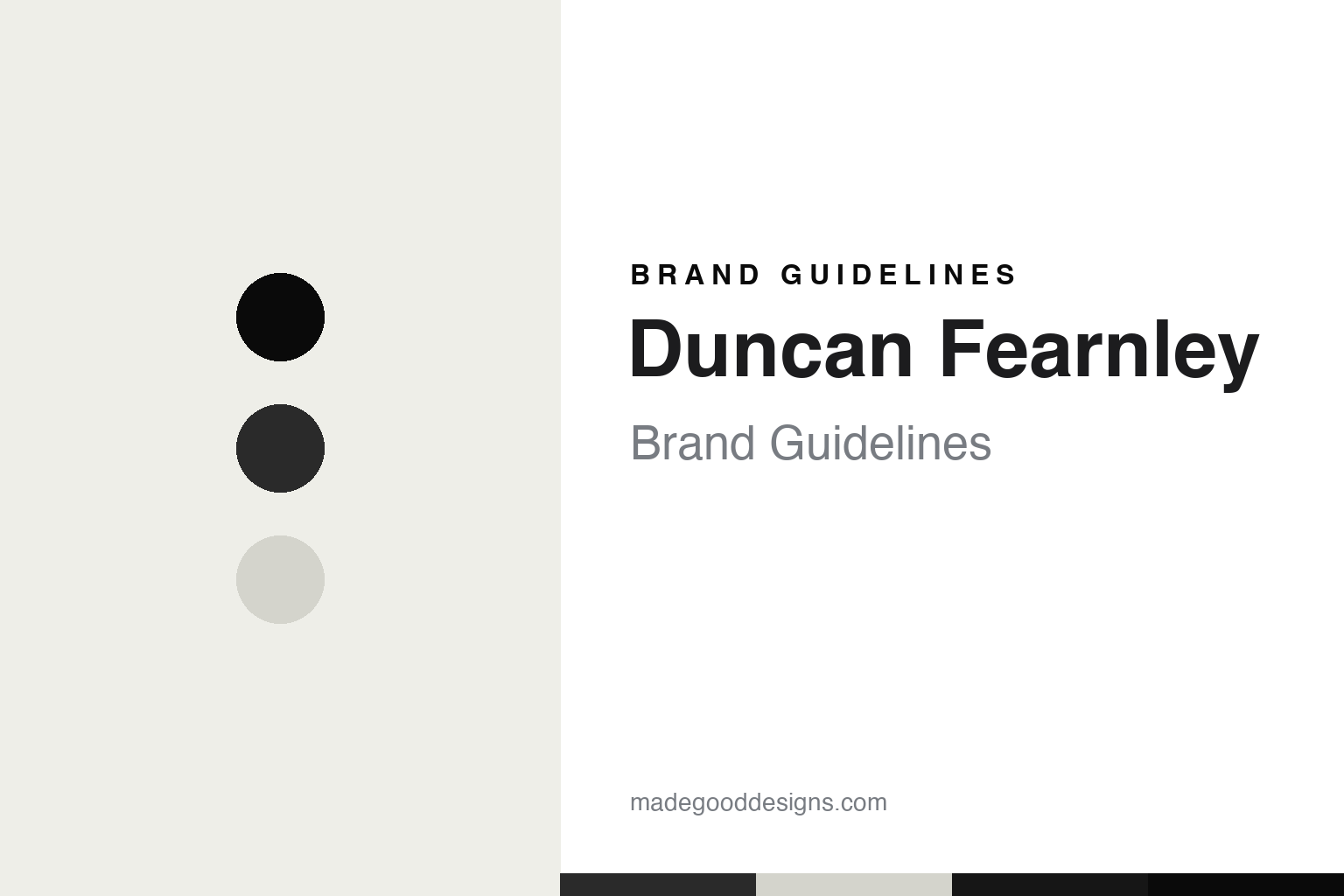
Duncan Fearnley Brand Guidelines
A cricketer’s name, new owners.
Aa
Two constants: a wicket-black palette and a club-grotesque register. Abstract homage — not a Duncan Fearnley product or mark; no bat, wicket device or logo is reproduced.
An apprentice in Yorkshire, a cricketer in Worcester
The brand is a person’s name — a county cricketer whose bats were, by one account, the dominant brand in the world in the early 1980s.
Duncan Fearnley was born in Pudsey, Yorkshire, on 12 April 1940. His company says he began making bats in 1955 as an apprentice at a Yorkshire firm, Senior Counties Bat Makers, selling first under the name “Tudor Rose” and then as “Fearnley of Farsley” — Farsley, like his birthplace Pudsey, sitting on the western edge of Leeds — and moved to Worcestershire in 1960. He played 97 first-class matches for Worcestershire between 1962 and 1968, later became the county club’s chairman, from 1986, and its president from 2011 to 2013.
For a period his bats were everywhere. English Wikipedia describes the brand in the early 1980s as “the dominant brand within the market throughout the world,” with a Worcester factory producing up to 5,000 bats a year by hand. Reports of his death name Sunil Gavaskar, Ian Botham, Graham Gooch and Allan Border among the players who used them; the company’s own list adds John Snow, Basil D’Oliveira, Dennis Amiss and Clive Lloyd. We give those as the names reported, without endorsement dates, which we did not find.
Duncan Fearnley died on 8 March 2024, aged 83.
Colour
The company passed through three controlling owners in the register in less than a decade. The last two are in India.
The bat company is Duncan Fearnley Cricket Sales Limited, incorporated on 5 August 1975 under the name Bridgids Limited and renamed at the end of 1976. Its register entry lists Mary Ann Fearnley as company secretary until 2002. When the UK began recording persons with significant control in 2016, the controlling shareholder shown was Greenfields Holdings Limited of Wolverhampton, controlled by Gary and Julie Dixon. How and when the business passed from the Fearnley family to them is not recorded in anything we could verify, so we do not date it.
The register is precise about what happened next. On 8 April 2025 the Dixons resigned as directors and control passed to The Iconic Cricket Company Ltd, of Harrow, whose own controlling person is recorded as an Indian national resident in India; two new directors were appointed the same day. On 30 December 2025 control passed again, to The Cricket Brands And Retail Company Ltd, also of Harrow and incorporated that month, whose controlling member is INENGINT LLP of Bengaluru. A new charge over the company was registered in September 2026.
The dates sit close together: the founder died in March 2024, and the company changed hands in April 2025. We note the sequence without suggesting any connection, because the record shows none. What the record does show is a familiar pattern in this round. An English cricketer’s name, built in Worcester, is now controlled through holding companies in Harrow by owners in India — a country at the centre of the cricket-goods trade.
One small register oddity is worth recording for anyone checking. The persons-with-significant-control record cites a company number for The Iconic Cricket Company that belongs to an unrelated business; the correct number appears on Iconic’s own entry. It is a clerical slip, not a mystery, and we mention it only so the next researcher is not misled.
Typography
Some top models say “made in England.” The rest do not say where they are made.
The company’s product listings describe its premium Phantom and Typhoon five-star bats as “Premium Grade 1 English Willow made in England.” We did not find an origin statement for its other ranges on the listing we read, and we did not find a current claim that bats are still made in Worcester. That is a bounded finding — one catalogue page — but it is the same shape seen across this round: the top English-willow model says England; the rest say nothing.
Whatever its origin, a Fearnley bat is the same regulated object as everyone else’s. MCC’s Law 5 says “The blade shall consist solely of wood” and limits it to 10.8 centimetres wide, 6.7 deep and four at the edges, checked with a gauge. The width goes back to 1774, after a batsman in 1771 brought out a bat wide enough, Wisden says, to hide the wicket; the depth and edge limits came in 2017, after complaints, in Wisden’s words, “that miscues were flying for six.” Fearnley’s great decade, the 1980s, came before those size limits, and before MCC, by its own account, “took steps in 2008 and 2017 to limit the materials and the size of the bats.” The bats that carried a Worcestershire cricketer’s name to Test grounds around the world were made under looser rules than any bat made today.
The willow itself comes from a small and regulated world. English cricket-bat willow grows mainly in eastern England, under a 1974 order that gave councils power to have diseased trees felled and burned; the largest supplier, J.S. Wright & Sons, says it plants about 30,000 trees a year. The trees take twelve to twenty years to grow — longer than some bat brands keep their owners.
Aa
A plain, sturdy club grotesque — the lettering of a county scoreboard. (Specimen set in Archivo, a sans STAND-IN; NOT the Duncan Fearnley logo, wicket device or products.)
The Black Wickets Device
The company says it put the first logo on a bat.
Duncan Fearnley’s company makes a large claim for its mark: that it “introduc[ed] the first logo into the game. The Black Wickets Device.” We could not verify that it was the first, and we report it as the company’s claim. But the device itself — a set of black stumps — is a good example of what a bat logo has to do: be recognisable in silhouette, on a narrow moving surface, from the far side of a ground.
The name carries the rest. “Duncan Fearnley” is a person, a county cricketer and a chairman; the logo is the wicket he spent his life defending and selling. The challenge for any new owner of a personal name is the one Millichamp & Hall faced when its founders left: keep the name honest about what it now is. For years the name on the bats was also the name in the Worcestershire club’s chair — a link between maker and game that few brands could claim, and that no change of ownership can transfer.
For this guide we use a wicket black and a pale stump tone with a plain club grotesque. These are an unofficial interpretation, not Duncan Fearnley’s own colour values, and nothing of its wicket device or mark is reproduced.
Explore & save
Keep Duncan Fearnley’s identity on hand — save it to a board in the Made Good inspiration library.
Duncan Fearnley identity set
Pin the wicket-black palette and the club-grotesque register to your own board.