Nabertherm Brand Guidelines
A potter’s kiln maker turned industrial.
Aa
Two constants: a signal palette and an engineering-condensed register. Abstract homage — not a Nabertherm product or mark; no furnace or logo is reproduced.
Pottery kilns for private use
The world-scale furnace maker began, by its own account, making kilns for hobby potters.
Nabertherm’s own timeline opens with a date and a modest product: “16.09.1947 Company foundation by Conrad Naber in Bremen.” At first, it says, the company “manufactured pottery kilns for private use with a few employees.” Conrad Naber was twenty-five; the company’s anniversary material describes two people in a basement in the Schwachhausen district. In 1954 it moved to Lilienthal, just outside Bremen, with fifteen employees, and it is still there.
Its name grew with it: Naber Industrieofenbau — industrial furnace construction — from 1967, and Nabertherm from 1989. That rename tells the story. A kiln maker for potters became a maker of furnaces for industry, laboratories and dental workshops, and only then took a name that sounds like heat itself. Its catalogue today runs to fibre optics and glass, advanced materials, additive manufacturing and foundry work, alongside the arts-and-crafts kilns it started with — chamber kilns, top-loaders and glass-fusing furnaces for studios and schools; a 2026 news item records a cooperation with the dental group Ivoclar.
It has also become an exporter on a scale few family firms reach. Its own timeline records exports of 29 percent in 1979, more than 60 percent by 2008 and “more than 75%” in 2020, with sales companies opened from 1997 in the United States, Britain, France, China and elsewhere. A pottery-kiln maker from a Bremen basement now sells most of what it makes abroad.
Colour
Three managing directors in seventy-five years.
Nabertherm’s governance is the most stable in this series. Conrad Naber ran the company until 2001, when, the timeline says, “As a spin off company, Nabertherm GmbH takes over operative function with Friedrich-Wilhelm Wentrot as Managing Director and Conrad Naber as Chairman of the Supervisory Board.” In 2007 his son Martin Naber became chairman of the supervisory board. Conrad Naber died on 29 January 2018, aged 95. On 9 April 2019 Timm Grotheer succeeded Wentrot. Three managing directors, one family, three-quarters of a century.
The company describes itself as “still successfully managed as a family company,” with “600 employees and 150,000 customers worldwide.” Its register entry is Nabertherm GmbH at the Walsrode court. Its factory has kept growing: new production halls in 2011, 2017 and 2021 brought the production area, by December 2021, to 25,000 square metres. It celebrated “100 Years Conrad Naber” in July 2022 — the founder’s centenary, marked four years after his death — and its own seventy-fifth anniversary that September.
Compare that with the other names in these pottery rounds. A Stoke kiln brand whose kiln company is dormant; a Nevada maker that has dated itself three ways; an American firm whose controllers, for years, came from a charity. Nabertherm’s record is almost boring by comparison: its most dramatic dates are a move of a few kilometres in 1954 and a change of name in 1989 — which, for a maker of furnaces that must hold extreme temperatures for hours, may be the point.
Its approach to the kiln’s “brain” is different too. Several American kiln makers in this series buy their controllers from specialists — Bartlett in Iowa, or Orton in Ohio. Nabertherm took a half-stake in an electronics company, HERMES, in 1998, and in December 2021 launched its own Controller Series 500 with a “MyNabertherm” app. A family firm that started with a basement and a few kilns now holds a stake in an electronics business of its own, and sells its own control system. It is certified to the ISO 9001 quality standard, and its sales companies run from Britain — where Nabertherm Ltd marked twenty-five years in 2025 — to an American subsidiary in New Castle, Delaware.
Typography
“All of our furnaces are hand-made at our factory in Germany,” Nabertherm says.
The origin claim is unusually broad. Nabertherm’s sustainability page says: “All of our furnaces are hand-made at our factory in Germany.” In 2022 it put the same idea another way, saying it “still produces 100% of its quality furnaces in Lilienthal.” Both are the company’s own statements, and we report them as such. What makes them notable is their scope: they cover every furnace, which is rarer in this series than a claim about one favoured model. They stand out in a trade where, as our earlier guides showed, the Bavarian kiln maker Rohde says it builds in the Czech Republic and markets its kilns as “German-engineered.”
It pairs the claim with energy. The factory carries, it says, about 2,450 solar modules with a peak output of 999 kilowatts, cutting carbon emissions by about a hundred tonnes a year, and its 500-series controllers include a “Solar Mode” that schedules firings for when a customer’s own panels are producing. A kiln, after all, is mostly an electricity bill.
For American buyers, the safety mark comes through the dealers. A US pottery retailer lists a Nabertherm Top 190 kiln as “Certified to UL standard 499 and CSA standard C22.2#221” and “Made in Germany.” We found that on the dealer’s page, not Nabertherm’s, and for one model, so we report it as the dealer’s listing. And whatever the kiln, the potter still reads a pyrometric cone — in North America, one made by the Orton foundation, whose own site says controllers “cannot measure heat-work.”
Aa
A tight engineering condensed — industrial, legible at the side of a machine. (Specimen set in Barlow Condensed, a sans STAND-IN; NOT the Nabertherm logo or products.)
Yellow on black
The mark is a warning sign — and a promise.
Nabertherm’s logo is a solid black rectangle with the wordmark in a bright yellow. It is the colour pairing of hazard signs and machine plates, and it works the same way: visible from across a workshop, unmistakable on the side of a furnace. Its motto is two words, which its philosophy page ends in capitals: “MORE THAN HEAT.”
That combination — industrial colours, a modest motto, a family that has kept the same name on the door since 1947 — is the identity. It does not need to tell a story about craft; its kilns go to potters, and its furnaces go to fibre-optic and dental laboratories, and the same black-and-yellow mark covers both.
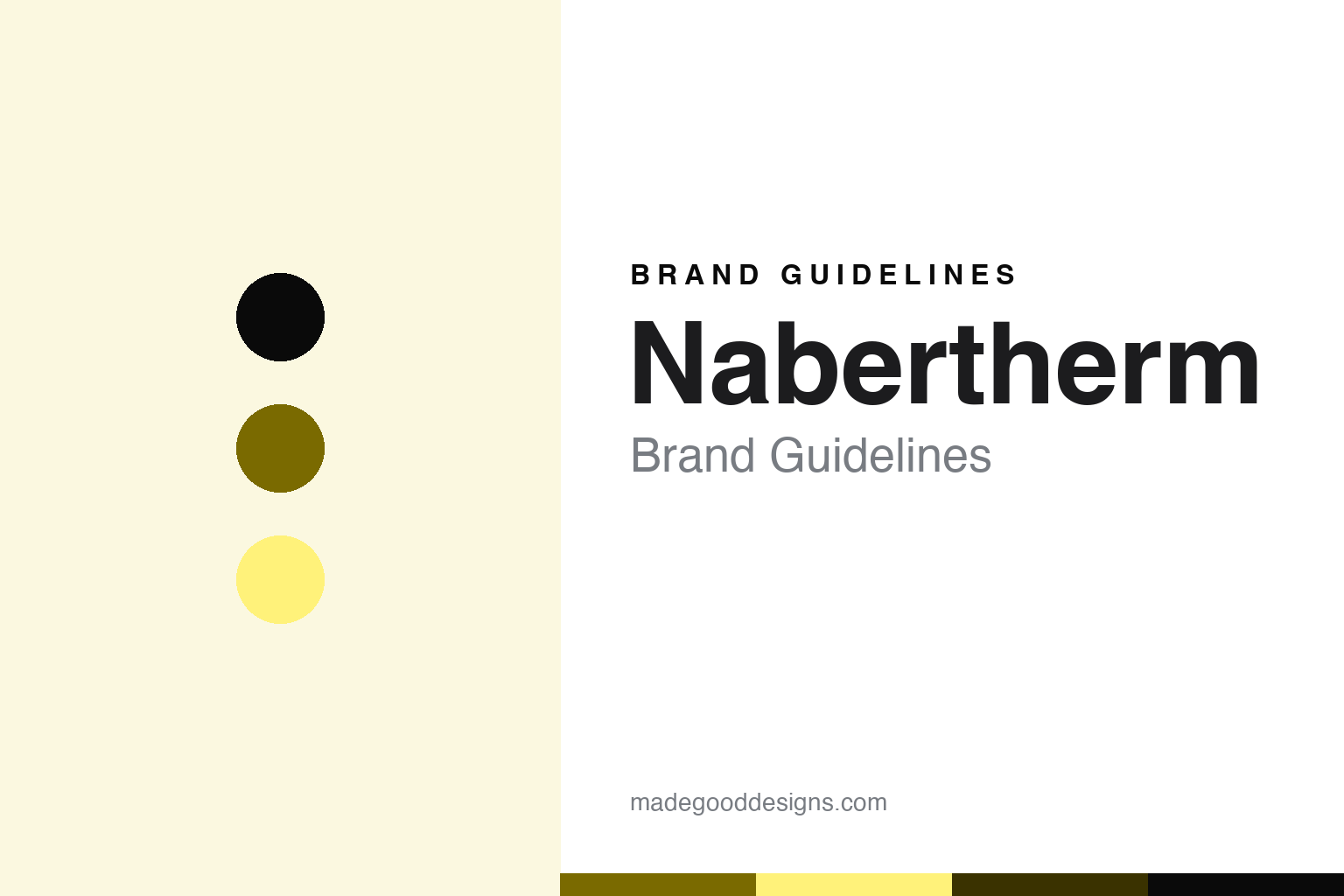
For this guide we use a signal yellow and a deep olive on near-black, after the logo’s contrast, with a tight engineering condensed. These are an unofficial interpretation, not Nabertherm’s own colour values, and nothing of its logo is reproduced.
Explore & save
Keep Nabertherm’s identity on hand — save it to a board in the Made Good inspiration library.
Nabertherm identity set
Pin the signal palette and the engineering-condensed register to your own board.