CEAT Brand Guidelines
A Turin cable name on Mumbai bats.
Aa
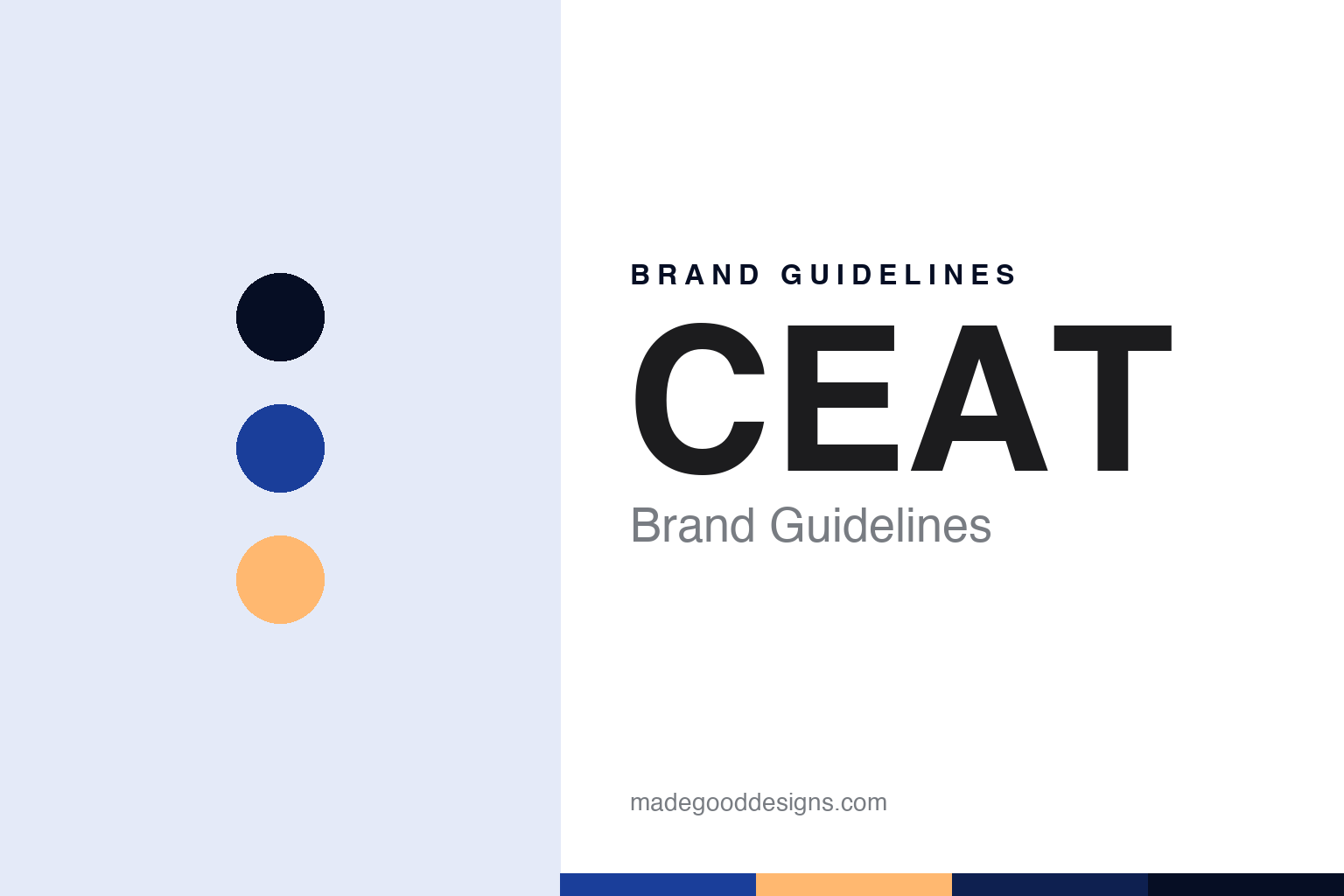
Two constants: a CEAT-blue palette and a bold-grotesque register. Abstract homage — not a CEAT product or mark; no bat, sticker, tyre or rhino is reproduced.
An acronym from Turin
The letters on the bat stand for an Italian cable company.
CEAT is an acronym, and not an Indian one. The company was founded in Turin in 1924 as Cavi Elettrici e Affini Torino — electric cables and allied products of Turin — by Virginio Bruni Tedeschi. Its Indian life began on 10 March 1958, when CEAT Tyres of India was incorporated in Mumbai, initially with the Tata group. In 1982 the RPG Group of the Goenka family acquired it, and it took the simple name CEAT in 1990. The name on a Mumbai-owned tyre — and on Indian bats — still spells out an Italian cable company’s initials.
It is a listed company in Bombay and on the National Stock Exchange, chaired by Harsh Goenka with Anant Goenka as vice-chairman, according to English Wikipedia; we give the board as listed there rather than from a current filing. English Wikipedia credits it as the first tyre company to win the Deming Prize, in 2023. Like MRF, it is a rubber company whose most visible presence in Indian cricket is a few square inches of sticker.
That is the point of this round. In our earlier cricket guides, bat makers told of bats that went out under other names. CEAT and MRF are the other names.
Colour
In 2015 CEAT announced a three-year bat deal with Rohit Sharma.
CEAT’s press release, reproduced in December 2015, put it plainly: “CEAT Ltd. today announced its association with… Rohit Sharma for a 3-year bat endorsement deal.” Anant Goenka, then managing director, said: “We are proud to announce Rohit Sharma as the latest Indian cricketer to join CEAT’s family.” Rohit — who would later captain India — replied with a cricketer’s pun: “I look forward to playing a long innings with CEAT!” The same release mentioned an earlier bat deal with Suresh Raina, the launch of CEAT-branded cricket gear and a tie-up with the Indian Premier League’s “Strategic Time Out.” Fees were not disclosed; the figures circulating online are unsourced, and we do not repeat them.
The rules behind such deals are specific. The International Cricket Council’s clothing and equipment regulations allow bat advertising, as they put it, “to allow an opportunity for players to obtain some revenue from controlled bat advertising.” A sponsor’s logo on the back of the bat is limited to a single patch of ten square inches; the face is reserved for the manufacturer’s marks in the top nine inches; and the Laws of Cricket cap any such identification at 0.02 centimetres thick. A 2021 investigation by Scroll.in reported that sponsors meet the rules by buying finished bats from established makers in bulk and replacing the logo. We found no document naming the maker of any CEAT-stickered bat.
The rules have their own exceptions. A note in the ICC regulations says that “Player’s Bat Logos and Charity Logos shall not be permitted in Excluded Events” — a category that begins with the men’s Cricket World Cup. On the sport’s biggest stage, the sponsor’s patch on the back of the bat must go. And the rules move: the 2013 edition of the regulations banned advertising connected with betting and gaming, while the May 2023 edition says that ban “no longer applies in respect of bilateral international cricket,” keeping it only for ICC events. The investigation in Scroll.in traces separate bat-sticker deals to the late 1980s, when Kapil Dev signed with the brand Power; CEAT entered a trade that was already a generation old.
Wikipedia lists later CEAT bat players including Shreyas Iyer, Yashasvi Jaiswal and Harmanpreet Kaur — the last a reminder that bat-sticker deals now reach the women’s game too. We give those names as listed there.
Typography
CEAT gives cricketers a rating — and has for thirty years.
CEAT’s most distinctive contribution to cricket is not a sticker but a scoreboard. The CEAT Cricket Ratings, launched in 1995 with Professional Management Group, were described at their start as the first international rating system to reward players’ performance each year, measured over a May-to-April season. Brian Lara was its first international Cricketer of the Year, for 1995–96; the first Indian winner was the fast bowler Venkatesh Prasad, the following year. Its governing council has been described as including Clive Lloyd, Ian Chappell and Sunil Gavaskar.
It is a clever piece of branding. A sticker is seen for as long as a player bats; an annual award attaches the brand’s name to a season’s worth of performances. CEAT built a brand presence in cricket that does not depend on any one batsman — and, unlike a sticker, it cannot be traded to a rival. The ratings have now run for three decades, giving CEAT a place in cricket even in seasons when no famous bat carries its name.
The tyre business behind it is ordinary heavy industry, and the cricket business is marketing. That division is the honest description of the tyre brands on Indian bats. The craft — the willow, the pressing, the shaping — happens elsewhere, by makers like SS and SG whose stories this series has told. The sticker is the part that is sold, and the part the crowd remembers.
Aa
A bold, blocky grotesque — the weight of a tyre wall, the clarity of a sticker. (Specimen set in Archivo Black, a sans STAND-IN; NOT the CEAT wordmark or products.)
A rhino retired
In 2008 CEAT changed its logo for the first time since 1958.
CEAT’s current wordmark dates from April 2008, when, the advertising-trade publication afaqs reported, it unveiled its first new logo since 1958: blue, all-capital, hand-drawn letterforms with bright orange lines on a theme of “raising the bar,” the E standing for motion. It was designed by the branding firm Ray+Keshavan. The chief executive at the time, Paras K. Chowdhary, said: “The new logo symbolises the strategic transformation at Ceat…”
The change retired two old assets: the rhinoceros mascot and the line “Born Tough.” A tyre company gave up a tough animal for a letter E meant to suggest motion — the kind of short, clean mark that reads well on a bat. Whether that was in mind in 2008 we cannot say; it is simply how the mark now works on a sticker.
For this guide we use a CEAT blue and a bar orange with a bold, blocky grotesque, after the 2008 wordmark’s colours. These are an unofficial interpretation, not CEAT’s own colour values, and nothing of its wordmark or former rhino is reproduced.
Explore & save
Keep CEAT’s identity on hand — save it to a board in the Made Good inspiration library.
CEAT identity set
Pin the CEAT-blue palette and the bold-grotesque register to your own board.